Flutter vs React Native: Which Hybrid Course Wins
 General
Anyone shortlisting a hybrid mobile app development course in Kerala runs into the same fork within a week: Flutter or React Native. Both build applications that run on Android and iOS from one codebase, both are hired for in Kochi and Thrissur, and both are taught locally. The differences that actually matter are the language you write, the way the interface is rendered, and which employers in your target list already run one of them. This guide sets out the comparison honestly.
Key Takeaways
- Both frameworks ship to Android and iOS from a single codebase, so the real choice is language, rendering model, and local hiring demand.
- React Native uses JavaScript and React, which suits anyone already comfortable with web development work and shortens the learning curve.
- Flutter uses Dart and draws its own interface, which gives very consistent visuals across every device, screen size and operating system version.
- Pick by the employers you are targeting and the skills you already hold, not by which framework is currently louder online.
What Hybrid Mobile App Development Means Today
Hybrid development once meant wrapping a website inside a shell and calling it an app. That approach earned the category a poor reputation, because the result felt slow, looked out of place on both platforms, and struggled with anything beyond simple content display for users.
The modern frameworks are a different proposition entirely. They compile to real applications, use platform level rendering or their own high performance engine, and can reach device hardware directly, so the finished product is difficult to distinguish from a native build in ordinary use.
The commercial case has not changed though. One codebase means one team, one release cycle, and roughly half the maintenance surface to worry about, which is why so many Kerala employers now default to a cross platform stack unless a project has a specific technical reason not to.
That default is worth understanding before you enrol. The app development track at Guiders Education is not a compromise route into the industry, it is the route most local product teams are actually hiring for at junior level.
The two frameworks that dominate this space are Flutter and React Native. A handful of alternatives exist and some are technically interesting, but neither appears often enough in Kerala job descriptions to justify choosing it as a first professional skill.
Both sit comfortably inside a wider full stack and mobile app development track, because a mobile app is only as good as the backend behind it and employers increasingly want people who can reason about both.
Flutter and React Native: The Differences That Matter
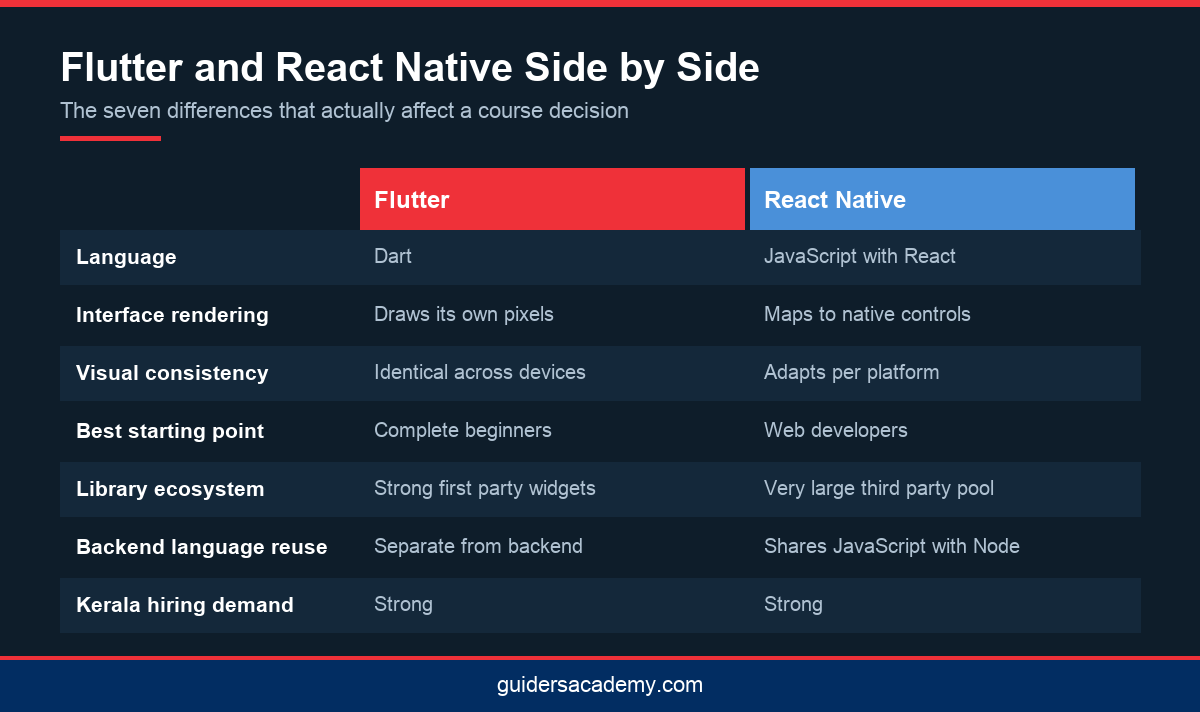
The first difference is language. React Native is written in JavaScript with React, so anyone who has built for the browser starts with most of the mental model already in place. Flutter uses Dart, which is easy to read but new to almost every learner.
The second is how the interface is drawn. React Native maps your components onto the platform's own controls, so an app inherits native behaviour and adapts as the operating system changes. Flutter paints every pixel itself, which gives identical visuals everywhere regardless of device or version.
That distinction has practical consequences. Flutter apps look the same on an older budget Android handset as they do on a new iPhone, which designers like. React Native apps feel more at home on each platform, which some users prefer without being able to say why. Both frameworks assume comfort with modern language syntax, the same foundation covered in the Kochi React programme.
Performance is close enough that it rarely decides a course choice. Both handle typical business applications comfortably. Heavy animation or graphics workloads favour Flutter's rendering engine slightly, while React Native benefits from a very large ecosystem of ready made libraries.
Tooling and community differ in character rather than quality. React Native inherits the enormous JavaScript package ecosystem, with the maintenance risk that implies. Flutter ships a more complete and consistent set of first party widgets, which reduces dependency hunting for beginners.
Hiring demand in Kerala is genuinely split. Both appear regularly in Kochi job listings, so neither choice closes doors. What matters is that you can demonstrate a shipped application in whichever one you pick rather than a passing familiarity with both.
Which One to Learn First Based on Your Career Goal
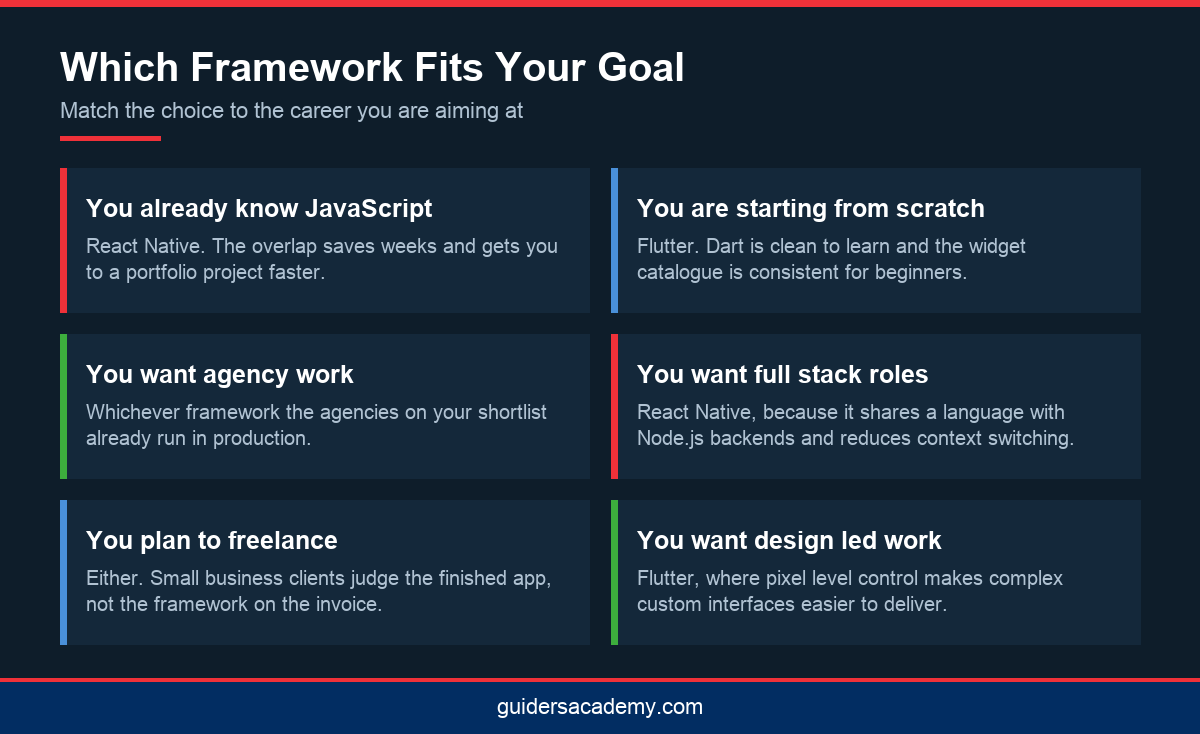
If you already know JavaScript or React, start with React Native. The overlap means you spend your first weeks on mobile specific concepts such as navigation and permissions rather than relearning syntax, which shortens the distance to a portfolio project considerably.
If you are starting from scratch with no web background, Flutter is a reasonable first framework. Dart is a clean language to learn, the widget catalogue is consistent, and beginners often produce a good looking working screen faster than they would elsewhere.
If you want to work in an agency serving many clients, look at what those agencies already run. Adapting to an existing codebase is most of the job, so matching the local employer stack matters more than any technical preference you form during training.
If your goal is full stack work, React Native has a structural advantage. Sharing a language with a Node.js backend means a graduate of the JavaScript-based full stack route can plausibly own the whole product rather than one layer of it.
If you plan to freelance for small businesses, either works. These clients want one app on both platforms at a modest budget, and they judge the result by whether it works and looks right rather than by the framework name on the invoice. If the real question is how long any of this takes, this timeline answers it more directly than a framework comparison can.
Whichever route you take, employers value the breadth. Understanding why companies prefer full stack developers explains why a mobile developer who can also read backend code progresses faster inside a small Kerala engineering team.
What to Expect From a Hybrid Course in Kerala
Whichever framework it teaches, the syllabus should start with language fundamentals rather than framework shortcuts. Learners who never understood asynchronous behaviour, typing, or state will produce screens that work in a demonstration and break as soon as real data arrives.
Navigation, state management, and API integration form the core. Multi screen applications with live data are what employers actually build, so a course that stops at static layouts has covered perhaps a third of what a first job will demand of you.
Device features must appear on the syllabus. Camera, location, notifications, permissions, and secure storage behave differently on each platform, and this is exactly the boundary where cross platform projects run into trouble during a release cycle.
The course has to end at a store submission. Signing an Android bundle, producing an iOS build, and passing review are the steps that convert a learner into someone who has shipped, and they are the steps most self taught developers never complete. Employers still test the fundamentals listed in this skills checklist for developers.
Ask hard questions about the final project. It should talk to a real backend, handle offline and error states, and be installable on your own phone. That artefact will carry more weight in an interview than every certificate in your file, because it gives a technical interviewer something concrete to probe.
Ask about what follows the syllabus as well. Mock technical interviews, code review from someone with production experience, and a documented placement record matter more than the module list when you are converting training into a first offer.
Conclusion
For most learners the honest answer is that a hybrid mobile app development course in Kerala is a good decision in either framework, and the choice should follow your existing skills and the employers you are targeting. Pick React Native if you already write JavaScript, pick Flutter if you are starting clean and want consistent visuals across every device, and in both cases insist on a programme that ends with a real application published in the store. To discuss which track fits your background and how long it would take, contact the Guiders Academy team about the current batch.