MERN Stack Course in Kerala: Your Complete Career Guide
 General
A MERN stack course in Kerala teaches one of the most in demand combinations of skills in web development today: MongoDB, Express, React, and Node.js, all built on JavaScript. Because a single language powers both the frontend and backend, MERN developers can move across a project end to end, which makes them attractive hires for lean product teams and IT services companies alike. This guide breaks down what MERN actually means, what a strong course should teach, the career paths it opens up, and how to choose the right training institute.
Key Takeaways
- MERN combines MongoDB, Express, React, and Node.js so one JavaScript skill set covers frontend, backend, and database work.
- A strong MERN stack course in Kerala teaches the full pipeline: building a UI, an API, and a database, then deploying all three together.
- MERN developers are hired across Kochi and Thrissur by both product startups and IT services companies for full stack roles.
What MERN Stack Means and Why Employers Want It
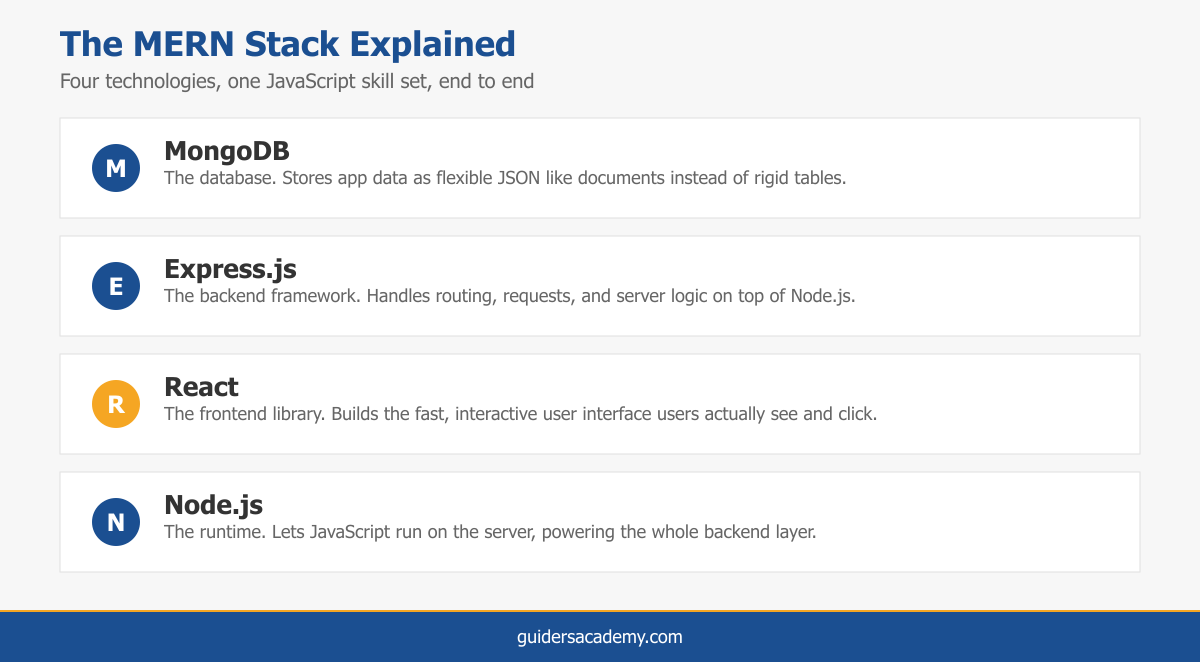
MERN is an acronym for four technologies that work together to build complete web applications: MongoDB for the database, Express.js for the backend framework, React for the frontend interface, and Node.js as the JavaScript runtime that ties the backend together. The appeal for employers is straightforward. Rather than hiring separate specialists for frontend, backend, and database work, a company can bring on one MERN developer who understands the entire flow of data through an application.
This matters most for smaller product teams and agencies, which make up a large share of Kerala's IT sector outside a handful of large enterprises. A five person startup building its first product cannot always afford three separate specialists, so a developer who can build a working feature from database schema through to the button a user clicks is disproportionately valuable. That efficiency is a big part of why the MongoDB team itself documents MERN as a standard, well supported path into full stack development.
The JavaScript everywhere approach also reduces context switching for developers. Instead of thinking in one language for the backend and another for the frontend, a MERN developer writes JavaScript throughout, which shortens the learning curve for anyone who has already picked up JavaScript fundamentals and wants to extend that knowledge into a complete, employable skill set rather than starting over with a new language.
It also helps candidates stand out in interviews that increasingly test for range rather than depth in a single narrow tool. A hiring manager comparing two junior applicants, one who can only describe how React components work and one who can walk through how a user's click travels from the interface through an Express API into a MongoDB query and back, will usually favor the second candidate, even if both attended courses of similar length. That end to end fluency is the real selling point of a MERN focused education, more than any individual technology within it.
What a MERN Course Should Actually Teach
A course that only teaches React and calls itself a MERN program is incomplete. Real coverage should start with JavaScript fundamentals, move through MongoDB for schema design and queries, Express.js for building REST APIs, and React for the interface layer, before tying all three together with Node.js as the server runtime.
Beyond the four core technologies, learners should build at least one full application from scratch: designing the database schema, writing API endpoints, building the React interface that consumes those endpoints, and deploying the finished product so it is reachable outside a local machine. Authentication, environment variables, and basic security practices like input validation deserve dedicated coverage too, since these are the details that separate a tutorial project from something a hiring manager would trust in production.
Version control discipline matters just as much as the technical syllabus. Learners who commit their MERN project to Git in small, logical steps, rather than one giant upload at the end, demonstrate a habit that any engineering team will expect from day one. A course that treats this as optional rather than core practice is skipping a skill that shows up in almost every technical interview.
Career Paths and Salary Range for MERN Developers in Kerala
Graduates of a solid MERN stack course in Kerala typically move into full stack developer, backend developer, or frontend developer roles, depending on which part of the stack they gravitate toward during training. Kochi's IT parks host both product startups building original software and IT services firms delivering client projects, and MERN skills are relevant to both kinds of employers.
Entry level MERN developers in Kerala generally start at salaries competitive with other junior software roles, with pay rising as they take on more complex features and larger codebases. Developers who can demonstrate strong deployment and DevOps adjacent skills, such as setting up CI pipelines or working comfortably with cloud hosting, often progress faster than those who stop at "the app runs on my laptop." Freelance MERN work is also common, since clients outside Kerala frequently look for developers who can deliver a complete, working product rather than one piece of a larger team.
How to Pick the Right MERN Training Institute
Ask to see example projects built by recent graduates before enrolling. A course that produces developers who can only replicate a guided tutorial is very different from one that produces developers capable of building an original feature under time pressure, which is exactly what most technical interviews test for.
Confirm the institute teaches current tooling rather than outdated patterns, covers deployment as a required module rather than an optional add on, and offers structured placement support backed by a verifiable track record. Institutes that treat mentorship as a checkbox rather than a real part of the learning process tend to produce graduates who struggle the moment a project deviates from the exact steps taught in class, so ask specifically how much one on one help is available when a learner gets stuck.
Cohort structure is worth asking about directly too. Learners who get regular, individual code review catch bad habits early, such as writing database queries that will not scale or components that re render far more often than necessary. A course that only ever reviews work in large group settings, with little individual feedback, tends to produce graduates who can follow instructions well but struggle the first time they face an unfamiliar bug without a tutorial to lean on.
Conclusion
A MERN stack course in Kerala is one of the most direct paths into a full stack developer role, provided the program actually covers all four technologies end to end rather than focusing narrowly on React. Look for an institute that teaches real deployment, real project work, and backs its claims with a genuine placement track record. Read more career guides on the Guiders Academy blog, or get in touch to find the MERN stack course in Kerala that fits your goals.
Frequently Asked Questions
What is a MERN stack course in Kerala and what does it cover?

How long does it take to complete a MERN stack course?
Do I need prior coding experience to start a MERN course?
What jobs can I get after a MERN stack course in Kerala?
Is MERN stack still relevant in 2026?
What is the difference between MERN and MEAN stack?
Can a MERN stack course guarantee a job?
How much do MERN developers earn in Kerala?
Should I learn MERN or focus on just frontend or backend?
What should I check before joining a MERN stack course in Kerala?