React JS Training Institute in Kochi: Career Guide
 General
Choosing the right React JS training institute in Kochi can shape the next decade of your career. React now powers the frontend of a huge share of the web and mobile products built by Kerala's growing IT and startup sector, and companies are actively hiring developers who can build fast, component based interfaces. This guide covers why React skills are in such high demand, what a strong curriculum should teach, the career paths open to frontend developers in Kochi, and how to evaluate an institute before you enroll.
Key Takeaways
- React JS is one of the most widely used frontend libraries among professional developers, and Kochi's IT parks hire for it consistently.
- A strong React JS training institute in Kochi combines JavaScript fundamentals, hooks based state management, API integration, and a deployed portfolio project.
- Placement support and real project work matter more than course length when comparing a frontend development course.
Why React JS Dominates Frontend Hiring Today
React has held its position as the frontend library most professional developers reach for, according to the Stack Overflow Developer Survey. That popularity translates directly into hiring demand. Product companies want interfaces that load fast and update smoothly without a full page refresh, and React's component model makes that achievable with a smaller, more maintainable codebase than older jQuery based approaches.
In Kochi specifically, IT parks like Infopark and SmartCity host a steady stream of product companies, service agencies, and startups that list React as a core requirement in frontend and full stack job postings. Employers are not just hiring people who know the syntax. They want developers who understand component design, state management, and how a frontend talks to a backend API, which is exactly the gap a well structured training program is meant to close.
Part of React's staying power is the ecosystem built around it. Tooling like Vite for fast builds, React Router for navigation, and a mature testing landscape mean teams can move quickly without reinventing basic infrastructure on every project. That maturity also lowers the barrier for hiring managers, since a developer who has worked with the standard React toolchain can usually contribute to an existing codebase within days rather than weeks. For a training institute, this means the syllabus has to track the current ecosystem rather than teaching patterns that were common five years ago but have since fallen out of use in production teams.
What a React JS Course Should Actually Cover
A React JS training institute in Kochi worth its fee should move well beyond building static components. Start with core JavaScript, since React itself is a JavaScript library, not a separate language, and skipping this step leaves gaps that show up the moment a learner tries to debug real code.
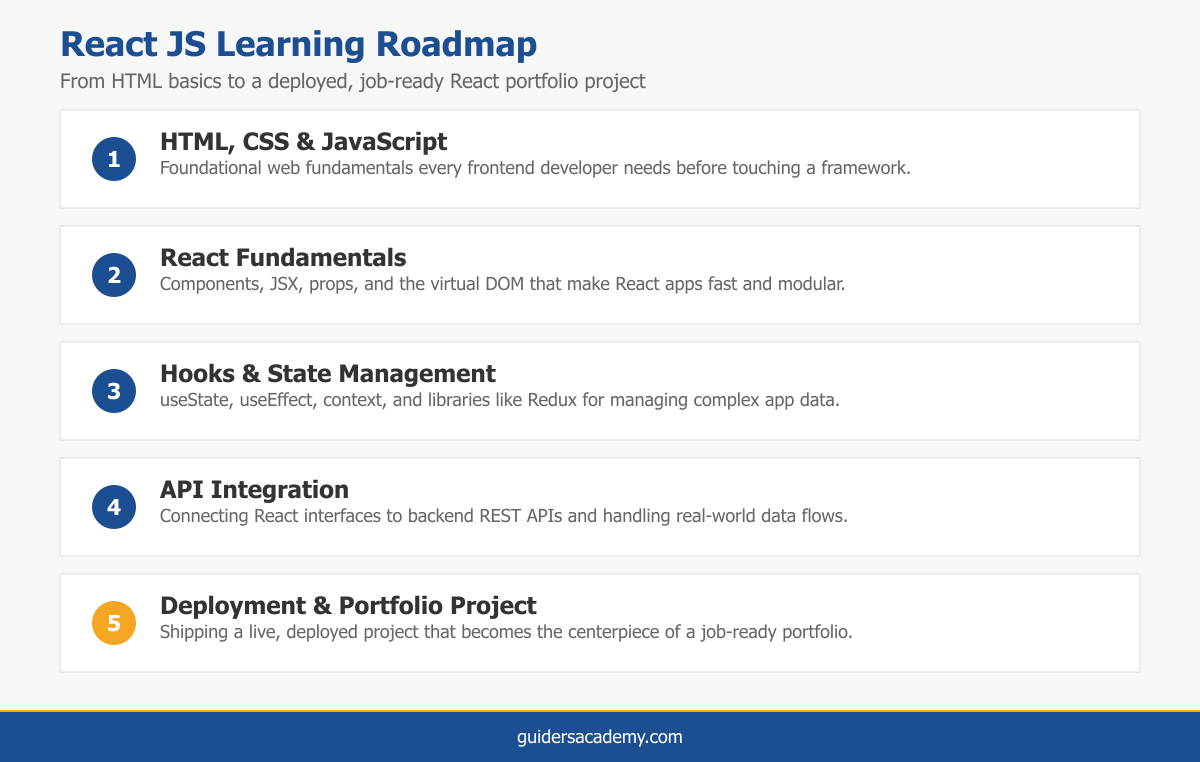
From there, a solid syllabus should cover components and JSX, props and composition, hooks such as useState and useEffect, and state management patterns for anything more complex than a single form. Equally important is API integration, since almost every production interface pulls data from a backend service, along with basic deployment so learners understand how a finished app actually reaches users. A course that stops at "build a to do list" without touching APIs or deployment will leave graduates underprepared for real interviews.
Good programs also spend real time on debugging skills, browser developer tools, and reading error messages rather than treating them as an afterthought. In practice, a junior developer's daily work involves as much troubleshooting as it does writing new code, so a curriculum that only covers the happy path leaves a significant gap. Version control with Git, basic command line comfort, and the habit of committing work in small, reviewable chunks round out what separates a graduate who can slot into a team immediately from one who needs months of additional on the job training before becoming productive.
Career Paths for React and Frontend Developers in Kochi
Graduates of a strong frontend development course typically move into roles like frontend developer, UI engineer, or React developer at product companies and digital agencies across Kochi. Many eventually broaden into full stack roles, since the line between frontend and backend responsibilities keeps blurring in smaller teams.
If you are weighing whether to specialize in frontend or go broader, it helps to understand the tradeoffs between web development and app development career paths before committing to one direction. Freelance and remote opportunities are also common for React developers, since the skill translates well to short, well scoped project work for clients outside Kerala.
Salary progression for frontend developers in Kerala tends to track project complexity and portfolio strength more closely than years of experience alone. A developer who can point to two or three deployed, well documented projects during an interview often has an advantage over one with a longer resume but no visible work. That is one reason a portfolio focused course structure matters so much. It gives graduates concrete evidence of their skills rather than a certificate that says little about what they can actually build. Many also use their first React role as a stepping stone into product management or technical lead positions after a few years, since frontend engineers who understand user experience end up well placed for those transitions.
How to Choose the Right React Training Institute
Not every web development course with 100 percent placement Kerala claims are backed by an equally strong curriculum, so look past the marketing and check specifics. Ask whether the syllabus teaches modern hooks based React rather than outdated class components, whether learners build and deploy a real project, and whether mentors are working developers rather than instructors reading from slides.
Placement support matters, but verify it through actual outcomes and student feedback rather than a headline number. A short, direct conversation with the admissions team is often the fastest way to judge whether an institute's placement process is genuinely structured or just a claim on a brochure.
Cohort size and mentor access are worth asking about directly. A batch of twenty learners sharing one mentor produces a very different experience from a batch of six, particularly when it comes to code reviews and getting stuck on a bug during a live project. It also helps to check how recently the syllabus was updated, since React's recommended patterns have shifted meaningfully over the past few years, from class components toward hooks, and from Create React App toward faster tools like Vite. An institute that has kept pace with those changes signals that its instructors are still working with the technology, not just teaching from a fixed slide deck year after year.
Conclusion
A good React JS training institute in Kochi does more than teach syntax. It builds JavaScript fundamentals, hands on project experience, and real placement support into one program, so graduates walk into interviews with a working portfolio, not just a certificate. The strongest signal of quality is rarely the marketing copy on an institute's website. It is the depth of the projects past students have shipped, how recently the curriculum was updated, and whether mentors are still working developers rather than career instructors. Read more career breakdowns on the Guiders Academy blog, or get in touch to talk through which frontend path fits your goals.
Frequently Asked Questions
What does a React JS training institute in Kochi actually teach?

How long does it take to learn React JS?
Do I need to know JavaScript before learning React?
What jobs can I get after a React JS course?
Is React JS still in demand in 2026?
What is the difference between React JS and React Native?
Does a React JS course guarantee placement?
What should I look for in a React training institute in Kochi?
Can a non computer science graduate learn React JS?
How much do React JS developers earn in Kerala?