Full Stack & Mobile App Development Courses in Kerala
 General
Choosing between web development courses in Kochi can feel overwhelming once you see how many stacks are on offer. MERN, Django, Spring Boot, Laravel, MEAN, Flutter and React Native all promise a route into a developer job, but they suit different goals, timelines and career paths. This guide compares every stack Guiders Academy teaches side by side, so you can pick a path with confidence instead of guesswork.
Key Takeaways
- Web and mobile development stacks differ mainly in learning curve, job market demand and the type of company that hires for them.
- A placement-focused course structured around real projects matters more than the specific stack you start with.
- Guiders Academy runs full stack and app development programs in both Kochi and Thrissur with hands-on, project-based training.
Why Full Stack Development Is in Demand in Kerala
Kerala's IT sector has grown well beyond its traditional strongholds, with Kochi's Infopark and Smart City campuses, and a growing base of startups and service companies in Thrissur and Thiruvananthapuram, all hiring developers who can work across the stack. According to the Stack Overflow Developer Survey, full stack skills consistently rank among the most in demand technology combinations globally, and Kerala's market mirrors that trend closely.
This demand is not evenly spread across every skill level. Companies are generally not short of candidates who know a single language in isolation. What is harder to find, and what commands better offers, is a developer who can move comfortably between a database, a backend API and a working frontend without needing three separate specialists to ship one feature.
IT and ITES Hiring Trends
Industry body NASSCOM has tracked steady growth in India's IT and ITES workforce, with tier-2 hubs like Kochi absorbing a growing share of that demand as companies look beyond metro cities for cost effective, skilled talent. This shift has made local, practical training more valuable than ever, since companies increasingly hire based on demonstrated project work rather than a degree alone.
Service companies operating delivery centers in Kerala also report that full stack hires are easier to place across multiple client projects than narrow specialists, since a single developer can flex between a legacy maintenance project one quarter and a greenfield build the next without needing to be reassigned to a different team.
The Startup Ecosystem in Kochi and Thrissur
Startups typically cannot afford large specialized teams, so they look for developers who can move between front end, back end and sometimes basic DevOps tasks. This is exactly the profile a structured full stack course is designed to produce, which is why graduates of well run programs often find startup roles faster than candidates with narrower, single skill backgrounds.
Kochi's startup scene in particular has matured enough that early hires are now expected to own a feature end to end, from database schema to the interface a user actually sees, rather than handing work off between siloed teams the way a larger, more established company might structure things.
Remote and Hybrid Opportunities
A growing share of full stack roles based in Kerala are remote or hybrid, serving clients and product companies outside the state entirely. This matters for students weighing where they want to live after graduating, since a strong portfolio and interview performance increasingly matter more than physical proximity to an employer's office.
Web Development Stacks Compared: MERN vs Django vs Spring Boot vs Laravel vs MEAN
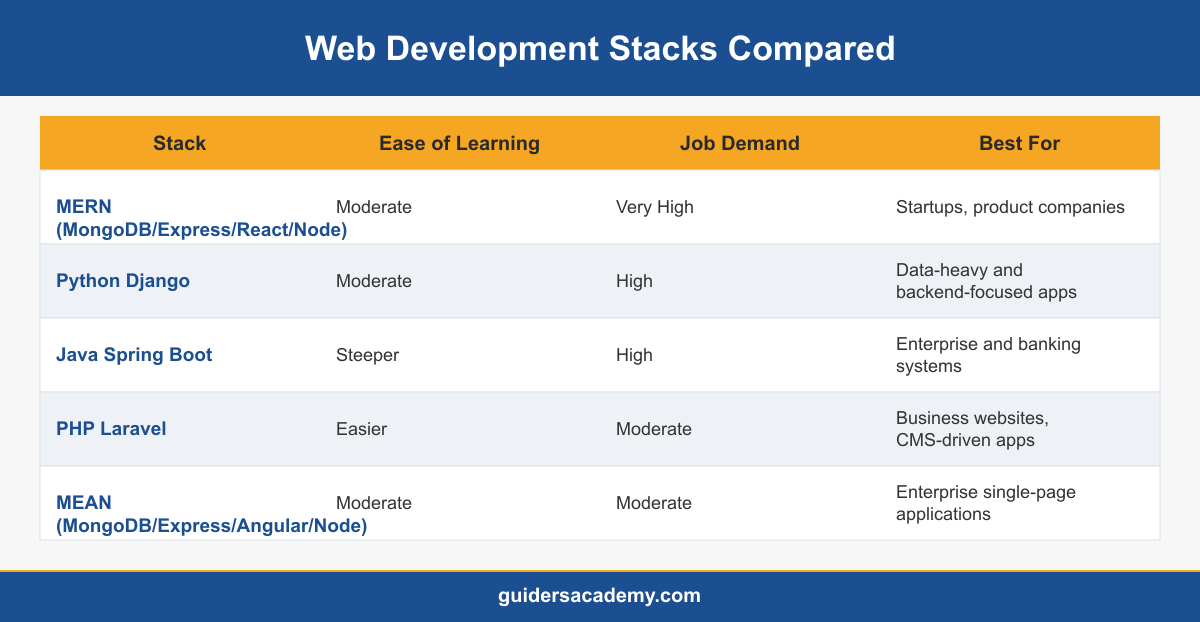
Each web development stack solves the same basic problem, serving dynamic content to a browser, but with different trade offs in learning curve, ecosystem maturity and the type of company that typically hires for it. The comparison below summarizes how MERN, Python Django, Java Spring Boot, PHP Laravel and MEAN compare across the factors that matter most to a student choosing a first stack.
Frontend-Heavy vs Backend-Heavy Stacks
MERN and MEAN lean toward frontend heavy, single page application development, which suits students who enjoy building interactive interfaces. Django, Spring Boot and Laravel put more emphasis on backend architecture, data modeling and business logic, which suits students who prefer structured, server side problem solving. Neither direction is objectively better; the right choice depends on which side of an application you find more engaging.
Which Stack Fits Which Career Goal
Students aiming for fast growing startups or product companies often gravitate toward MERN because of its speed of iteration and JavaScript only workflow, since the same language covers both the frontend and backend, which shortens the learning path considerably. Those targeting large enterprises, banks or government adjacent IT projects tend to benefit more from Spring Boot's structure and long track record in those sectors, where stability and predictable maintenance often matter more than raw development speed.
Freelancers and agency focused developers frequently choose Laravel because of how quickly it can produce business websites and content driven applications for clients, while developers who want the widest possible range of enterprise employers sometimes pick Django, since Python skills also open doors into data and automation work outside of pure web development.
Learning Curve and Time to First Job
MERN and Laravel tend to have the shortest realistic path to a first junior role, since both stacks favor convention over configuration and let students reach a deployable project relatively quickly. Spring Boot and MEAN generally take longer to feel comfortable in, given Java's stricter typing and Angular's more structured, opinionated approach, but graduates often report that this upfront investment pays off in more stable, longer tenured roles once they land their first job.
Mobile Development Compared: Flutter vs React Native vs Native iOS
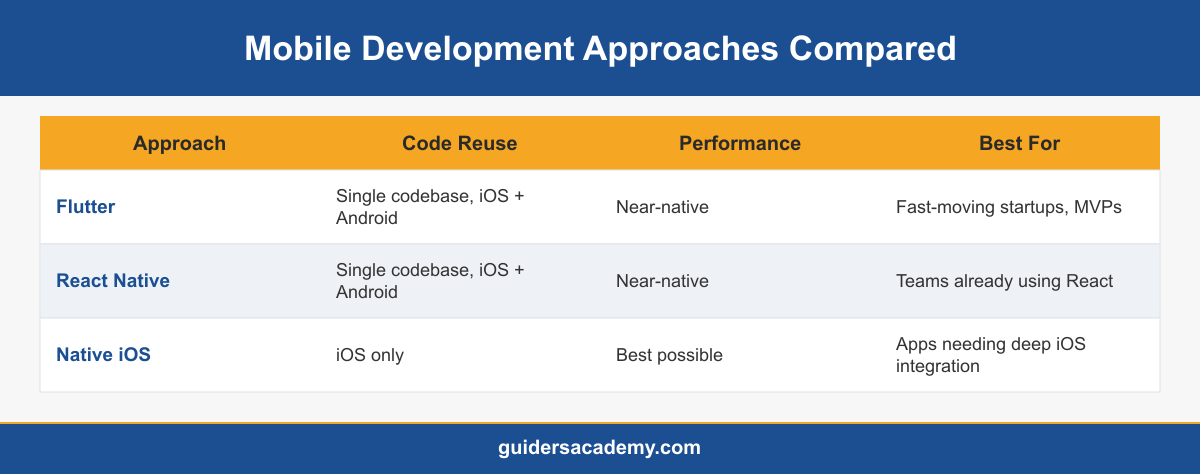
Mobile development follows a similar logic to web development, with a trade off between speed of development and platform specific performance. Flutter and React Native both let a single codebase target iOS and Android, which cuts development time roughly in half compared to building two native apps separately. Native iOS development, in contrast, gives the deepest possible integration with Apple's platform at the cost of maintaining a separate codebase for Android.
Cross-Platform vs Native Trade-offs
Cross platform tools like Flutter and React Native have closed most of the performance gap with native apps for typical business applications, and both are backed by major companies, Google and Meta respectively, which keeps their tooling actively maintained. Native iOS development remains the right choice mainly for apps that need deep hardware integration or must ship the absolute best possible performance on Apple devices specifically.
Job Market Demand for Each
Flutter and React Native developers are in strong demand from startups building MVPs quickly and businesses that want one team maintaining both platforms. Native iOS specialists remain valuable at larger companies with dedicated platform teams, but represent a narrower slice of the overall mobile job market compared to the two cross platform options, which makes cross platform skills the more broadly employable starting point for most students.
How to Choose a Stack Based on Your Career Goal
If your goal is to join a startup or product company quickly, MERN or Flutter offer the fastest path from zero to a deployable project, since both prioritize development speed and a gentler learning curve over strict architectural conventions.
If you are targeting enterprise or government adjacent employers, Spring Boot's structure and reputation carry real weight in those hiring processes, and the extra time invested learning Java properly tends to pay off in more stable, longer term roles.
If freelancing or agency work appeals to you, Laravel's speed for building client websites makes it a practical first choice, particularly for developers who want to start taking on paid project work relatively early in their learning journey.
There is no universally correct stack, only the one that matches where you want to work. Talking to working developers in each ecosystem, or asking an institute which stacks their recent graduates were actually hired for, is often more useful than researching stacks in the abstract.
What a Placement-Focused Full Stack Course Should Include
Regardless of which stack you choose, the structure of the course matters as much as the syllabus. Look for project-based learning where you build two or three complete, deployable applications rather than isolated exercises that never get connected into a working whole.
A strong program also includes a portfolio review process, since employers increasingly evaluate candidates on GitHub repositories and live demos rather than certificates alone. Ask specifically how many one on one code review sessions are built into the program, since debugging real problems with a mentor is where most of the actual learning happens.
Finally, interview preparation, including mock technical interviews and resume support, is what actually shortens the time between graduation and a job offer. A course that ends the day the last lecture finishes, with no support for the job search that follows, leaves students to figure out the hardest part entirely on their own.
Guiders' Full Stack and App Development Programs in Kochi and Thrissur
Guiders Academy's Full Stack Web and App Development program is taught across both the Kochi and Thrissur campuses, covering the web and mobile stacks compared above alongside AI assisted development workflows that are increasingly expected in modern development teams.
The program is built around the same project based, placement focused structure described above, backed by verified student outcomes and testimonials. Students interested in complementary skills can also explore the AI driven digital marketing program, a natural pairing for developers who want to understand how the applications they build are actually marketed.
Dedicated, in depth guides for each individual stack, MERN, Python Django, Java Spring Boot, PHP Laravel, React JS, MEAN and Flutter, cover curriculum details, salary expectations and career paths in more detail than this overview can, for students who already know roughly which direction they want to take.
AI-Assisted Development Skills Employers Now Expect
Development teams in Kerala, like everywhere else, have started expecting new hires to work comfortably alongside AI coding assistants rather than treating them as optional extras. This does not replace the need to understand what code actually does, but it does change what a course should teach on top of the fundamentals.
A modern full stack program should show students how to use AI tools for scaffolding boilerplate code, debugging errors faster, and writing tests, while still requiring students to understand and be able to explain every line that ends up in their portfolio project. Interviewers increasingly probe for this understanding directly, since relying on a tool without knowing why it works is easy to expose in a technical interview.
Where AI Tools Help Most
AI assistance tends to help most with repetitive scaffolding, such as generating a first draft of a CRUD API or a form component, freeing up study time for the parts of a stack that actually require judgment: data modeling, state management decisions, and structuring an application so it stays maintainable as it grows.
Where Human Understanding Still Matters Most
Debugging a production issue, designing a database schema that will not need a costly rework in six months, and making architectural trade-offs between competing approaches all still depend on a developer's own understanding, not a tool's suggestion. Courses that lean entirely on AI generated code without building this underlying judgment tend to produce graduates who struggle once a problem falls outside a tool's training data.
Career Outcomes and Salary Expectations After a Full Stack Course in Kerala
Graduates of a structured full stack program typically start in junior developer roles, whether that is a MERN developer, a Django backend developer, or a Flutter mobile developer, with salary depending heavily on portfolio strength and interview performance rather than the stack alone.
Entry level salaries across most of these stacks fall in a broadly similar band in Kerala's market, with the more noticeable pay differences appearing at the two to three year mark, once a developer has demonstrated ownership of real production features rather than just coursework.
Progression into mid-level, full ownership roles typically happens within two to three years for developers who continue building outside of formal coursework. Freelance and contract opportunities are also widely available across every stack covered here, giving graduates flexibility beyond traditional salaried employment.
Common Mistakes Students Make When Choosing a Stack
The most common mistake is choosing a stack purely because it is trending online, without checking whether local employers in Kochi or Thrissur are actually hiring for it. A stack with strong global demand but thin local hiring can still mean a longer job search than a slightly less fashionable stack with steady regional demand.
A second common mistake is underestimating how much the course structure matters compared to the stack itself. Two students who both learn MERN, one through isolated tutorials and one through a project based, mentored program, will typically have very different outcomes in an interview, even though they technically know the same technology.
Finally, some students try to learn multiple stacks at once before they have shipped a single complete project in any of them. Depth in one stack, proven by a real deployed application, is worth more to employers than shallow exposure to three or four different technologies.
Conclusion
There is no single best stack for every student, only the right stack for your specific goals, timeline and target employers. What matters most across web development courses in Kochi and Thrissur is a placement-focused structure built around real projects.
Explore Guiders Academy's full stack and app development programs, browse the blog for deeper guides on individual stacks, or get in touch today to find the right path for your career.
Frequently Asked Questions
What are the best web development courses in Kochi?

Which full stack is easiest for beginners to learn?
Is Flutter or React Native better for a first mobile app course?
Do I need a computer science degree to join a full stack course?
How long does a full stack web development course in Kerala take?
What is the difference between MERN and MEAN stacks?
Can I switch from web development to mobile app development later?
What jobs are available after a full stack course in Thrissur?
Does Guiders Academy offer placement support for developer courses?
Should I learn a web stack, a mobile stack, or both?