Aviation Courses in India 2027: Programmes, Eligibility and Careers
Aviation Courses in India 2027: Programmes, Eligibility and Careers
 AViation
Search for aviation courses in India and you will find hundreds of brochures that all promise the skies. Very few explain that the word covers six quite different families of training, each with its own regulator, its own eligibility rules, its own cost band and its own first job. A pilot programme and an airport management diploma have almost nothing in common beyond the airport. This hub lays every family side by side for 2027. It sets out who can apply after 10th, Plus Two or a degree, which certifications employers actually check, how the programmes compare on time and money, and how to choose one with confidence rather than on the strength of a poster.
Key Takeaways
- Aviation training in India splits into six families: flying, aircraft maintenance, airline and airport management, cabin crew, IATA travel and distribution, and security and cargo.
- Each family answers to a different authority, so the same certificate can carry real weight in one role and none in another.
- Pilot training sits in a cost band of its own; management, cabin crew and IATA programmes are far more accessible after Plus Two.
- Choose by the first job you want, then work backwards to the eligibility, certification and placement route that reaches it.
What Counts as an Aviation Course in India?
An aviation course is any structured programme that prepares you for a role in the air transport system. That system is wider than most students imagine. It includes the people who fly aircraft, the people who maintain them, and the far larger workforce that runs airports, airlines, cargo terminals and travel distribution on the ground.
Most of the jobs are on the ground. For every pilot on a flight deck there are teams handling check in, baggage, ramp operations, load control, security screening, cargo documentation and reservations. Those roles hire in volume and they hire steadily, which is why most aviation courses in India train for them rather than for flying.
The programmes also differ in what they award. Some lead to a licence issued by a regulator. Some lead to a university degree or diploma. Others lead to an industry certificate from a body such as IATA. Knowing which of these you are buying is the first and most important question to ask any institute.
Providers vary just as widely. Aviation courses in India are run by government academies, private flying schools, universities, approved maintenance organisations and independent training institutes. Some teach a single family in depth. Others, especially in Kerala, teach several ground based families under one roof and share faculty and facilities between them.
This is where many students go wrong. They compare institutes on campus photographs and placement banners before they have decided which family of training they actually want. The sections below fix that order. Decide the family first, then the programme, then the provider.
If you are still at the stage of asking whether aviation suits you at all, start with this look at whether studying aviation opens real opportunities, then return here to map the options.
The Six Families of Aviation Programmes
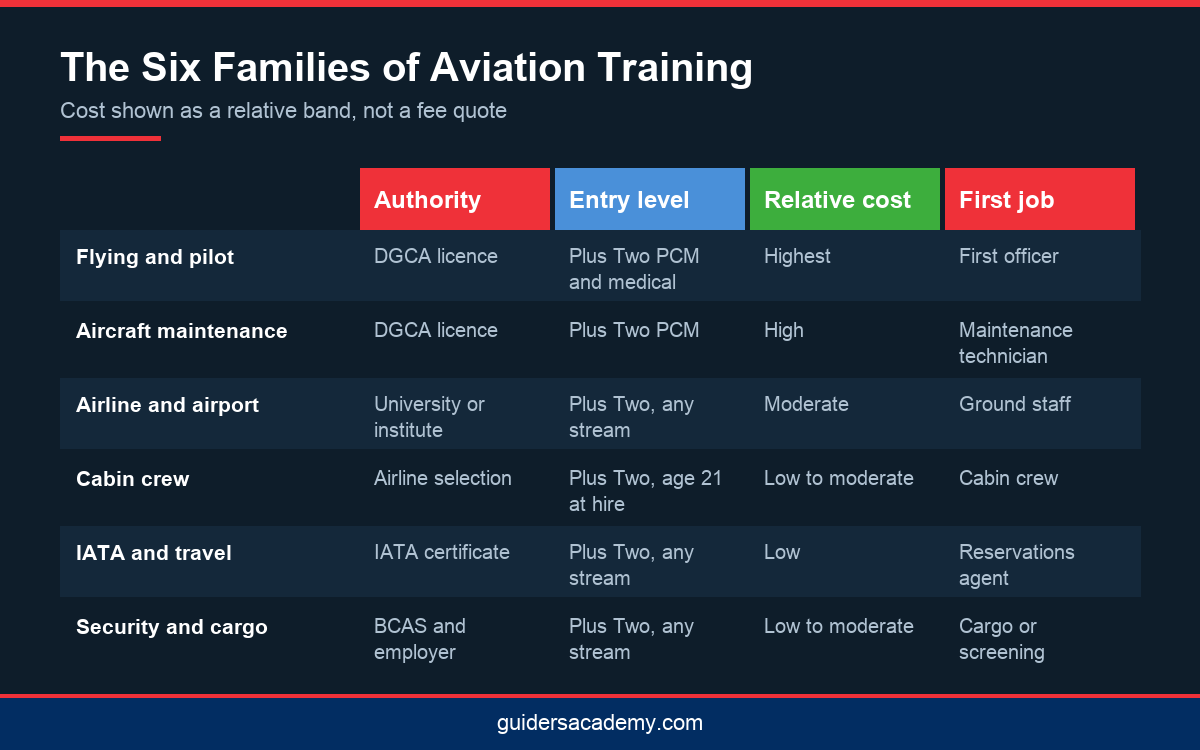
Every one of the aviation courses on the market fits into one of six families. The table below compares them on the points that matter most to a student choosing in 2027: who regulates or certifies the training, what you need to apply, how the cost compares and where the first job usually is.
Read it as a map rather than a ranking. A family that suits one student badly may be exactly right for another, depending on subjects studied, budget, physical standards and the kind of working day that appeals.
Flying and Commercial Pilot Training
Pilot training leads to a licence issued by the Directorate General of Civil Aviation, India's civil aviation regulator. It combines ground school in subjects such as air navigation, meteorology and regulations with a required minimum of logged flying hours at an approved flying training organisation.
It is the most expensive family by a wide margin and the most demanding on medical fitness. Government backed academies such as Indira Gandhi Rashtriya Uran Akademi, which operates under the Ministry of Civil Aviation, sit alongside private flying schools across the country.
Aircraft Maintenance Engineering
Aircraft maintenance engineering trains the technicians who certify that an aircraft is fit to fly. The licence is again issued by DGCA, and the training must be completed at an approved maintenance training organisation.
It suits students with a strong science background who enjoy precise, hands on technical work. The working day is in hangars and on the ramp, often on night shifts when aircraft are on the ground.
Airline and Airport Management
This is the largest family by number of students. Diplomas, BBA and BCom programmes with an aviation specialisation teach airport operations, passenger handling, airline commercial functions, cargo basics and customer service.
Roles include ground staff, customer service agents, ramp coordinators and operations assistants. A full guide to the airline and airport diploma covers the diploma route in depth, and the degree routes are compared in this Kochi and Thrissur guide to the BBA route.
Cabin Crew and Inflight Hospitality
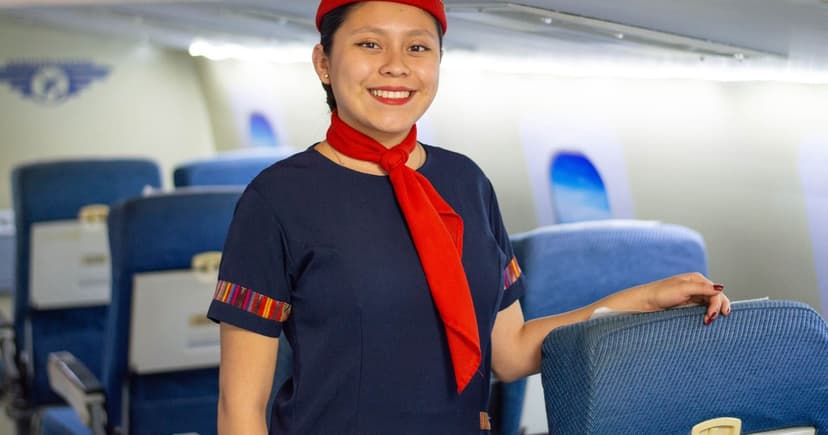
Cabin crew programmes prepare students for airline selection: grooming, communication, safety awareness, service standards and interview practice. Airlines then train new crew themselves after hiring, so the external course is preparation rather than a licence.
Physical and age standards apply. The Emirates cabin crew careers page lists a minimum age of 21, a minimum height of 160cm with an arm reach of 212cm, and Grade 12 education, as read in October 2026.
IATA, Travel and Distribution
IATA courses teach the industry's shared standards: fares and ticketing, reservations systems, passenger ground services, cargo and dangerous goods. The certificates are recognised by airlines and travel companies across many countries.
They are short compared with degrees and are often taken alongside one. The IATA training catalogue lists the full range, and a beginner's explainer on IATA qualifications explains how the levels fit together.
Security, Safety and Cargo
Airport security roles in India follow the training standards set by BCAS, the national regulator for civil aviation security. Cargo roles add documentation, warehouse handling and dangerous goods awareness.
Both are growing faster than most students realise, partly because fewer applicants target them. Why safety training sits at the heart of every syllabus is explained in a separate post.
Eligibility: What You Need After 10th, Plus Two or a Degree
Eligibility is where the families separate most sharply. Your stage of education decides which doors are already open, which need an extra qualification, and which are closed for now.
Most aviation courses in India are open to Plus Two students from any stream. The two big exceptions are flying and aircraft maintenance, which depend on science subjects and medical standards. Everything else is far more accessible than students often assume.
The rules below are the general pattern. Always confirm the exact criteria with the regulator or the airline before you pay a fee, because standards are revised and individual providers sometimes add their own conditions.
After 10th
After 10th the options are mostly short certificate programmes in customer service, travel and ticketing, and introductory IATA modules. They build useful skills, but most airline and airport employers expect Plus Two at the point of hiring.
The sensible plan is to complete Plus Two while taking a short certificate alongside it. That way the certificate is ready when you become eligible for entry level roles.
After Plus Two
Plus Two opens the widest range. Airport and airline management diplomas, BBA and BCom programmes with aviation, cabin crew preparation and IATA courses all accept students from any stream.
Pilot and aircraft maintenance training are the exceptions. Both generally require Physics and Mathematics at Plus Two, and pilot training requires a DGCA medical assessment. The Kerala guide for Plus Two students goes through each option stream by stream.
After Graduation
Graduates can take postgraduate diplomas in airport or airline management, or add an IATA specialisation to an existing degree. Commerce graduates often move toward cargo, ticketing and airline finance roles.
Air traffic control recruitment by the Airports Authority of India generally looks for a science or engineering degree, so that route suits graduates with the right subjects. Options after a BCom with aviation are covered separately.
Medical and Physical Standards
Medical standards matter most for pilots, who must pass DGCA medical examinations and keep them current through their careers. Cabin crew face airline set standards on height, reach and fitness.
Ground roles have far fewer physical requirements, which is one reason they suit a wider range of students. Check standards before you enrol, not after.
Duration and Cost: How the Programmes Compare
Duration and cost vary more across aviation courses than across almost any other field of study. The differences are structural, not just a matter of which institute charges more.
Duration follows the same pattern. Pilot and engineering routes take several years from enrolment to licence. Degrees take three years. Diplomas usually run for a year or less, and the shortest aviation courses, such as individual IATA modules, can be completed in weeks or a few months alongside other study.
Pilot training sits in a band of its own. Flying hours, aircraft, fuel and instructors are expensive, and the cost is many times that of any ground based programme. Students should plan funding before applying and should be wary of any offer that seems far cheaper than the rest of the market.
Aircraft maintenance engineering is the second costliest family. It runs over several years and requires approved workshops and equipment, which providers must maintain to keep their approval.
Degrees with an aviation specialisation run over three years and are priced in line with other professional undergraduate programmes. Diplomas are shorter and correspondingly more accessible. IATA certificates and cabin crew preparation are the shortest and least costly options.
Cost should always be read against what the course leads to. A shorter programme that ends in a recognised certificate and an active placement process can be better value than a longer one that ends with a certificate no employer asks for. An honest look at whether fees pay back works through that calculation for Kerala.
Ask every provider the same three questions. What exactly is included in the fee? Which certificate or licence is awarded, and by whom? What happens if you need to repeat a module or an assessment? Clear written answers are a good sign. Vague ones are a warning.
Regulators and Certifications That Give a Course Its Value
An aviation certificate is only as valuable as the body behind it. Before enrolling, find out which authority recognises the programme, and whether employers in your target role actually check for that recognition.
Four kinds of recognition carry weight in India. Each matters for different roles.
DGCA Licences and Approvals
DGCA issues pilot and aircraft maintenance licences and approves the organisations that train for them. For those two families, DGCA approval is not optional. A programme without it cannot lead to the licence.
For management, cabin crew and IATA programmes, DGCA approval is not the relevant test. Be cautious of marketing that implies otherwise.
BCAS Security Training
BCAS sets the security training that airport staff must complete. Much of it is delivered after hiring, by or for the employer, so students should understand the standards rather than expect to arrive fully certified.
Awareness of these standards is still an advantage at interview, particularly for screening and terminal roles.
IATA Certificates
IATA certificates are recognised internationally, which is why they matter so much for students aiming at Gulf carriers and travel companies. They are awarded on passing IATA's own examinations.
Guiders Academy is an IATA Authorized Training Center. The IATA training page lists the programmes taught at the Kochi and Thrissur branches.
Skill Council and University Recognition
The Aerospace and Aviation Sector Skill Council defines national occupational standards for many ground roles. University affiliation matters for degree programmes, because the degree is awarded by the university rather than the institute.
Guiders' degree routes carry an OUM (Open University Malaysia) affiliation. The accreditations Guiders holds are listed on one page.
Career Paths Each Family Leads To
The best way to compare aviation courses is to start from the job and work backwards. Each family feeds a distinct set of first roles, and progression from those roles follows its own pattern.
Flying leads to first officer roles after type rating and airline selection. Progression to captain depends on hours, assessments and seniority. Aircraft maintenance leads to technician and then licensed engineer roles in airlines and maintenance organisations.
Airline and airport management leads to passenger service, ramp coordination, operations support and customer service roles. Progression is to supervisory and duty manager grades, and often into specialist tracks such as load control or cargo.
Cabin crew preparation leads to airline selection days. Successful candidates then progress through cabin classes and into senior and supervisory crew roles over several years.
IATA and distribution training leads to reservations, ticketing, fares and travel consultancy roles in airlines, travel management companies and online travel businesses. Security and cargo training leads to screening, cargo handling, documentation and compliance roles.
Some aviation courses lead to more than one path. A management diploma with an IATA certificate can feed passenger service, ticketing or cargo roles, which gives graduates options if one employer is not hiring in a particular season. That flexibility is worth weighing when you compare programmes.
Pay differs widely between these families and between employers. Rather than quote figures that date quickly, read how pay is built across aviation careers for the structure of base pay, allowances and progression.
Graduates from Guiders have been placed at employers including Emirates, Qatar Airways, Air India, Cochin Airport and Bangalore Airport. The placements record shows recent outcomes, and one graduate's route into cabin service tells the story in detail.
How to Choose the Right Aviation Programme
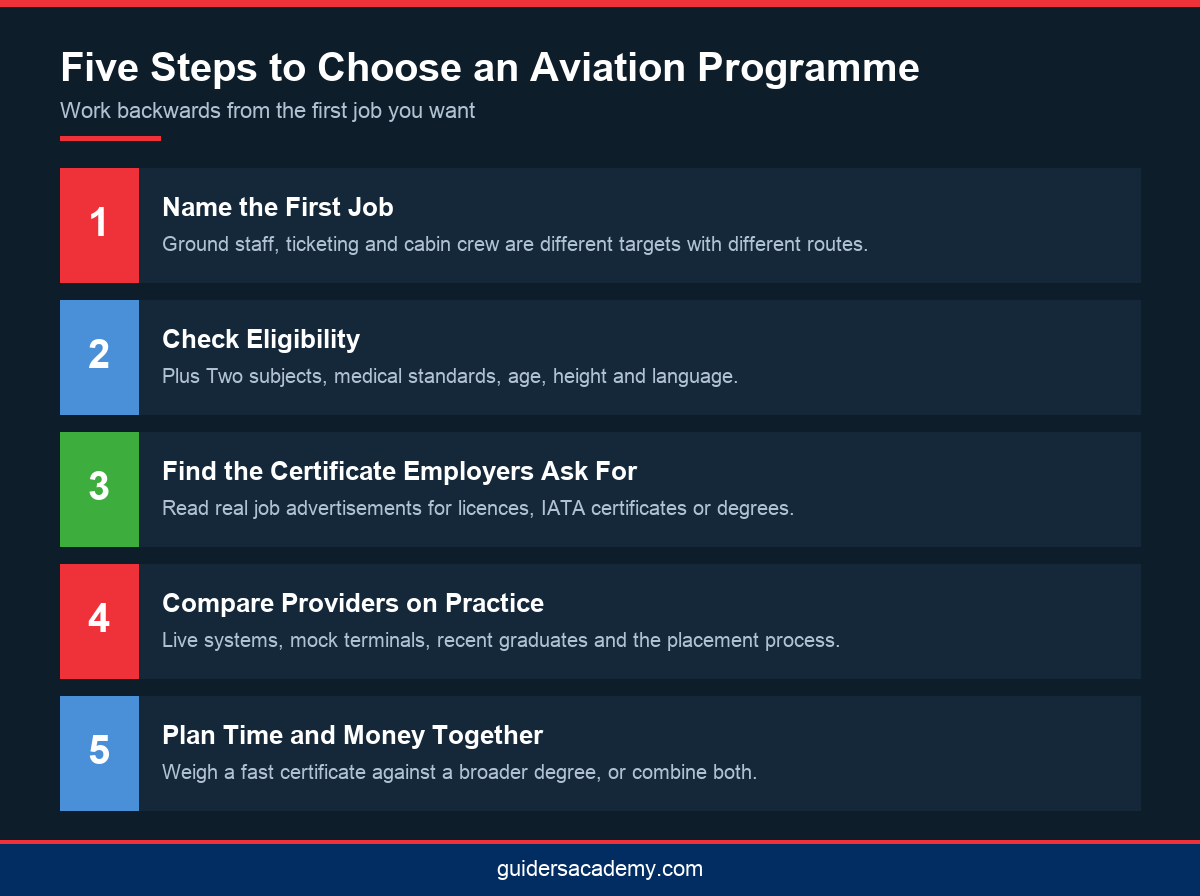
Choosing well is a sequence, not a single decision. The five steps below keep the choice grounded in your own goals rather than in an institute's marketing.
First, name the first job you want. Be specific. Ground staff at an international airport, ticketing at a travel company and cabin crew at a Gulf carrier are three different targets with three different preparation routes.
Second, check eligibility honestly. Subjects at Plus Two, medical standards, age, height and language all close some doors and open others. It is far better to discover a barrier now than after a year of study.
Third, identify the certificate that the target employer actually asks for. Read real job advertisements. If they ask for an IATA certificate, a licence or a particular degree, that is your answer.
Fourth, compare providers on that certificate, on practical training and on placement process. Ask how many hours are spent on live systems and mock terminals rather than in lectures. Ask to speak to recent graduates.
Fifth, plan the money and the time together. A shorter programme with a strong certificate may get you earning sooner, while a degree gives a broader base for later promotion. Many students combine both.
Be wary of shortcuts. Aviation courses that promise a job before you have even enrolled, or that cannot name the certificate they award, should be treated with caution. A good provider is open about the selection process employers run and about what you must do yourself to succeed in it.
For a longer checklist, the guide on choosing an aviation institute covers the questions to ask on a campus visit.
Studying Aviation in Kerala: Kochi and Thrissur
Kerala is an unusually good place to start an aviation career. The state has four commercial airports and strong travel links with the Gulf, and many of its aviation graduates go on to work for international carriers and airports.
That outbound pattern shapes what a good Kerala programme should teach. IATA certification, spoken English, customer service under pressure and familiarity with Gulf recruitment processes all matter more here than in many other states.
Guiders Academy teaches aviation from two branches, at Kadavanthra in Kochi and near Sakthan Stand in Thrissur. Guiders Academy's aviation programme page lists the current programmes in one place.
For Plus Two students, the main routes are the Diploma in Airport Management and BBA with Aviation and Tourism, which combines a degree with aviation and tourism specialisation.
Short programmes sit alongside them. The passenger ground service programme follows IATA's syllabus for check in and passenger handling, and computer reservation system training builds the systems skills that ticketing and reservations roles demand.
Gulf recruitment adds another reason to choose carefully. Carriers and airports in the region run their own selection, so aviation courses taught in Kerala should prepare students for assessment days, group activities and interviews in English as well as for the technical syllabus. Ask any provider how it prepares students for those stages.
Whichever route you take, apply the same tests described above: the certificate awarded, the practical training, and the placement process. Those three answers matter more than any ranking.
Conclusion
Aviation courses in India are not one subject but six families, each with its own regulator, eligibility rules, cost band and first job. Start with the role you want, confirm you meet the standards for it, and identify the certificate that employers in that role actually check. Then compare providers on that certificate, on practical training and on how placement works in practice. Pilot and engineering routes reward early planning and serious funding. Management, cabin crew and IATA routes are open to Plus Two students from any stream and lead quickly into work. To talk through which route fits your subjects and goals, speak to the admissions team at the Kochi or Thrissur branch.
Frequently Asked Questions
Which aviation courses can I join after Plus Two?
Students from any stream can join airport and airline management diplomas, BBA or BCom programmes with aviation, cabin crew preparation and IATA courses. Pilot and aircraft maintenance training generally require Physics and Mathematics at Plus Two.
Which aviation course has the most jobs?
Ground roles in airline and airport operations hire in the largest numbers, including passenger service, ramp coordination and customer service. Cargo and security roles are also growing steadily because fewer applicants target them than target flying roles.
Do I need a DGCA approved course for every aviation job?
No. DGCA approval is essential for pilot and aircraft maintenance licences. For management, cabin crew and IATA programmes, the relevant tests are university recognition, IATA certification and whether employers in your target role ask for them.
How much do aviation courses cost?
Cost varies by family. Pilot training is many times more expensive than any ground programme, with aircraft maintenance second. Degrees are priced like other professional programmes, while diplomas, IATA certificates and cabin crew preparation cost the least.
Is an IATA certificate useful in India?
Yes. Airlines, airports and travel companies in India and the Gulf recognise IATA certificates for ticketing, reservations, ground services and cargo roles. They are particularly valuable for students from Kerala who are targeting international carriers and airports.
What are the requirements to become cabin crew?
Each airline sets its own. As read in October 2026, Emirates lists a minimum age of 21, a height of 160cm with 212cm arm reach, Grade 12 education, fluent English and some customer service experience.
Can I study an aviation course after graduation?
Yes. Graduates can take postgraduate diplomas in airport or airline management, or add IATA certification to an existing degree. Science and engineering graduates can also consider air traffic control recruitment run by the Airports Authority of India.
Should I choose a diploma or a degree?
A diploma gets you into work sooner and costs less. A degree takes longer but gives a broader base for supervisory roles later. Many students combine a degree with a short IATA certificate to gain both advantages together.
Where can I study aviation in Kerala?
Guiders Academy teaches aviation programmes at its Kochi and Thrissur branches as an IATA Authorized Training Center. Read what recent graduates say about the training, then visit a branch to see the facilities in person.
Frequently Asked Questions
Which aviation courses can I join after Plus Two?

Which aviation course has the most jobs?
Do I need a DGCA approved course for every aviation job?
How much do aviation courses cost?
Is an IATA certificate useful in India?
What are the requirements to become cabin crew?
Can I study an aviation course after graduation?
Should I choose a diploma or a degree?
Where can I study aviation in Kerala?