Aviation Training Institutes in Kerala: 6 Things to Check
 General
There is no shortage of advice on choosing between aviation training institutes in Kerala, and almost all of it is written in the abstract: check the faculty, check the placements, check the infrastructure. That advice is correct and useless, because every institute claims all three. What is missing is a way to score them against each other. This piece provides a comparison framework with six weighted criteria, the specific evidence to demand for each one, and the answers that should end a conversation immediately.
Key Takeaways
- Every institute claims good faculty, infrastructure and placements, so the useful question is what evidence each claim comes with.
- Score six criteria rather than forming a general impression, because a strong campus tour hides weak placement outcomes easily.
- Placement percentages without a batch size denominator are marketing figures rather than data you can compare across institutes.
- Visit in person during a working day, because an empty classroom at eleven in the morning tells you more than any brochure.
Why the Usual Advice Fails
The standard guidance asks you to check accreditation, faculty, infrastructure, and placement support. The problem is that every institute in the state will answer yes to all four, and none of those answers are comparable without evidence attached to them.
Marketing has also converged. Brochures, websites, and counselling conversations across the sector use nearly identical language, which means a prospective learner reading three of them side by side genuinely cannot distinguish between the institutions on the page.
That pushes decisions toward the wrong signals. Proximity, fee level, and the confidence of the counsellor who spoke to you end up deciding a two year commitment, and none of those correlate with whether you will be employed afterwards.
A scoring framework fixes this by forcing specificity. Instead of asking whether an institute has placement support, you ask how many learners were in the last batch, how many were placed, in what roles, and with which employers.
It also protects against the campus tour effect. A well presented building creates a strong impression that has almost no relationship to teaching quality, and structured scoring keeps that impression in proportion to everything else you are assessing.
The existing guidance on what to look for when comparing institutes covers what to look for in principle, and this framework is designed to sit alongside it as the scoring method.
None of this requires distrust. Good institutes answer specific questions readily because the answers reflect well on them, and the ones that deflect are telling you something useful without meaning to.
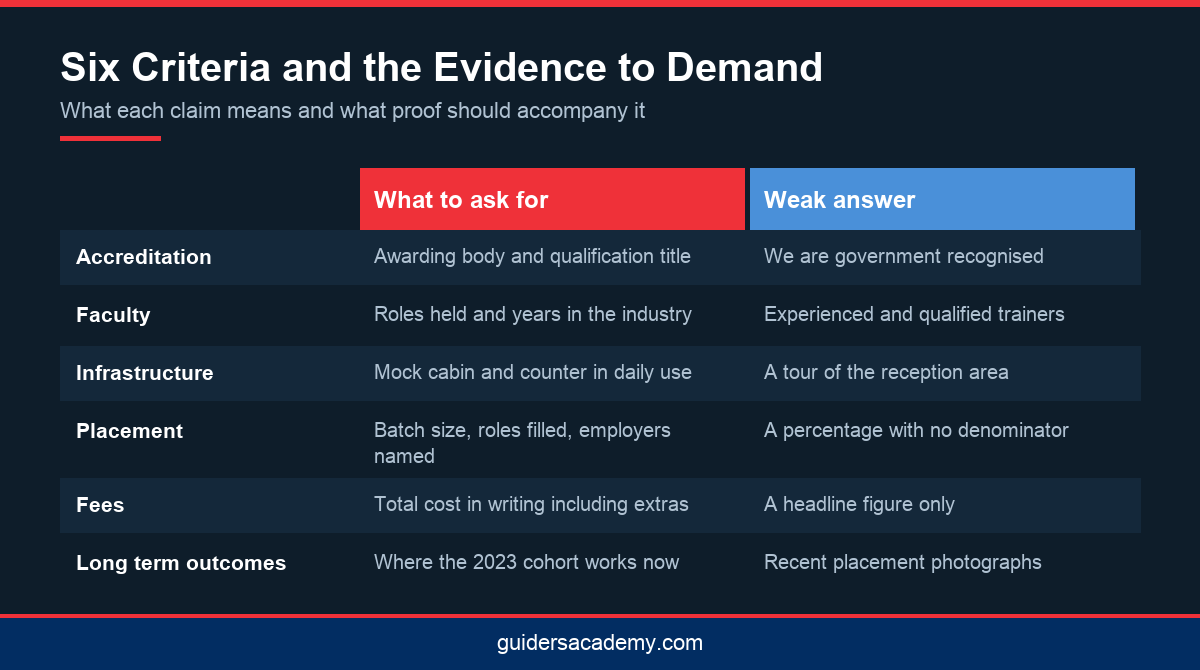
The Six Criteria and the Evidence to Demand
Accreditation and affiliation come first. Ask which body approves which specific programme, request the qualification title, and read the wording on a sample certificate, because approval attaches to programmes rather than to institutions in general.
Faculty background is the second criterion and the most revealing. Ask how many trainers have worked in airline or airport operations, in which roles, and for how long, because industry experience changes what a classroom can teach.
Infrastructure is third but should be weighted carefully. A mock cabin, a check in counter simulation, and a grooming facility are genuinely useful, while an impressive reception area contributes nothing to whether you pass an airline interview.
Industry recognition matters and is verifiable. Training frameworks published by IATA are used by credible institutes, and the operational context set by the Airports Authority of India shapes what ground roles actually require.
Placement evidence is the fourth criterion and the one most often misrepresented. A percentage is meaningless without the batch size behind it, so ask for the raw numbers, the roles filled, and the employers who hired.
Fee transparency is fifth. Ask what the total cost is including examination fees, uniform, materials, and any recruitment related charges, and get it in writing, because a low headline fee frequently conceals additions later in the programme. Certification claims are the easiest to verify, and a beginners guide to IATA qualifications explains what the real ones look like.
Learner outcomes over time form the sixth. Where are graduates from three years ago now, not just the ones placed immediately, because a course that produces first jobs but not careers is only solving half of the problem.
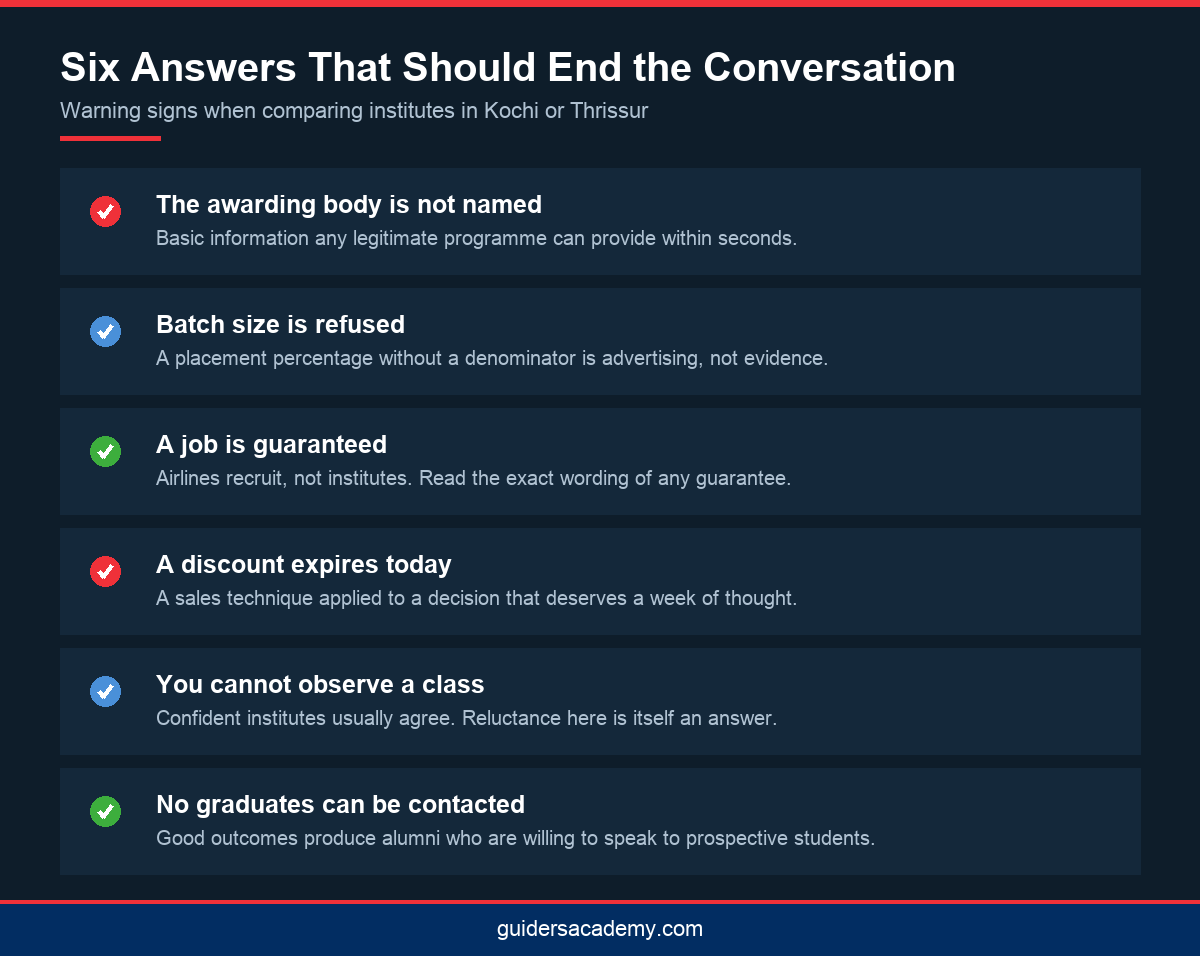
Questions That Should End a Conversation
If an institute cannot name the awarding body for the qualification it issues, stop there. This is basic information that any legitimate programme can provide immediately, and hesitation at this point predicts problems at every later stage.
If a placement percentage is quoted and the batch size is refused, treat the figure as advertising. Ninety percent of ten learners and ninety percent of two hundred are entirely different institutions, and only one of them is worth your fee.
If you are told that a job is guaranteed, be cautious. Airline recruitment is conducted by airlines, no institute controls the outcome, and a guarantee either has conditions buried in the contract or is simply not true as stated.
If pressure is applied to enrol immediately with a discount that expires today, that is a sales technique rather than an education decision. A programme worth two years of your life will still be worth it next week.
If nobody will let you sit in on a class, ask why. Observing an ordinary session, unannounced, is the single most informative thing a prospective learner can do, and confident institutes usually agree without much hesitation.
If former students cannot be contacted, that is a meaningful gap. Any institute with good outcomes has graduates willing to speak, and connecting you with one or two is a straightforward request that should not be difficult.
The existing guidance on how to choose the best aviation institute covers the positive signals to look for, and these are the negative ones that should override them. Placement claims should be tested against the roles described in this overview of industry openings.
If the fee structure changes between the first conversation and the enrolment form, stop and read both carefully. Additions for examinations, uniform, materials, or recruitment support that appear late are the most common source of dispute between learners and institutes in this sector.
How to Run the Comparison in Practice
Shortlist three institutes, the aviation programme at Guiders Education among them, rather than one or ten. One gives you nothing to compare against, ten becomes unmanageable, and three is enough to see where the differences actually lie once you start asking each of them the same questions.
Visit on an ordinary working day rather than an open day. Open days are staged and show the institution at its best, while a Tuesday morning shows you class sizes, punctuality, and whether the facilities are actually in use.
Ask each institute the identical set of questions and write the answers down. Comparison only works if the inputs match, and written notes prevent the confident conversation from outweighing the weak answer a week later.
Weight the criteria according to your own goal. Someone targeting cabin crew should weight grooming and interview preparation heavily, while someone aiming at ground operations or logistics should weight the operational modules and industry links more.
Verify at least two claims independently. Check an accreditation against a public register, and speak to one former student who was not introduced to you by the institute, because self selected references are not evidence.
Compare total cost rather than headline fee, and factor in travel and accommodation if you would relocate. The accreditations an institute publishes openly are worth as much as the ones described only in conversation. Curriculum depth matters most in the areas covered by a complete guide to airline and airport management diplomas.
Finally, weigh the placement process rather than the placement claim. Ask how recruitment days are arranged, who prepares learners for them, and whether the institute maintains a documented placement record you can examine.
Conclusion
Comparing aviation training institutes in Kerala becomes straightforward once you stop asking whether an institute is good and start scoring six criteria with evidence attached. Shortlist three, ask each the same questions, visit on an ordinary working day, verify two claims independently, and compare total cost rather than advertised fees. The institutes that answer specifically are usually the ones worth joining. To put these questions to Guiders directly, including a request to observe a class, contact the Guiders Academy team.
Frequently Asked Questions
How should I compare aviation training institutes in Kerala?

What accreditation should an aviation institute hold?
How do I judge a placement percentage?
Should I trust a job guarantee?
Is expensive training better than affordable training?
How important is a mock cabin or simulation facility?
Can I sit in on a class before enrolling?
How many institutes should I shortlist?
What else should I verify independently?