From Classroom to Cabin Crew: What It Really Takes
 AViation
Most articles about cabin crew training in Kerala describe a syllabus. This one follows the year instead, because what learners actually want to know is what each stage feels like and where people struggle. The account below is a composite, drawn from the typical path an aviation student takes from a first classroom week through grooming standards, service training, interview rounds, and a first airline offer. It is written to be honest about the parts that are hard rather than to make the route look effortless.
Key Takeaways
- The first term is classroom heavy and disciplined, which surprises learners expecting the visible glamour of the role immediately.
- Grooming, communication, and service standards are assessed continuously rather than taught once and forgotten about afterwards.
- Airline recruitment runs in rounds, and most candidates are filtered on communication and composure before any technical question.
- The offer usually arrives after several attempts, so the graduates who succeed are the ones who treat rejection as a rehearsal.
Month One: The Classroom Nobody Pictures
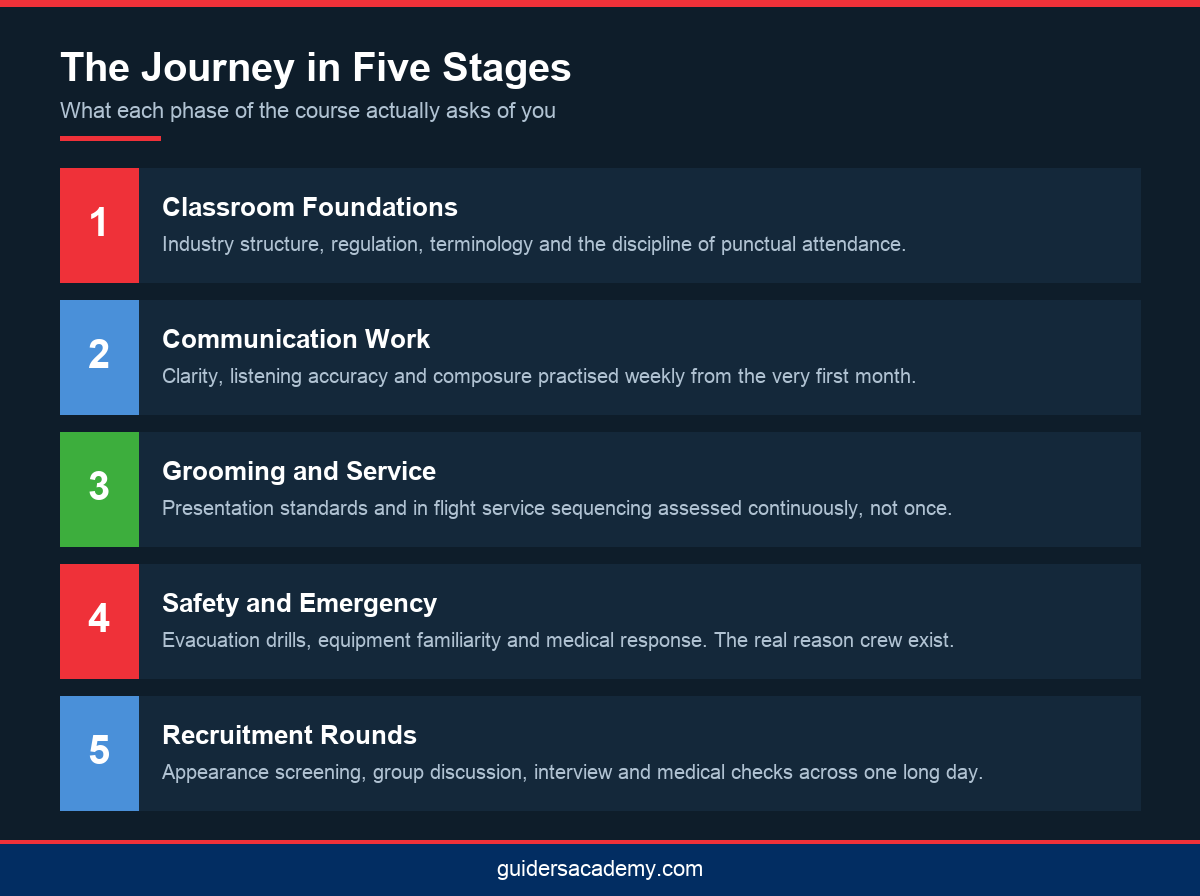
The first weeks look nothing like the photographs that draw people to the profession. There is no aircraft, no uniform, and no airport. There is a classroom, a timetable, and a syllabus that begins with how the aviation industry is organised and who regulates what.
That regulatory grounding matters more than it appears. Understanding the role of the Directorate General of Civil Aviation and the structure of airline operations gives context for everything taught later, including why certain safety procedures are non negotiable.
Attendance discipline arrives immediately and it catches people out. Aviation training runs on punctuality because the industry does, and a learner who drifts in late during the first month is being taught something about the job rather than punished arbitrarily.
The academic load is real. Terminology, geography, airline codes, and documentation all have to be memorised, and learners who arrived expecting a personality based course discover that there is a body of knowledge to hold before anything else begins.
Communication assessment starts here too. Speaking clearly, listening accurately, and responding without hesitation are practised from the first week, because these are the abilities that will decide most interview outcomes eighteen months from now.
This is where the first group of learners reconsiders. Some leave, and that is a reasonable outcome. The course is a filter as much as a training programme, and discovering the mismatch in month one is far better than discovering it in a final interview.
For those who stay, the classroom becomes familiar quickly. The aviation programme at Guiders Education is built so that theory arrives before practice for a reason, and the sequencing starts to make obvious sense by the second term.
The Middle Terms: Grooming, Service and Safety
Grooming standards are introduced as a professional requirement rather than a personal preference, which takes some adjusting to. Uniform presentation, hair, posture, and personal presentation are assessed regularly because airlines assess them too, at every stage of recruitment.
The reaction to this varies enormously. Some learners find it uncomfortable at first and most come to appreciate it, because the same discipline transfers into how they present themselves in any interview, aviation or otherwise, for the rest of their working life.
Service training is where the course becomes practical. Meal service sequencing, passenger interaction, handling special requests, and managing a difficult conversation in a confined space are practised repeatedly until the responses become automatic rather than considered.
Safety and emergency procedures form the serious core of the syllabus. Evacuation drills, equipment familiarisation, and medical response are the reason cabin crew exist, and any programme that treats this as secondary to service has misunderstood the profession entirely.
The industry standards taught here are recognisable internationally, and the training frameworks published by IATA shape much of what a credible Kerala institute delivers in this part of the programme.
Language and accent work continues throughout. Clarity matters more than accent, and learners are pushed toward being understood easily by passengers from anywhere rather than toward imitating any particular way of speaking. Safety modules carry the most weight of all, for the reasons set out in this piece on safety training in aviation.
By the end of these terms most learners have changed noticeably. The combination of discipline, repetition, and constant assessment produces a visible shift in confidence, which is the quality airline recruiters are actually looking for in the room.
Recruitment Season: What the Rounds Actually Involve
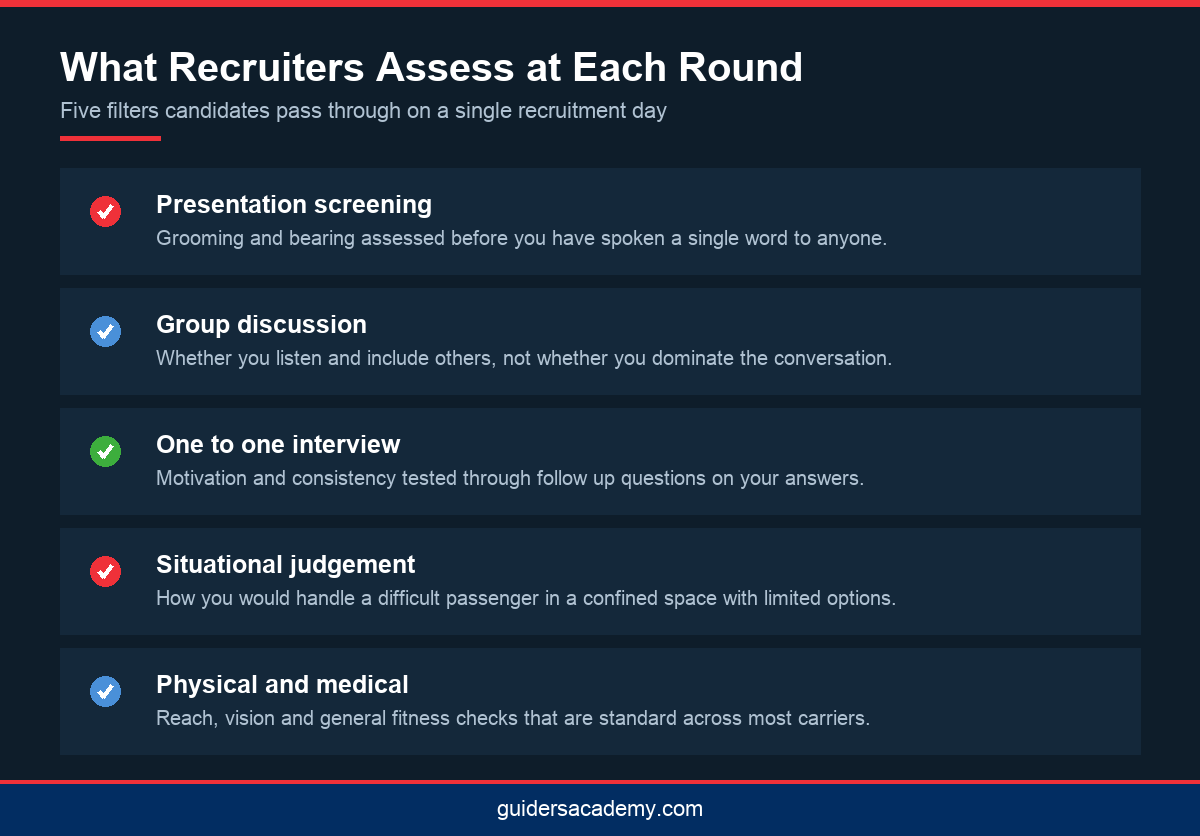
Airline recruitment usually runs as a sequence of rounds on a single long day. Candidates arrive early, are assessed on appearance and presentation before speaking to anyone, and a significant proportion are released within the first hour.
The group discussion round follows and it is misunderstood by most candidates. Recruiters are watching whether you listen, include others, and stay composed under disagreement, not whether you dominate the conversation or produce the cleverest argument.
One to one interviews test consistency and motivation. Questions about why this profession, how you handle difficult people, and what you would do in a specific service situation are asked to see whether the answers hold together under follow up.
Physical and medical requirements are checked at some point, including reach, vision, and general fitness. These are standard across airlines and are best confirmed early rather than discovered at the final stage of a process you have invested months in.
Most candidates are not selected on the first attempt, and that is the single most useful thing to know in advance. Recruiters see hundreds of people, the process is heavily filtered, and a rejection is rarely a judgement on your potential.
The graduates who eventually succeed treat each attempt as a rehearsal. They record what they were asked, notice which round they reached, work on that specific weakness, and return to the next airline recruitment day better prepared than before. Outcomes differ sharply by role, and this overview of openings across the industry shows where they sit.
This is where institutional support matters. Mock rounds, grooming review, and honest feedback from someone who has sat on the other side of the table shorten the learning curve considerably, which is why a documented placement process is worth asking about before enrolling.
The First Year in the Job and What Comes After
The first months on the job are demanding in ways training cannot fully replicate. Irregular hours, time zone changes, and standing through long sectors take a physical toll, and new crew members consistently report that the fatigue surprised them.
The service standards learned in training turn out to be the easy part. What takes longer to develop is judgement: reading a cabin, noticing a passenger who is unwell before they say anything, and defusing a situation before it escalates into an incident.
Colleagues change every flight, which is unlike almost any other job. Crew members learn to build working rapport with strangers within minutes, and that ability becomes one of the most transferable skills the profession produces over time.
Career progression opens sooner than many expect. Senior crew, purser, trainer, and recruitment roles all sit within reach, and the skills every aviation student should develop map directly onto what those promotions assess.
Not everyone stays airborne, and that is entirely normal. Ground operations, customer experience management, training, and airline commercial roles all recruit from former cabin crew, and the career opportunities after airport management overlap considerably.
The international route is genuinely open from Kerala. Gulf carriers recruit regularly from this state, and the pathway is well established, though it asks for adaptability to a different working culture as much as it asks for technical competence. Women entering the field will find this account of training and barriers worth reading.
Looking back at the year, most graduates identify the same turning point. It was not a lesson or an exam, but the moment the discipline stopped feeling imposed and started feeling like their own, which is when the interviews began to go differently.
Conclusion
Cabin crew training in Kerala is more demanding and less glamorous than the profession's image suggests, and that is exactly why the graduates who complete it well stand out in a recruitment hall. The route runs through a heavy classroom term, months of grooming and safety discipline, and usually several attempts at airline rounds before an offer arrives. Anyone willing to treat rejection as practice will get there. To ask about the current aviation batch, entry requirements, and how the mock recruitment rounds work, contact the Guiders Academy team.
Frequently Asked Questions
What does cabin crew training in Kerala actually involve?

How long does the course take before I can apply to airlines?
What are the basic eligibility requirements?
Is it normal to be rejected at the first airline interview?
Do I need to speak English with a particular accent?
How physically demanding is the job itself?
What if I decide cabin crew is not right for me?
Can I work for international airlines from Kerala?
How do I choose an institute for this training?