Web3 and Blockchain Training in Kochi: Hype or Hiring?
 General
Web3 and blockchain development training in Kochi attracts a lot of interest and a fair amount of confusion. The technology is genuinely different from ordinary web development, the vocabulary is unfamiliar, and the job market is smaller than the marketing around it suggests. This guide sets out what the field actually involves day to day, what a serious syllabus must contain, which roles exist in Kerala and beyond it, and how to judge a programme without being carried along by enthusiasm alone.
Key Takeaways
- Blockchain development is careful backend engineering with unusual constraints, not a separate discipline that replaces ordinary programming skill.
- A credible syllabus covers cryptographic basics, smart contract languages, testing, security, and the ordinary web layer that users interact with.
- The Kerala job market for this skill is real but small, so keep general full stack ability as your working foundation.
- Judge a programme by whether learners deploy and audit working contracts on a test network, not by how many buzzwords appear in the brochure.
What Web3 Development Actually Involves
Web3 describes applications where some part of the logic and data lives on a public blockchain rather than on a server the company controls. In practice this means writing programs that run on a shared network, where every participant can verify what happened and nobody can quietly change it later.
That constraint drives everything else. Code deployed to a blockchain is usually permanent, so a defect cannot simply be patched the following morning the way a server bug can. Every execution also costs a fee paid by a user, which means wasteful logic carries a direct monetary price rather than a theoretical one.
The work is closer to careful backend engineering than to anything glamorous. Developers spend their time on data structures, access control, arithmetic that must never overflow, and tests that cover cases an ordinary web application would tolerate failing occasionally without consequence.
There is still an ordinary application around it. Users interact through a normal web or mobile interface that reads from the chain, prompts a wallet to sign a transaction, and then waits for confirmation, which means standard front end skills remain essential rather than optional. That backend grounding is the same one built in the MERN programme in Kerala.
The Ethereum developer documentation is the reference most training material is built from, and it is worth reading directly. Anyone who cannot follow it after a course has probably been taught vocabulary rather than engineering.
None of this is a shortcut past learning to program. Effective training on the web and app development track at Guiders Education assumes you already write reasonable code, or it teaches that first before touching a single smart contract.
What a Blockchain Development Course Should Teach
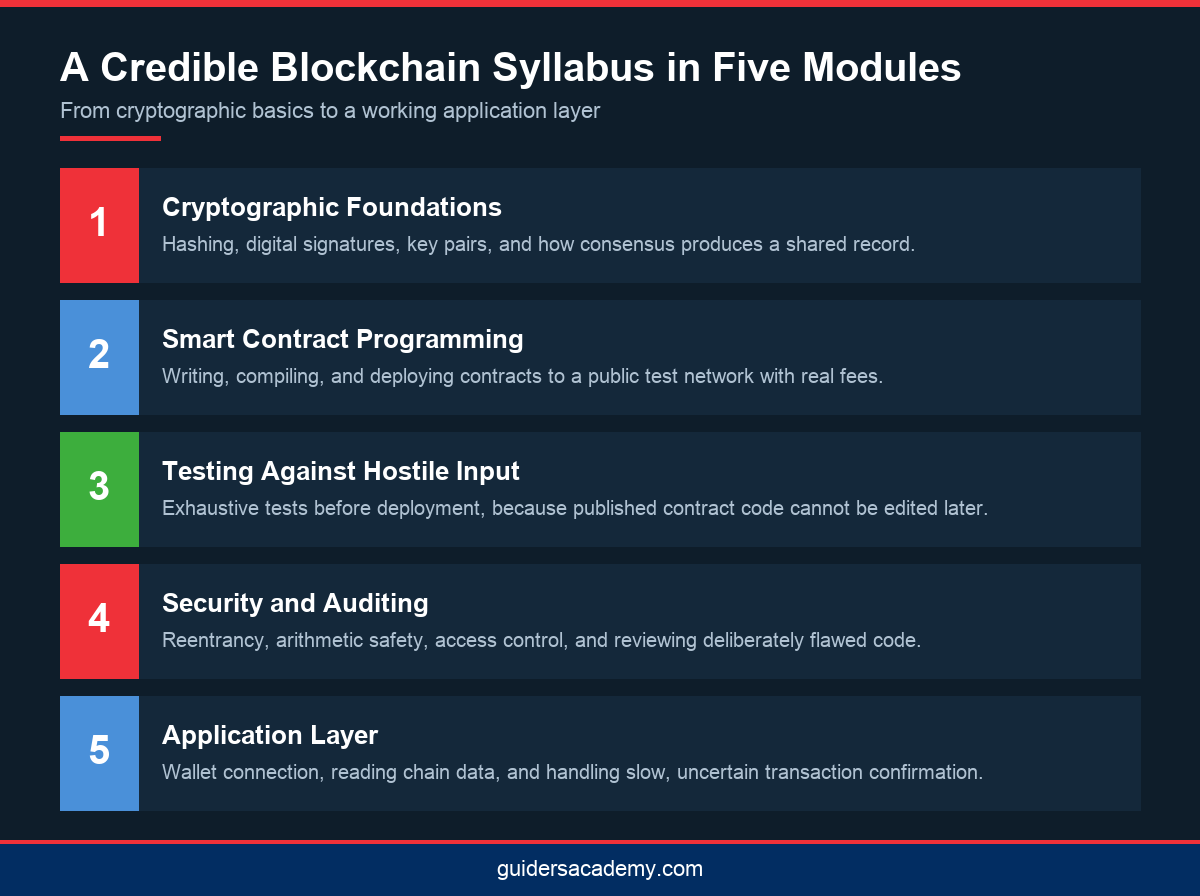
The course should open with the underlying concepts: hashing, digital signatures, public and private keys, and how consensus lets strangers agree on a shared record. Without these, later modules become instructions to memorise rather than a system a learner can reason about.
Smart contract programming follows. Learners should write, compile, and deploy contracts to a test network, understand how state is stored and how much it costs, and see for themselves what happens when a function is called by an address that should not have access.
Testing deserves far more time than most syllabuses give it. Because deployed code cannot be edited, a contract must be tested exhaustively before release, including deliberately hostile inputs and the sequences of calls that an attacker would try in the wild.
Security must be a dedicated module rather than a closing lecture. Reentrancy, integer handling, access control mistakes, and unsafe assumptions about external calls have each caused very large losses, and every one of them is a pattern a trained developer learns to recognise.
The application layer completes the picture. Connecting a web interface to a wallet, reading chain data, submitting transactions, and handling the long and uncertain confirmation times gracefully are what turn a contract into something an ordinary user can actually use. Teams also expect the general engineering habits listed in this skills checklist for developers.
Backend fundamentals still matter throughout. Most production systems keep a conventional server alongside the chain, so the skills from a structured backend training built on Spring Boot or an equivalent backend track remain directly relevant, and a course built on Node.js tooling will assume you already have them.
Where the Jobs Are and How Realistic They Are
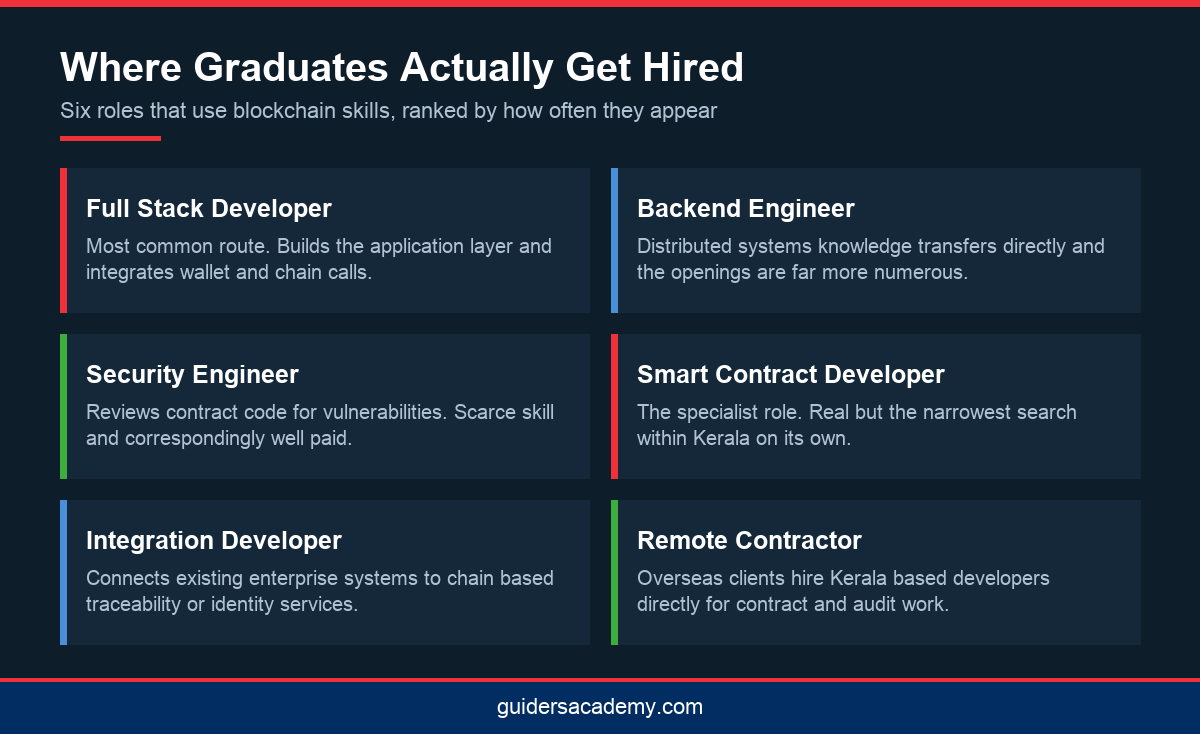
The honest position is that Kerala has a small number of blockchain specific openings compared with mainstream web and mobile roles. They exist, and some of them pay very well, but a graduate who can only write smart contracts will face a much narrower search than one who can also build ordinary applications competently.
Most local demand sits inside services companies delivering for overseas clients, plus a handful of product teams working on supply chain traceability, digital identity, and payment infrastructure. Remote roles for firms outside India widen the pool considerably for strong candidates.
Adjacent roles absorb many graduates. Backend engineers who understand distributed systems, security engineers who can read contract code, and full stack developers who can integrate a wallet flow are all hired more frequently than pure smart contract specialists.
That is why the sensible strategy is layered rather than exclusive. Build employable general skills first, then add blockchain as a specialisation, following the same logic as any sound developer roadmap from zero to a job.
Employers test this specialisation carefully. Interviews commonly involve reading an unfamiliar contract and identifying what could go wrong, which cannot be prepared for by memorisation and separates learners who practised from those who watched.
Compensation reflects scarcity when the skill is genuine. Developers who can show deployed contracts, a written audit of someone else's code, and a working application around both are in a much stronger position than the volume of course certificates would suggest.
How to Judge a Web3 Course Before You Enrol
Ask what learners deploy. A programme where every participant writes, tests, and deploys contracts to a public test network is teaching engineering. One where contracts are only demonstrated on screen is teaching a subject rather than a skill you can be paid for.
Ask how security is assessed. The strongest sign of a serious course is an exercise where learners are handed deliberately flawed code and asked to find the vulnerability, because that is very close to what the work actually involves day to day.
Check that the programme covers the surrounding application. A course that never connects a contract to a user interface has skipped the half of the job that most employers will hand to a junior developer during their first month on a team. Judging any programme starts with the same evidence set out in this guide to choosing a development course.
Be cautious about promises. Any institute quoting guaranteed salaries or presenting the field as a shortcut past general programming is selling enthusiasm rather than engineering. Ask instead for specific outcomes: what did last year's cohort actually build, and where are those graduates working now.
Confirm the prerequisites are honest. Learners who arrive without solid programming fundamentals struggle badly, so a course that admits anyone regardless of background is either teaching very little or will lose a large part of its cohort partway through.
Finally, look at the institution rather than the module list. Published accreditations, faculty with production experience, and a documented placement process are what convert a technical syllabus into a career outcome you can actually plan around over the next two or three years.
Conclusion
Web3 and blockchain development training in Kochi is worth pursuing if you approach it as a specialisation built on top of real engineering skill rather than as a way around it. Insist on deployed contracts, a genuine security module, and a working application layer, and keep your general development ability strong so that your job search is never limited to one narrow category of opening. To discuss how the specialisation fits alongside a full stack track, and what the realistic timeline looks like from your current level, speak to the Guiders Academy team about current batches.