From Zero to Job: Full Stack Developer Roadmap
 General
What Is Full Stack Development and Why It Matters in 2026
The tech industry is booming, and a full stack developer course is one of the most powerful ways to enter it. Whether you are a fresh 12th-grade graduate or someone looking to switch careers, web development offers tremendous opportunities in India and globally. But where do you begin? What tools do you learn first? How long does the journey take? This guide breaks down every phase of the full stack developer roadmap for beginners, from writing your very first line of code to confidently applying for your first developer job.
Key Takeaways
A full stack developer course teaches both front-end and back-end skills, making you a versatile hire in today's market.
Web development training follows a structured path: HTML/CSS, JavaScript, a back-end language, databases, and deployment.
Building real projects and a strong portfolio is what converts learning into employment.
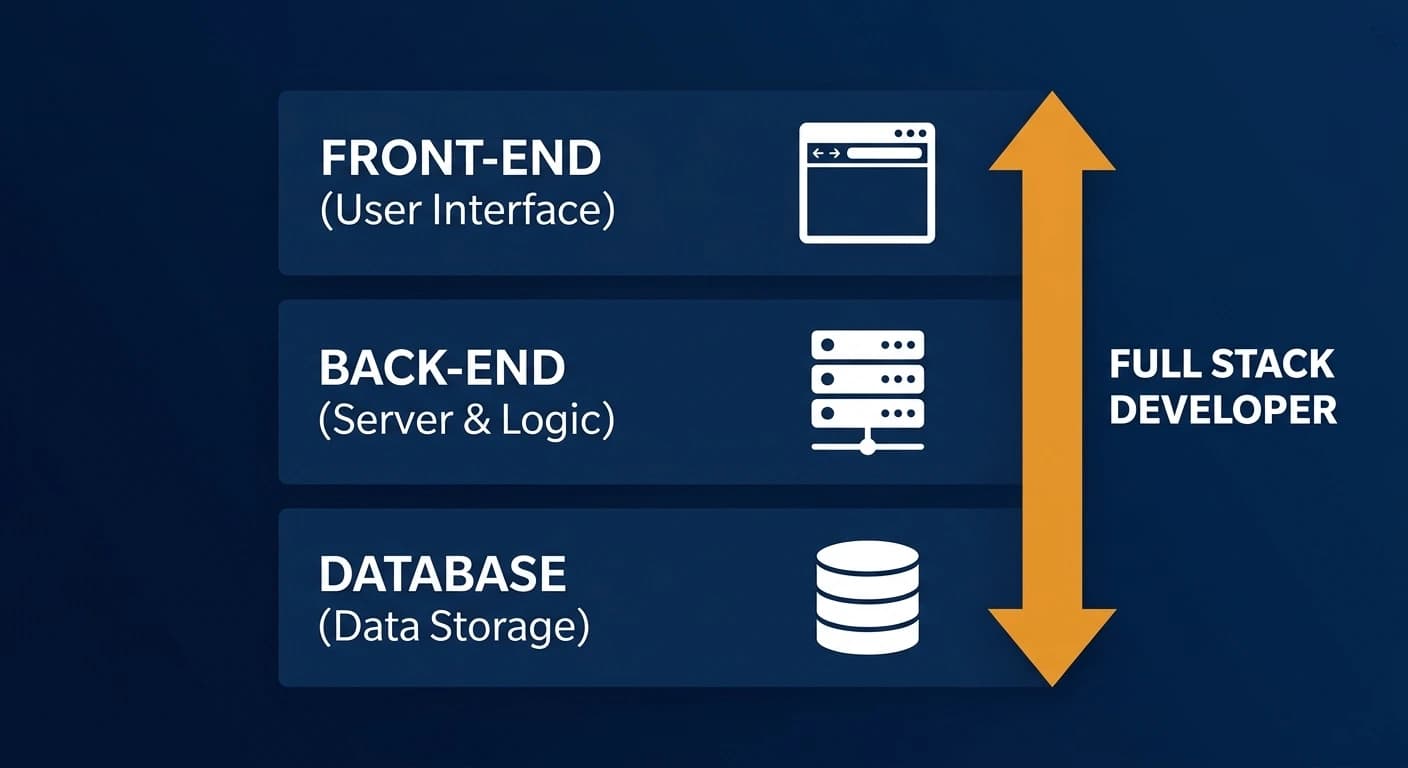
Full stack developers work on both the visible side of a website (what users see) and the server side (what powers it behind the scenes). This dual skill set makes them highly valuable. In 2026, India's tech industry employs over 5 million software professionals, and demand for full stack developers continues to grow year on year.
Companies ranging from startups to large enterprises prefer hiring full stack talent because a single developer can manage entire product cycles. For students exploring career-oriented programs, web development training bridges the gap between academics and industry employment. At Guiders Academy, career-focused programs are designed with exactly this employability goal in mind: combining technical training with practical readiness.
Full stack development is not just about coding. It involves understanding how systems communicate, how databases store data, and how applications are deployed on servers. When you learn all of these together, you become a professional who can contribute meaningfully from day one on the job.
Phase 1: Master the Front-End Foundations
The front end is what users interact with directly. It includes the layout, buttons, colors, and interactive elements on a webpage. Here is what beginners should focus on first:
HTML: The structure of every web page. Learn semantic tags, forms, and basic accessibility.
CSS: Styling and layout. Focus on Flexbox, Grid, and responsive design principles so your pages look great on mobile devices.
JavaScript: The language that adds interactivity. Start with variables, functions, and DOM manipulation before moving on to frameworks.
React or Vue.js: Once JavaScript basics are solid, pick one popular front-end framework. React is currently the most in-demand option.
Front-end skills alone can take three to five months to build at a focused pace. Practice by building small projects: a personal portfolio page, a calculator app, or a weather dashboard using a public API. The goal is to write code every single day, even if only for thirty minutes.
Phase 2: Build Your Back-End Skills
The back end handles business logic, user authentication, data processing, and communication with databases. This is where the real power of an application lives. Popular back-end technologies for beginners include:
Node.js with Express: JavaScript on the server side. Great choice if you already know JavaScript from front-end training.
Python with Django or Flask: Python is beginner-friendly, widely used, and a favorite in data-heavy applications.
PHP with Laravel: Still widely used for web applications and content management systems.
For a full stack developer course for beginners, Node.js is often recommended because it keeps the language consistent across both front-end and back-end development. Learn to build REST APIs, handle HTTP requests, and manage user sessions. Security fundamentals like input validation and authentication using JWT tokens are also essential at this stage.
Understanding how the front end communicates with the back end via APIs is the key milestone of this phase. When you can build a full login and registration system from scratch, you have genuinely crossed into intermediate territory.
Phase 3: Databases, Version Control, and DevOps Basics
No application survives without data management. Databases store everything from user profiles to product inventories. Databases to learn include SQL (MySQL or PostgreSQL) for relational data and MongoDB for flexible NoSQL storage that works particularly well with Node.js applications.
Version Control with Git: Git is non-negotiable. Employers expect every candidate to know how to commit code, manage branches, and collaborate using platforms like GitHub. Create a GitHub profile and push your projects there early in your journey.
Basic DevOps and Deployment: You should know how to deploy a project to a live server. Platforms like Vercel, Netlify, or Render make front-end and full stack deployment straightforward for beginners. Learning the basics of cloud platforms like AWS or Google Cloud is a bonus that strengthens your profile further. This phase rounds out your full stack skill set. By this point, you can build, connect, and deploy a complete web application independently.
Choosing the Right Full Stack Developer Course for Beginners
Not all learning paths are equal. The right course can cut your learning time significantly and give you industry-relevant skills faster. When evaluating a web development training program, look for a structured curriculum, project-based learning, mentor and peer support, and placement guidance.
Kerala has seen a significant rise in demand for tech-trained professionals, driven by the state's growing startup ecosystem and IT parks in Kochi and Thiruvananthapuram. Understanding how to choose a career-focused training program is the first step toward making a smart investment in your future. Whether you are in Kochi, Thrissur, or Ernakulam, accessible and quality training options exist for committed learners.
Building Your Portfolio and Landing Your First Developer Job
Your portfolio is your professional identity as a developer. It tells hiring managers what you can build, not just what you have studied. Include at least three to five completed projects with live links and GitHub repositories, a brief description of each project covering what it does and what technologies it uses, and a clean readable layout that itself demonstrates your front-end skills.
For job searching, apply to junior developer roles, freelance projects, and internships simultaneously. Join developer communities on LinkedIn, Discord, and local tech meetups in Kerala. Use job platforms like LinkedIn, Naukri, and Indeed with targeted keywords like "junior developer Kerala" or "web developer Kochi."
Guiders Academy's placement support framework provides students with career guidance and industry connections to ease the transition from training to employment. For those who have followed pioneering career paths in Kerala, the tech field continues to open new doors with the right training foundation.
Practical Training: Why Hands-On Learning Matters Most
Theoretical knowledge alone will not get you hired. Employers test candidates with live coding rounds, project reviews, and technical interviews. The only way to perform well in these is through consistent, practical training. During your web development training, simulate real working conditions. Set deadlines for your projects. Review others' code. Debug issues independently before seeking help. These habits build the problem-solving mindset that separates hired developers from those still searching.
Guiders Academy's commitment to practical, industry-aligned training reflects a philosophy that applies across all technical disciplines: structured hands-on learning accelerates both skill development and confidence. This principle is just as true in web development as it is in any other professional field.
Conclusion
The path from zero to a developer job is demanding but completely achievable with the right plan. A quality full stack developer course gives you a structured roadmap: front-end foundations, back-end logic, database management, version control, and portfolio building. Each phase builds on the last, and consistent daily practice is what converts learning into employable skill. Kerala's growing tech ecosystem offers real opportunities for trained developers, especially those who approach learning with discipline and curiosity.
Ready to start your journey? Contact Guiders Academy to learn more about professional training programs designed to help you build a rewarding tech career in Kerala and beyond.
Frequently Asked Questions
What does a full stack developer do?

What should a beginner learn first in a full stack developer course?
How long does it take to complete web development training?
Is a full stack developer course suitable for students after 12th grade?
What programming languages are used in full stack development?
Do I need a college degree to become a full stack developer?
What is the difference between front-end and full stack web development training?
How important is building a portfolio in a full stack developer course?
Can I find full stack developer jobs in Kerala after completing a course?
What tools should I know before applying for a developer job?