React Native Course in Kerala: Who Actually Hires For It
 General
A React Native course in Kerala teaches you to build apps that run on both Android and iOS from a single JavaScript codebase, which is why product teams across Kochi and Thrissur keep hiring for the skill. Instead of maintaining two separate native apps, one developer ships features to both platforms at once. This guide explains what React Native actually is, what a serious syllabus must cover, the roles it opens up, and the questions worth asking an institute before you pay a fee.
Key Takeaways
- React Native lets one JavaScript codebase serve both Android and iOS, which cuts build time and hiring cost for small product teams.
- A credible syllabus runs from JavaScript fundamentals through navigation, state, native modules, and a real release to both app stores.
- Kerala hiring for cross platform developers comes from product startups, IT services firms, and agencies serving overseas clients.
- Choose a course by the graduate projects it can show you, not by the tools listed on its brochure.
What React Native Is and Why Kerala Employers Ask for It
React Native is a framework that lets developers write mobile applications in JavaScript and React, then render them using genuine native interface components rather than a web view. The result behaves like a normal Android or iOS app because it is one, and users cannot tell the difference from a native build in everyday use.
The commercial argument is straightforward. A company that wants an app on both platforms would otherwise need Kotlin or Java skills for Android and Swift for iOS, which means two teams, two codebases, and two release cycles. React Native collapses that into a single team shipping to both stores from shared code.
For Kerala specifically, that economics matters more than it does in a large metro market. Most employers here are lean product startups, mid sized IT services firms, or agencies delivering for overseas clients, and very few can justify separate Android and iOS teams for a single product line at current budgets.
The framework also reuses knowledge that many learners already have. Anyone who has worked through React on the web already understands components, props, and state, so the jump to mobile becomes a matter of learning platform APIs rather than starting a new language from scratch this year.
That overlap is why React Native sits naturally alongside the rest of a full stack and mobile app development track. A learner who has already built a React interface for the browser can extend the same mental model to a phone screen without relearning fundamentals.
Employers read the skill as evidence of range. A candidate who can ship a working mobile app, connect it to an API, and explain why a particular navigation pattern was chosen is more useful to a small team than one who can only describe framework features in an interview setting.
What a Good React Native Course in Kerala Should Cover
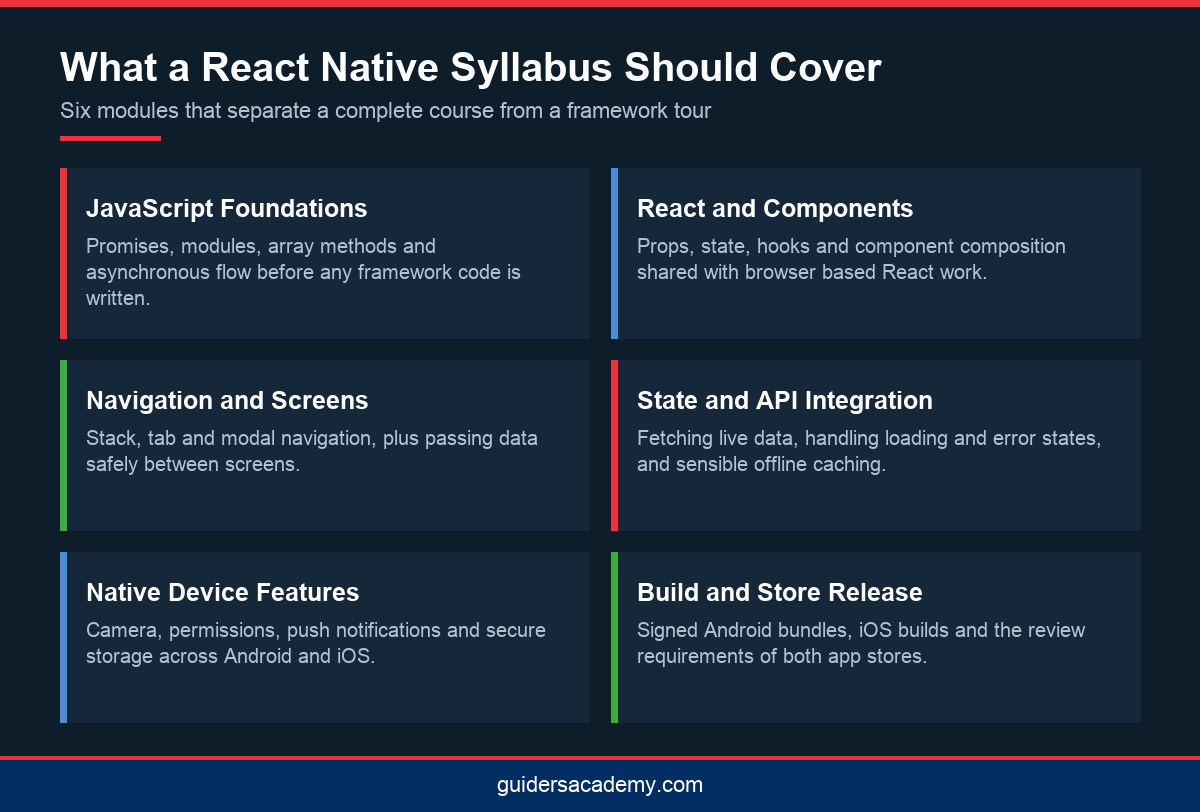
The syllabus should open with JavaScript itself, not with the framework. Learners who skip promises, array methods, destructuring, and modules end up copying patterns they cannot debug, and that gap shows up the first time an asynchronous call behaves unexpectedly inside a production screen.
From there the course moves into React fundamentals: components, props, state, and hooks. These are the same concepts used on the web, and a good programme makes the connection explicit so learners can move between browser and mobile work without treating them as unrelated skills. Anyone arriving from browser work covers this ground faster, which is why moving across from structured React training in Kochi is such a common route into mobile.
Navigation deserves its own module. Real applications have stacks, tabs, and modal screens, and passing data safely between them is where beginners most often get stuck. Any course that demonstrates only single screen examples has not prepared anyone for a real client brief or a first job.
State management and API integration come next. Learners should fetch data from a live backend, handle loading and error states properly, cache what makes sense offline, and understand why an app that assumes a perfect network fails badly on an ordinary Indian mobile connection.
Native modules and platform differences round out the technical syllabus. Camera access, push notifications, permissions, and secure storage all behave differently on Android and iOS, and a graduate who has never touched them will stall on the first feature request that leaves pure JavaScript.
Finally, the course must end in a release. Building a signed Android bundle, configuring an iOS build in Xcode, and walking through store review requirements are the steps that separate a tutorial follower from someone who has actually shipped software.
Career Paths and Hiring Demand for React Native Developers
The most common first role is mobile application developer, working on a product team that already has an app in the stores. The job usually mixes feature work with defect fixing, and early responsibilities tend to be screens and components rather than architecture decisions. Recruiters read that combination the way this piece on range against specialisation describes.
A second route is cross platform developer inside an IT services company, where the same person may move between two or three client apps in a year. This suits learners who want breadth quickly and are comfortable adapting to codebases written by someone else.
Many graduates also work as full stack developers who happen to own the mobile layer. Because React Native shares its language with Node.js backends, a learner who has already completed the JavaScript route through the same stack can credibly claim both ends of the stack.
Freelance and contract work is realistic in this niche, particularly for small business apps and internal tools. Clients in this bracket usually want one app on both platforms at a modest budget, which is precisely the problem React Native was built to solve for them.
Kochi carries most of the openings, with Thrissur and the surrounding districts contributing steady demand from services firms and smaller product companies. Candidates willing to consider remote roles for clients outside Kerala widen the pool considerably without relocating anywhere.
Pay tracks demonstrated delivery more than certificates. Developers who can point to a published app, explain the release process, and describe a performance problem they diagnosed move up faster than those whose portfolio stops at a course project screenshot.
How to Choose Between React Native and the Other Mobile Routes
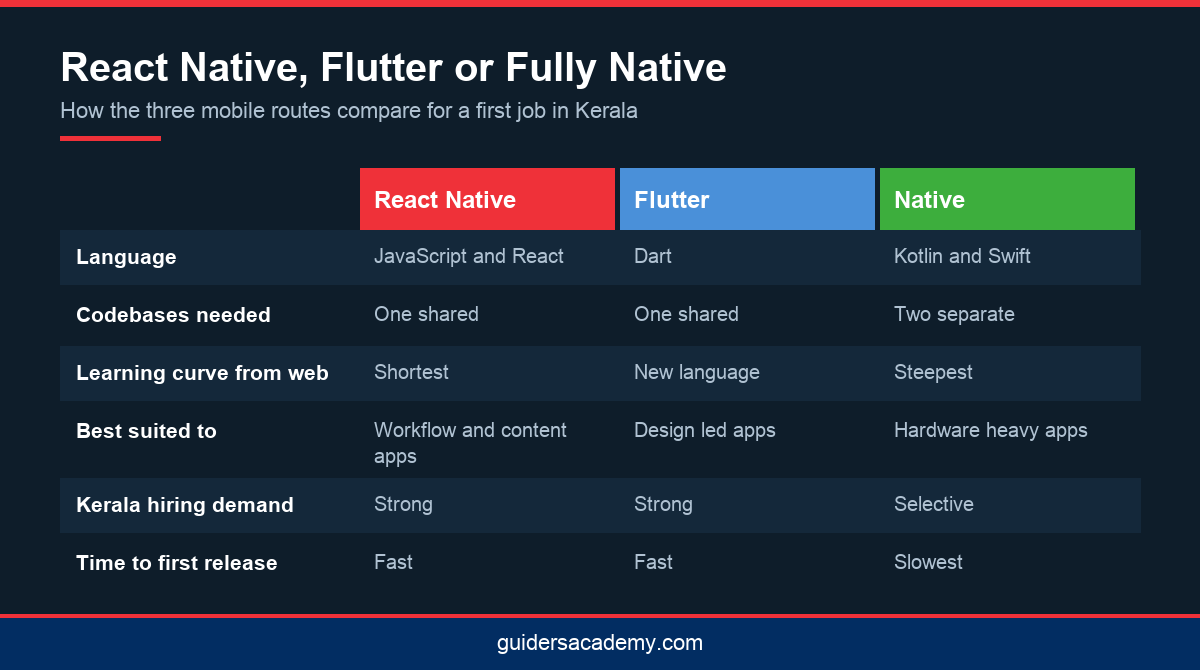
React Native is the strongest choice when a team already writes JavaScript, when the app is content and workflow driven rather than graphics heavy, and when time to market on both platforms matters more than squeezing out the last measure of native performance.
Flutter is the main alternative and uses Dart with its own rendering engine, which gives very consistent visuals across devices. It is a reasonable pick for design led apps, though it asks learners to take on a new language rather than build on existing web knowledge.
Fully native development in Swift or Kotlin still wins for applications that lean hard on device hardware, complex animation, or platform specific integrations. The cost is two codebases, which most Kerala employers only accept when the product genuinely requires it. If you are still judging how much time the wider route takes, this realistic timeline is a useful check.
Comparing these honestly is easier once you have seen how the wider decision plays out across web development and app development careers. The right answer depends on the kind of employer you want, not on which framework is trending.
When you evaluate the app development track at Guiders Education, ask to see applications built by recent learners and, where possible, installed on a phone. A course that can only show slides has not proved it can take anyone from JavaScript basics to a shipped build in either framework.
Ask about the support that follows the syllabus too. Structured placement support, mock interviews, and code review from someone who has worked in industry matter as much as module titles when you are trying to convert training into a first offer.
Conclusion
A React Native course in Kerala is one of the most practical routes into mobile development, provided the programme goes past component syntax and takes you through navigation, native modules, and a real store release. Look for graduate applications you can install, faculty who have shipped production software, and honest placement records rather than headline claims. If you already know some JavaScript, the distance to your first mobile role is shorter than you think. Speak to the Guiders Academy team about the app development track and current batch dates.