What a Logistics Graduate Actually Does All Day
 General
Descriptions of a logistics graduate career in Kerala usually list job titles and stop there. This piece follows an ordinary working day instead, hour by hour, because that is what actually tells you whether the work suits you. The account below is a composite drawn from the typical path graduates take through a freight forwarding or supply chain desk in Kochi. It covers what the mornings look like, where the pressure comes from, and the decisions that shape the following five years.
Key Takeaways
- The work is coordination under time pressure rather than warehouse labour, and most of it happens on a phone and a screen.
- Documentation accuracy carries real financial consequence, which is why employers value careful people over confident ones.
- The first year teaches operations, and the second year is where graduates choose a lane that shapes the rest of the career.
- Kochi's port and airport activity means the local market offers genuine variety without needing to relocate outside the state.
Morning: The Shift That Starts Before the Office Opens
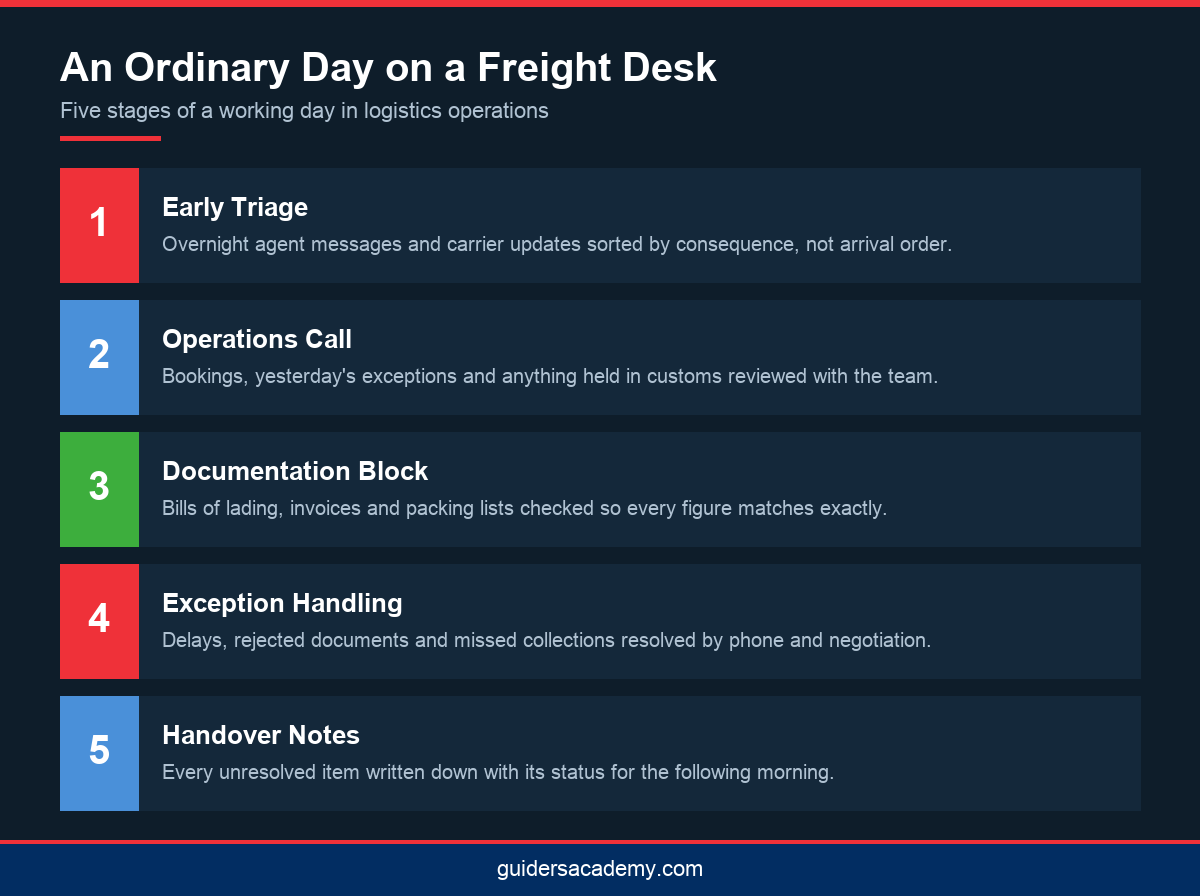
The day begins earlier than most office roles because shipping does not run on convenient hours. Overnight messages from overseas agents, carrier updates, and customer queries have accumulated, and the first task is triage rather than anything planned.
Priorities emerge quickly from that pile. A container that missed a vessel connection outranks a routine rate enquiry, and learning to sort by consequence rather than by arrival order is one of the first skills a new graduate develops.
The morning call with the operations team follows. Bookings for the day, exceptions from yesterday, and anything stuck in customs are reviewed, and a new graduate spends the first weeks mostly listening and taking notes on unfamiliar terminology.
Documentation work then occupies a large part of the morning. Bills of lading, invoices, packing lists, and certificates each have to match one another exactly, because a single inconsistency can hold a shipment at a border for days.
That accuracy requirement surprises graduates who expected a people facing role. The job involves constant communication, but the underlying discipline is precision, and employers notice within weeks which new joiners can be trusted with paperwork.
Customs and regulatory processes are increasingly digital, and familiarity with portals including GST filing systems is now assumed rather than taught on the job, which is a change from a few years ago.
By late morning the shape of the day is set. The graduate who prepared well is executing a plan, and the one who did not is reacting to whichever customer called most recently, which is an exhausting way to work. Documentation work of this kind is one reason the role of transportation in the supply chain is worth understanding early.
Afternoon: Where the Pressure Actually Comes From
The afternoon brings the exceptions, and exceptions are the job. A delayed vessel, a rejected document, a customer changing a delivery address, or a truck that has not arrived at the warehouse each require a decision and a phone call.
Cost sits behind every one of those decisions. Detention and demurrage charges accumulate daily, so a delay that is resolved in four hours rather than two days is a measurable financial outcome rather than merely a tidier outcome.
This is where new graduates learn that logistics is a negotiation business. Carriers, agents, transporters, and customs brokers all have their own constraints, and getting a shipment moving usually means persuading someone rather than instructing them.
Communication style matters more than people expect. The person who is calm, specific, and consistently accurate gets faster responses from agents than the one who escalates loudly, and that reputation compounds over months in a small market.
Perishable cargo raises the stakes considerably. Kerala's spice, seafood, and horticultural exports have narrow time windows, and coordination failures translate directly into spoiled consignments rather than into an inconvenient rescheduling.
The variety is genuine, which is what most graduates report enjoying. The career opportunities in logistics span freight forwarding, warehousing, customs clearance, and transport coordination, and a single desk can touch several of them.
By the end of the afternoon the exceptions are either resolved or documented for the following morning, and the discipline of writing down where each one stands is what separates a manageable week from a chaotic one.
Language is quietly useful here as well. A large share of agents and counterparts across the Gulf and Southeast Asia work in English, but the ability to switch into Malayalam with a local transporter and back again within the same hour is an everyday part of the job in Kochi. Port-side coordination has its own career track, described in this outline of what a port manager does.
The First Year: What Gets Learned and What Gets Tested
The first three months are mostly vocabulary and process. Incoterms, document types, carrier procedures, and the internal system all have to become automatic before anyone can think strategically about a shipment or a customer relationship.
Months four to eight bring ownership of small accounts. This is where a graduate discovers whether they enjoy the responsibility, because a customer's shipment becoming your problem at nine in the evening is not a hypothetical situation.
Mistakes happen and they are instructive. A wrongly declared weight, a missed cut off, or a document sent to the wrong party each carry consequences, and the graduates who own the error and fix it are the ones who get promoted.
By the end of the first year most people have found their preference. Some enjoy customer facing coordination, others prefer documentation and compliance, and a third group is drawn to the analytical side of route and cost planning.
That preference matters because it determines the next move. The range of jobs available after a logistics course is wider than most graduates realise on their first day at a desk.
Employers assess reliability far more than brilliance in this first year. Turning up, following through, and flagging a problem early are the behaviours that get someone considered for a supervisory role within two or three years.
The sector context helps explain why demand holds up. Analysis published by IBEF tracks the expansion of Indian logistics capacity, and Kerala's port and airport activity keeps local hiring reasonably steady alongside it.
Year Two Onward: Choosing a Lane
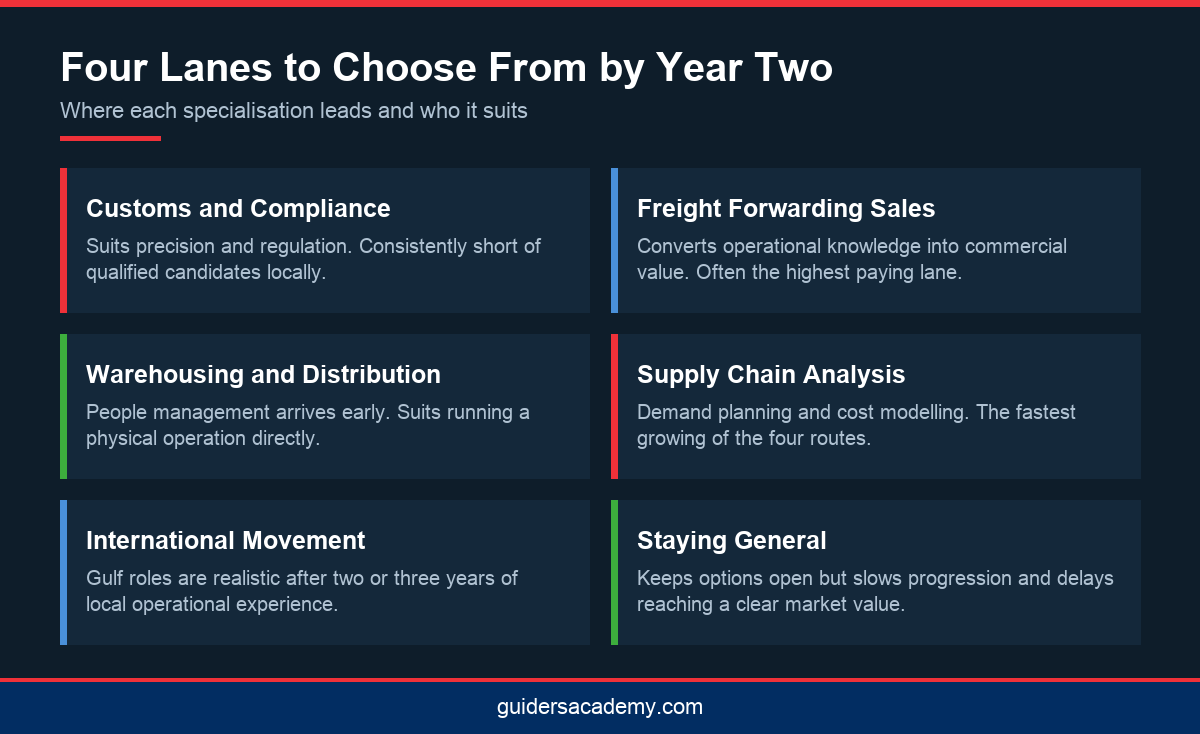
The second year is where a career takes shape. Staying general keeps options open but slows progression, while committing to a specialism produces faster advancement and a clearer market value within a fairly short period.
Customs and compliance is one lane. It suits people who like precision and regulation, it is consistently short of qualified candidates, and it travels well because the underlying knowledge applies across employers and cargo types.
Freight forwarding sales is another and it pays differently. It suits people who enjoy customer relationships and negotiation, and it converts operational knowledge into commercial value, which is why many operations staff eventually move across.
Warehousing and distribution management is a third. It involves people management earlier than the other routes, and it appeals to graduates who prefer running a physical operation to coordinating one from a desk.
Supply chain analysis is the fourth and the most recently established. Demand planning, route optimisation, and cost modelling reward comfort with data, and this lane is growing faster than the traditional operational routes in most organisations.
International movement remains an option throughout. The logistics programme at Guiders Education frequently leads to Gulf roles, because the operational knowledge transfers and the recruitment channels are already established.
Whichever lane is chosen, the pattern is consistent. Graduates who reach a supervisory position within four years almost always did so by becoming genuinely reliable first and specialising second, rather than the other way round. Choosing a lane is easier after reading this look at the fastest-growing careers in the state.
Conclusion
A logistics graduate career in Kerala is a coordination job with financial consequences attached, and the day looks nothing like the warehouse imagery the industry is usually illustrated with. Expect early mornings, constant exceptions, and documentation that has to be exact. Expect also genuine variety, a market that hires steadily because of the state's port and airport activity, and four distinct lanes to choose from by year two. To discuss which logistics programme fits your goals, contact the Guiders Academy team.
Frequently Asked Questions
What does a logistics graduate career in Kerala involve day to day?

Is logistics work physically demanding?
Why does documentation accuracy matter so much?
What are the realistic entry level roles?
How quickly can I move into a supervisory role?
Which specialisation pays best?
Does Kerala offer enough variety without relocating?
Are Gulf logistics jobs realistic from Kerala?
What should I focus on during the course itself?