Voice Search SEO Training in Kerala: The Missing Skill
 General
Voice search SEO training in Kerala sits at an awkward point: everyone agrees it matters, very few institutes teach it as a distinct discipline, and the search landscape it addresses has changed again since most syllabuses were written. Spoken queries behave differently from typed ones, and AI answer engines increasingly resolve a question without sending anyone to a website at all. This guide explains what answer engine optimisation actually involves, what a serious module should cover, and which parts of it employers in Kochi are willing to pay for.
Key Takeaways
- Spoken queries are longer, more conversational and far more local, which changes both the phrases you target and how a page is written.
- Answer engine optimisation aims to be quoted inside an AI answer rather than simply ranked in a list of blue links.
- Structured data, clear question and answer formatting, and verifiable factual statements do most of the work in this discipline.
- The skill is scarce enough locally that adding it to an SEO profile is a genuine differentiator at interview stage.
How Voice and AI Answers Changed Search Behaviour
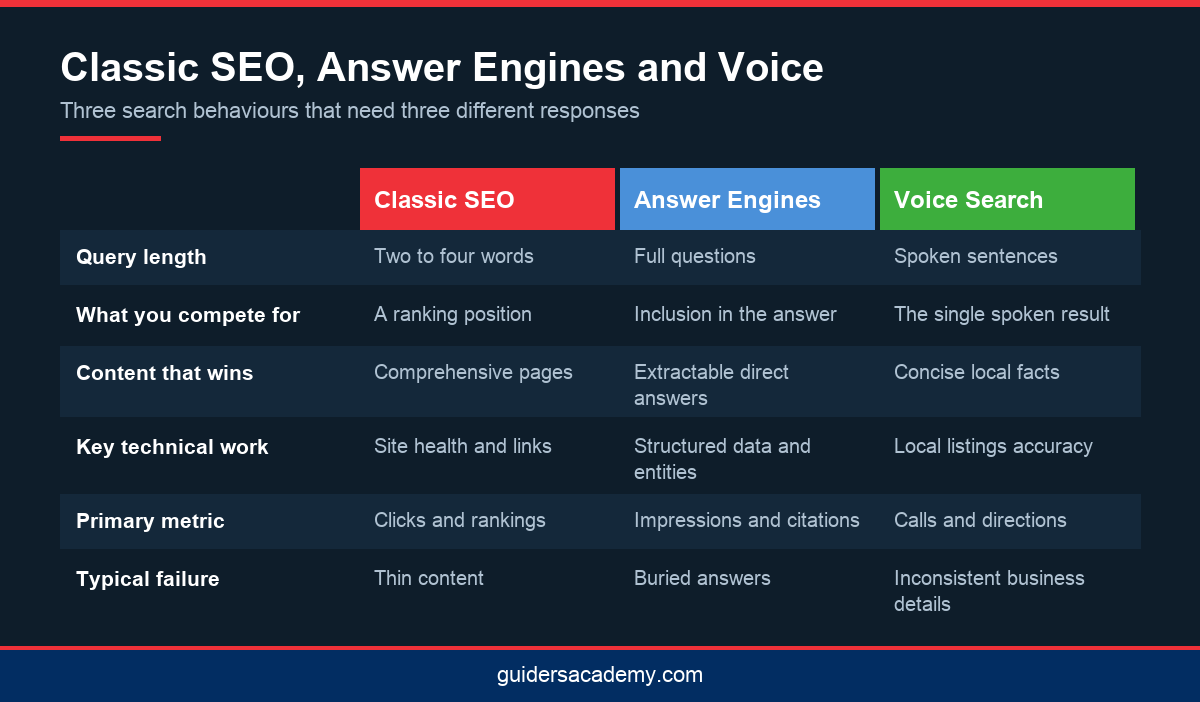
A typed query is terse because typing is effort. A spoken query is a sentence, because speaking is not. That single difference reshapes keyword research: the phrases people actually say are longer, contain question words, and read like something one person would ask another.
Spoken searches also skew heavily local and immediate. People ask for opening hours, directions, availability, and prices while they are already moving, which means the answer has to be present, accurate, and easy for a machine to extract from your page.
Alongside this, AI generated answers now sit above the results on many queries. The engine reads several sources, synthesises a response, and cites a few of them, so the competition is no longer for a ranking position but for inclusion in the answer itself.
That has an uncomfortable consequence. A page can be genuinely useful, be read by the model, contribute to the answer, and receive no visit at all. Marketers who measure only sessions will conclude that their work stopped working when the opposite is true. The shift is part of the broader change described in this look at where AI is taking marketing work.
The response is not to abandon search fundamentals. The Google search documentation still describes what makes a site eligible in the first place, and a site that fails those basics will not be quoted by anything.
What changes is the layer built on top. Content has to be structured so that a specific answer can be lifted out cleanly, attributed to a credible source, and repeated by a machine without distortion, which is a writing discipline as much as a technical one.
What Voice Search and AEO Training Should Cover
The module should begin with query research done properly. Learners need to gather the actual questions people ask, from search suggestions, from customer service logs, and from sales conversations, rather than inventing conversational phrases that nobody uses in practice.
Content structure comes next. A page that answers a question in the first two sentences, then supports the answer with detail, performs far better in extraction than one that builds slowly to a conclusion in the way a traditional article does.
Structured data deserves hands on work. Marking up frequently asked questions, organisations, people, products, and locations gives an engine explicit facts to work with, and the FAQ structured data guidance sets out how the markup is expected to behave.
Local signals matter disproportionately for spoken queries. Consistent business information, accurate opening hours, correct categories, and genuine reviews determine whether a Kerala business is offered as the answer when someone asks for a service nearby.
Measurement needs its own session. Because a quoted answer may generate no click, learners should track impressions, brand searches, direct traffic, and assisted conversions rather than judging the work by session count alone and concluding it failed. Structured data work overlaps with front-end skill, which is why some marketers pick up the basics through a web and app development track.
Finally, testing. Learners should ask the same question of several assistants and AI tools, record which sources are cited, and work out why. That exercise teaches more about answer engine behaviour than any amount of theory delivered from slides.
Regional language queries deserve a mention too. A growing share of spoken search in Kerala happens in Malayalam, and marketers who understand how transliteration, place names and mixed language phrasing behave in search have an advantage that very few competitors currently hold.
The Skills That Make You Hireable in This Niche
Employers do not usually advertise for a voice search specialist. They advertise for an SEO executive and then ask, during the interview, how the candidate would handle AI answers and zero click results. Being able to answer that clearly is the practical advantage.
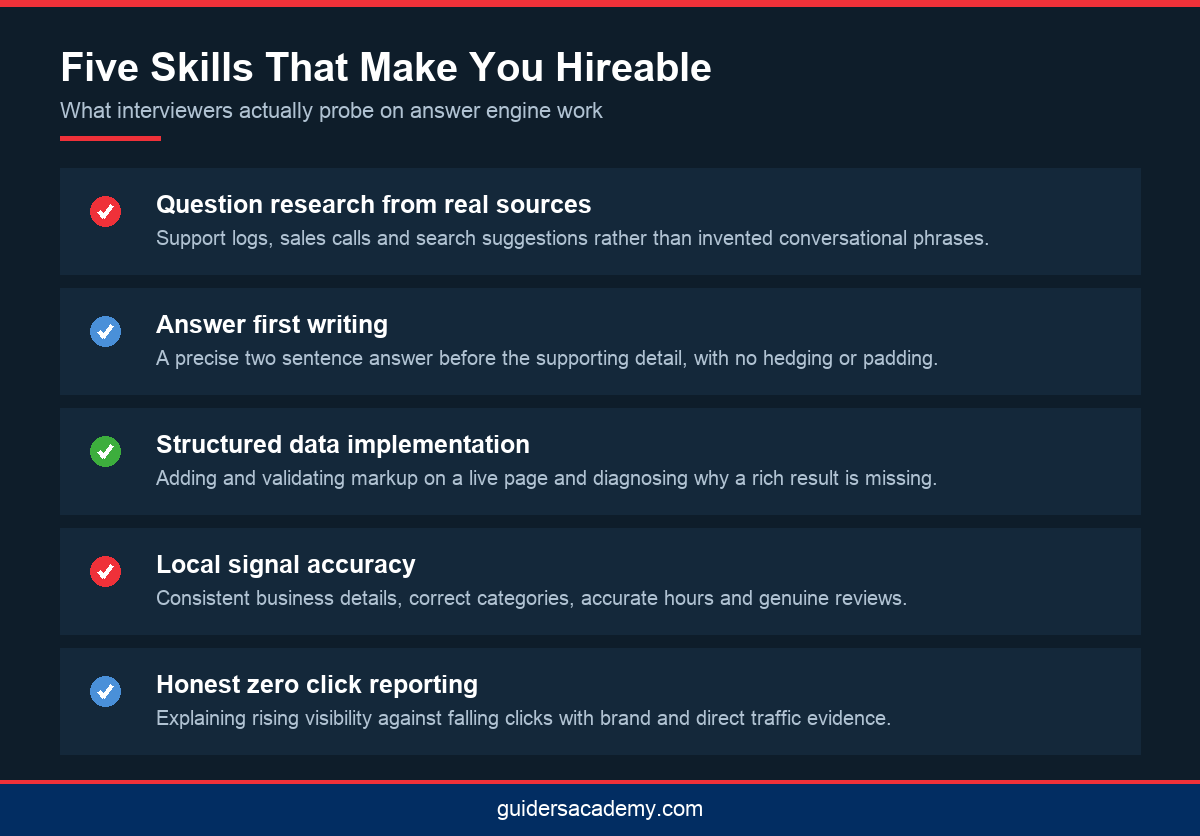
Writing is the core skill and the one most often underestimated. Producing a crisp, factually precise answer in two sentences, without hedging or padding, is harder than it sounds and is exactly what an extraction friendly page requires throughout.
Technical comfort is the second requirement. You need to implement schema markup without breaking a page, validate it, and diagnose why a rich result is not appearing, which means reading documentation rather than relying on a plugin to make decisions for you.
Research discipline is the third. Real question sets come from real customers, and marketers who build them from actual conversations consistently outperform those who generate a list of conversational phrases from a keyword tool and stop there.
Reporting honestly is what keeps a client. Explaining why traffic can fall while visibility rises, and showing the supporting brand and direct signals, is a conversation that requires evidence, and the ability to hold it separates a professional from a technician. Career-wise it sits alongside the roles mapped in AI against digital marketing jobs.
For anyone building this alongside broader skills, the wider digital marketing career guide for Kerala sets out where the specialism fits within a full marketing role rather than as a standalone job title.
Choosing a Course and What to Expect Afterwards
Very few institutes teach this as a dedicated subject, so the realistic question is whether an SEO or digital marketing programme covers it seriously inside its syllabus. Ask directly whether learners implement schema markup and test AI answers on live pages.
Beware of courses that treat the topic as a single lecture on future trends. Answer engines are a present reality with practical techniques attached, and a module that only describes the change without teaching the response has not prepared anyone to do the work.
Look for live site access. Implementing structured data on a real page, watching it validate, and then seeing whether the page gets cited is a completely different learning experience from reviewing a screenshot of somebody else's markup.
Ask what tools learners use for measurement. Search console data, brand query tracking, and manual answer engine checks are all necessary, and a course that reports only on sessions has not understood the measurement problem it is meant to solve.
Consider how the specialism combines with others. The digital marketing programme at Guiders Education is most valuable when it sits on top of solid organic search skills rather than replacing them with a narrower focus.
Finally, check the outcome. Ask where recent learners are working, what they were hired to do, and whether the institute can point to a documented placement record rather than a general claim about industry demand. If you are still weighing formats, this assessment of studying online is worth reading first.
Be realistic about the timeline as well. This is a compounding discipline where results appear over months rather than weeks, so any programme promising rapid visibility gains from structured data alone is describing something that does not happen in practice.
Conclusion
Voice search SEO training in Kerala is worth seeking out because the discipline is real, the techniques are learnable, and the local supply of people who can do it well is still thin. Focus on question research from genuine sources, content written for clean extraction, structured data implemented on live pages, and measurement that does not collapse when clicks fall. Build it on top of solid organic search skills rather than instead of them. To discuss how the module fits inside the wider marketing programme, speak to the Guiders Academy team.