MEAN Stack Developer Course in Thrissur: A Guide
 General
A MEAN stack developer course in Thrissur opens a path into enterprise style JavaScript development without needing to relocate to Kochi first. MEAN, which stands for MongoDB, Express, Angular and Node.js, is the more structured cousin of the popular MERN stack, and it is still actively used by teams that want Angular's built in discipline on the frontend. This guide explains what MEAN actually is, what a course should cover, what it pays, and where MEAN developers based in Thrissur find work.
Key Takeaways
- MEAN swaps React for Angular on the frontend, giving developers a more structured, opinionated framework favored by some enterprise teams.
- A solid MEAN course should cover TypeScript and Angular fundamentals alongside Node.js, Express and MongoDB, finishing in a full deployed project.
- Thrissur based developers can work remotely for enterprise teams or commute into Kochi's IT corridor, so location does not limit MEAN career options.
What the MEAN Stack Actually Is
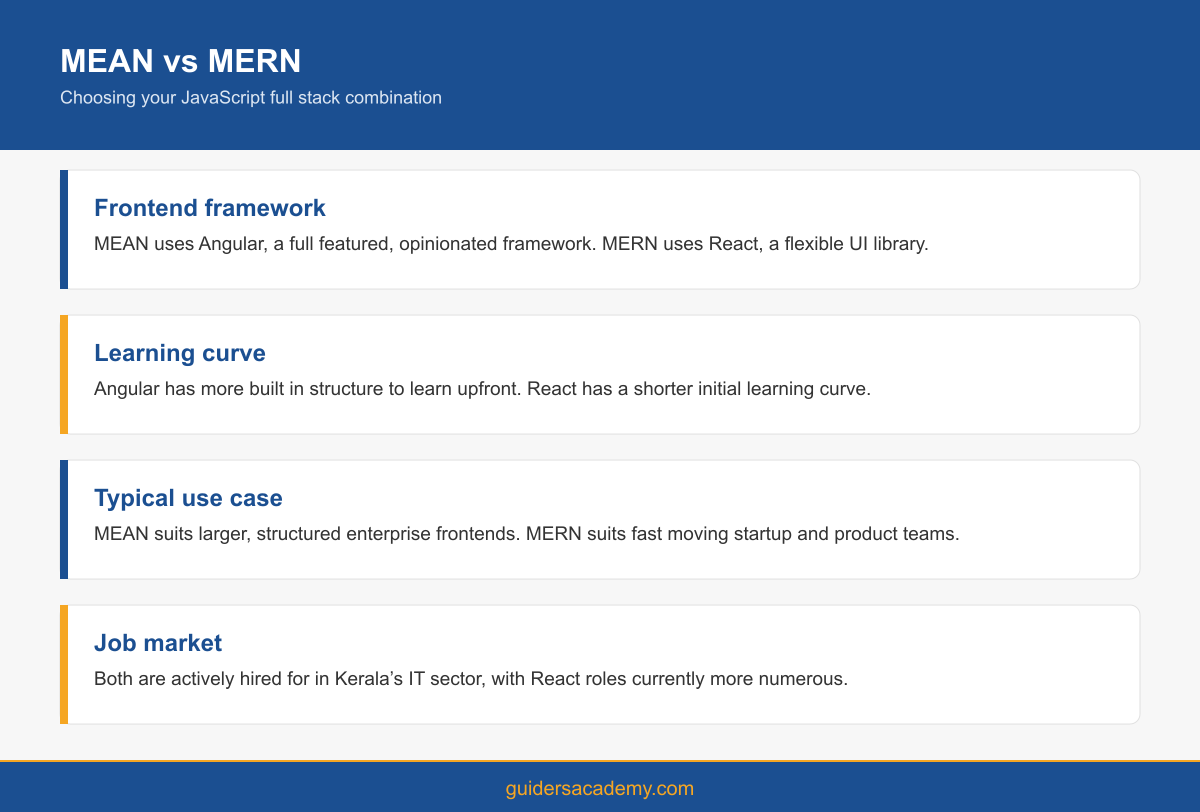
MEAN stands for MongoDB, Express, Angular and Node.js. It shares three of its four layers with the more commonly discussed MERN stack, the difference being the frontend framework. Where MERN uses React, MEAN uses Angular, a complete framework maintained by Google that comes with routing, forms handling and dependency injection built in, rather than assembled from separate libraries.
That built in structure is exactly what some enterprise teams prefer, since it enforces consistency across large codebases with many contributors, which matters more as an application and its team grow.
Because Angular ships as a complete, opinionated framework rather than a flexible library, teams that adopt it tend to spend less time debating architecture decisions internally, since Angular's conventions largely settle those questions before a project even starts.
What a MEAN Stack Course Should Cover
A MEAN course should start with JavaScript and TypeScript fundamentals, since Angular is built around TypeScript rather than plain JavaScript. From there, it should cover Angular's component and module system, then move to the backend with Node.js and Express, and finish with MongoDB for data storage.
As with any full stack program, the course should end in a real deployed project connecting all four layers, not isolated exercises. Guiders structures its web development courses in Thrissur around this same live project approach, regardless of which specific stack a student chooses.
Salary Expectations for MEAN Developers in Kerala
MEAN developers in Kerala generally earn in a comparable band to MERN developers at the entry level, since three of the four technologies overlap directly and hiring managers weigh full stack competence more than the specific frontend framework listed on a resume.
Where MEAN developers sometimes earn a premium is at enterprise and government adjacent organizations that have standardized on Angular for internal or regulated systems, since those teams often struggle to find developers already comfortable with Angular's stricter structure and are willing to pay for it.
As with most full stack roles, pay grows fastest for developers who can also handle basic deployment and cloud hosting tasks rather than relying entirely on a separate operations team.
Career Paths for MEAN Developers From Thrissur
Being based in Thrissur does not limit MEAN career options the way it might have a decade ago. Many enterprise teams that use Angular hire remotely, and Thrissur's growing IT presence means local companies are also building Angular based products. For developers open to commuting or relocating, Kochi's Infopark corridor adds another layer of opportunity.
The broader full stack developer roadmap that applies to MERN developers applies just as directly to MEAN developers, since the underlying skills, comfortable full stack problem solving, transfer regardless of which specific frontend framework a job posting asks for.
MEAN Skills That Transfer Beyond Angular
Even for students who eventually move away from Angular specifically, MEAN training builds transferable strengths: comfort with strongly typed code through TypeScript, a habit of structuring applications around modules and services rather than loose scripts, and solid Node.js and MongoDB experience that carries directly into MERN or any other JavaScript backend work.
This is one reason MEAN remains a reasonable starting point even outside Angular specific job listings. A developer who has built a disciplined, modular Angular application generally adapts faster to a new frontend framework later than one who has only worked in a more permissive, loosely structured codebase.
How to Choose a MEAN Stack Training Program
Since Angular has a steeper initial learning curve than React, look for a course that gives TypeScript and Angular fundamentals real time before rushing into building features. Confirm the program includes placement support and has placed students into roles that specifically use Angular, not just generic frontend positions.
A smaller batch size matters even more with Angular, since its structure has more concepts to absorb early on, and hands on mentoring during that stage makes the difference between finishing the course confident or finishing it confused.
Conclusion
A MEAN stack developer course in Thrissur is a realistic path into structured, enterprise style JavaScript development, whether you plan to work remotely or eventually move toward Kochi's IT corridor. Angular's discipline suits developers who want more built in structure than React offers, and that preference alone can shape a strong career direction.
To learn how Guiders structures its MEAN and MERN training, get in touch, or read more on our blog about choosing the right stack for your goals.
Frequently Asked Questions
What does MEAN stand for in a MEAN stack developer course?

How is MEAN different from MERN?
Do I need to know TypeScript before starting a MEAN course?
Can I work as a MEAN developer while based in Thrissur?
Is Angular harder to learn than React?
What jobs can I get after a MEAN stack course?
Does Guiders Academy offer placement support for MEAN graduates?
Is MEAN stack still in demand in 2026?
Can I learn both MEAN and MERN?
Where can I learn more about Guiders Academy as an institute?