Kerala Logistics Industry 2026: Which Jobs Are Growing
 General
Assessments of the Kerala logistics industry 2026 tend to arrive in two flavours: uncritical optimism about infrastructure, or vague pessimism about competition from neighbouring states. Neither helps someone deciding whether to train for this sector. This piece works through what is actually driving demand here, which categories of role are growing against those that are flat, the technology genuinely changing daily work, and the specific skills that decide who gets promoted. Where figures are not verifiable, that is stated rather than estimated.
Key Takeaways
- Kerala's logistics demand is anchored in perishable exports, port and airport capacity, and a high volume consumer import base.
- Cold chain, last mile distribution, customs compliance and supply chain analysis are the categories growing fastest into 2026.
- Digitisation has moved the work toward systems literacy, so comfort with portals and platforms now outranks manual process knowledge.
- Promotion in this sector follows documentation accuracy, systems skill and a chosen specialism rather than years of general service.
What Actually Drives Logistics Demand in Kerala
The state's logistics profile is shaped by what it sends out and what it brings in. Spices, seafood, coir, rubber, and horticultural produce move outward, while a consumer base with high per capita spending pulls a substantial volume of goods inward.
That export mix is unusually perishable. Time sensitive cargo requires cold chain handling, tight documentation, and coordination between road, air, and sea legs, which raises the skill requirement compared with general dry cargo movement.
Port and airport capacity anchors the sector. Container handling through Kerala ports and air cargo through the state's airports generate the freight forwarding, customs clearance, and warehousing activity that most graduates enter.
Inland movement matters as much as the gateways. Road freight connects producers in the interior to the ports, and coordination across that leg is where a large share of delays and costs actually originate in practice.
Policy direction is visible at national level, with the Ministry of Commerce and Industry driving logistics cost reduction and multimodal integration, which flows through to state level infrastructure and process changes.
Sector analysis from IBEF tracks the broader expansion of Indian logistics capacity, and Kerala participates in that as a specialised export gateway rather than as a bulk manufacturing corridor.
The practical implication for anyone entering the logistics programme at Guiders Education is that specialisation in time sensitive and export oriented handling is more valuable here than generic warehousing knowledge.
Neighbouring state competition is real but often overstated. Cargo does move through Tamil Nadu and Karnataka gateways when transit economics favour it, yet the perishable and time critical share stays close to origin, which is precisely the segment Kerala training is best positioned to serve. Online retail is one of the clearest drivers, and this analysis of e-commerce and supply chains traces the effect.
Which Roles Are Growing and Which Are Flat
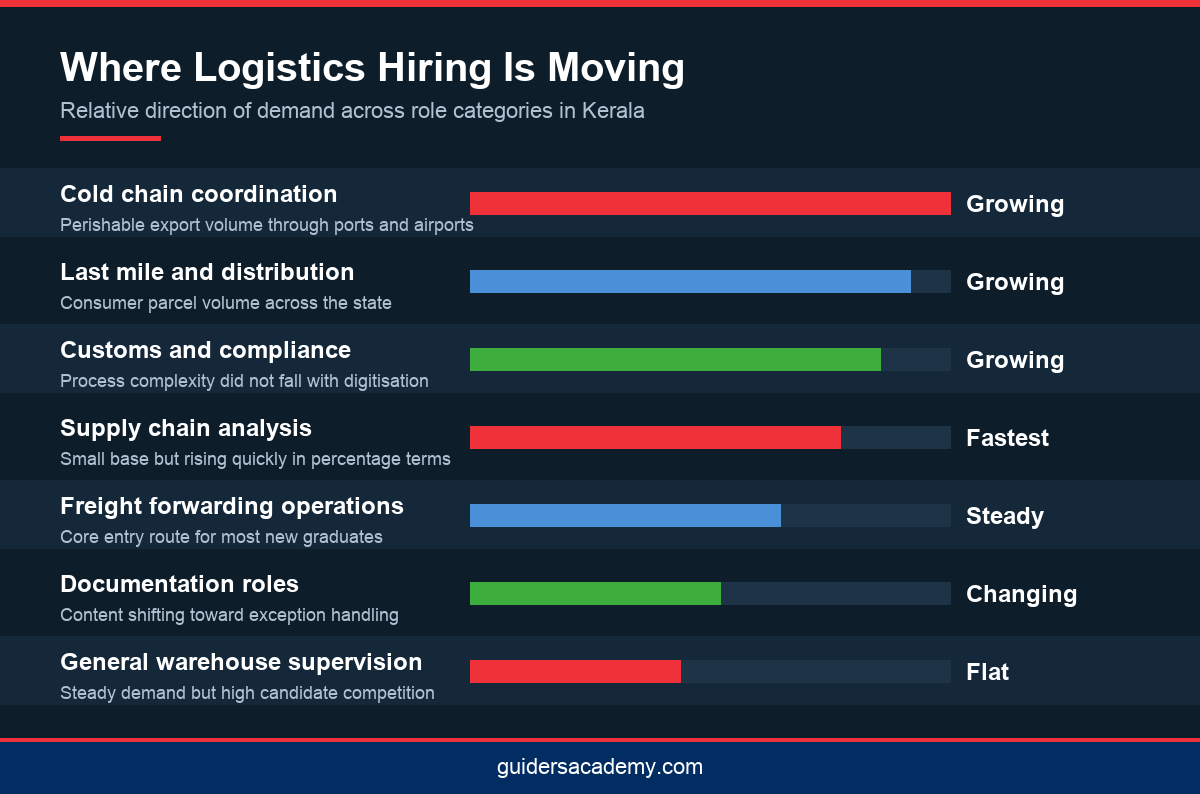
Cold chain coordination is the clearest growth category. Perishable export volume requires people who understand temperature integrity, transit windows, and the documentation that accompanies regulated food and agricultural consignments.
Last mile and distribution management has expanded rapidly alongside consumer commerce. The volume of parcels moving to households across the state has created supervisory and route planning roles that barely existed a decade ago.
Customs and regulatory compliance continues to grow because process complexity has not reduced despite digitisation. Candidates who genuinely understand classification, valuation, and documentation remain persistently scarce relative to demand.
Supply chain analysis is the fastest growing category in percentage terms even though the absolute numbers are still modest. Demand planning, cost modelling, and route optimisation reward people comfortable working with data rather than only with processes.
Traditional documentation roles are flat rather than declining. Automation has absorbed some routine work, but exception handling still requires judgement, so the roles are changing in content more than they are disappearing from the market.
General warehouse supervision is also broadly flat. Demand is steady, competition for these positions is high, and progression tends to be slower than in the specialised categories that fewer candidates deliberately target.
The wider picture of global trends affecting the logistics industry explains why these categories are moving in different directions rather than rising uniformly together.
Reverse logistics is worth watching as a smaller emerging category. Returns handling, repair routing, and recycling flows are becoming a defined function inside larger distribution operations rather than an afterthought handled by whoever has capacity that week. Warehouse roles in particular are changing, as this piece on sustainable warehouse management describes.
The Technology That Changed Daily Work
Customs and tax processes are now largely digital. Familiarity with the GST portal and related filing systems is assumed rather than taught on the job, and candidates without it start noticeably behind their peers.
Transport and warehouse management systems have become standard even at mid sized operators. Learning one properly transfers reasonably well to others, and the ability to work confidently inside a system is now a hiring criterion.
Track and trace visibility has changed customer expectations permanently. Clients expect status information without asking for it, which shifts the coordinator role from reactive reporting toward proactive exception management throughout the day.
Data handling has quietly become a core skill. Spreadsheets full of shipment, cost, and transit data are the raw material of most improvement work, and comfort with them separates candidates far more than employers advertise.
Automated documentation reduces routine typing but raises the consequence of errors, because a mistake propagates across several documents instantly rather than being caught during manual re entry as it once might have been.
Predictive and planning tools are arriving gradually rather than transforming the sector overnight. Their practical effect so far is to raise the value of people who can question an output rather than accept it uncritically.
The trajectory of these changes is set out in this overview of innovations in logistics and transportation, which covers the direction rather than the daily detail.
The Skills That Decide Who Gets Promoted
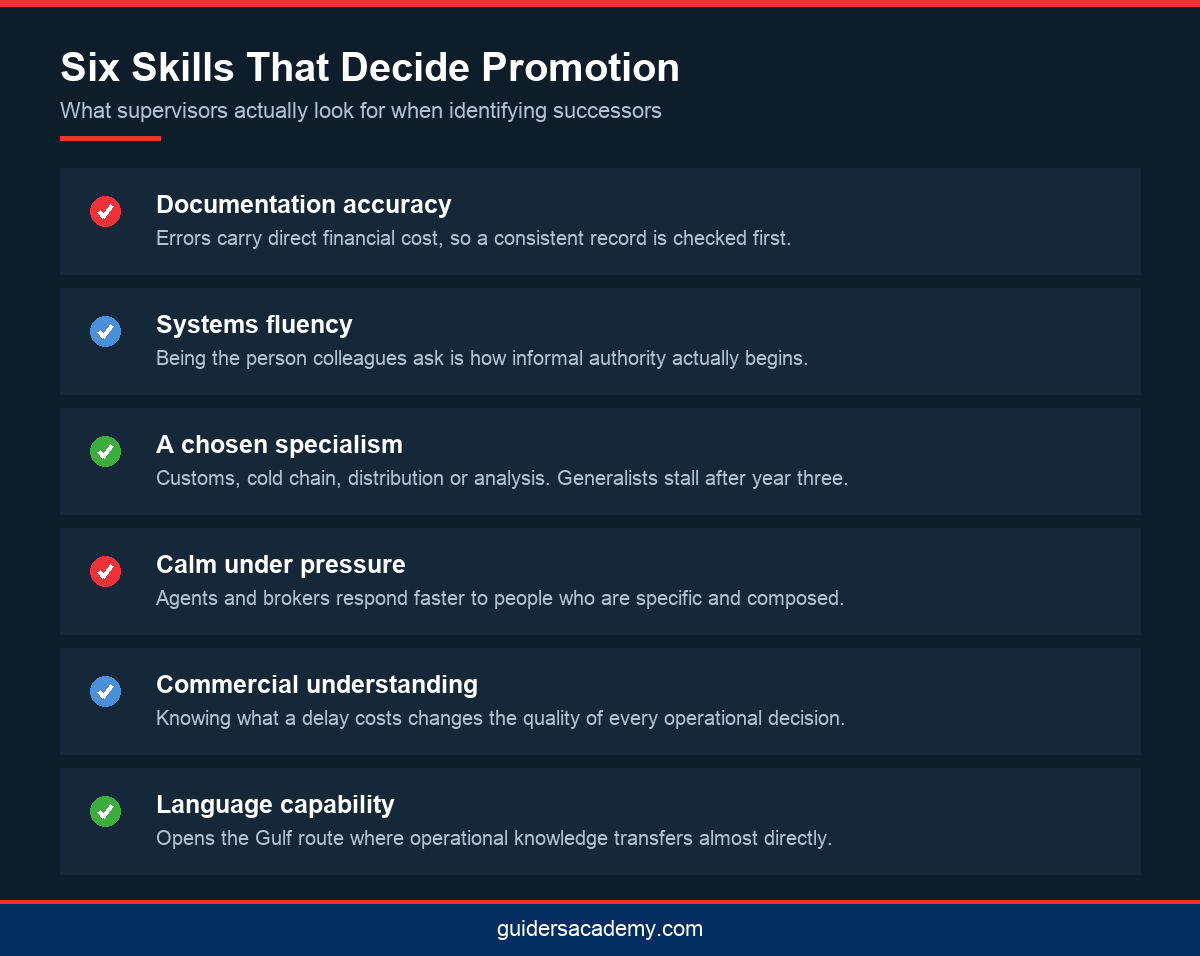
Documentation accuracy remains the foundation and it is not a soft requirement. Errors in shipping paperwork carry direct financial consequence, so a consistent record of precision is the first thing supervisors look for when identifying successors. Read across the roles, the Kerala logistics industry 2026 rewards the same three capabilities almost everywhere.
Systems literacy is the second differentiator. Being genuinely fluent in the operational platform, rather than merely able to complete the familiar screens, makes someone the person colleagues ask, which is how informal authority begins.
A chosen specialism is the third. Customs, cold chain, distribution management, and analysis each provide a clear market value, whereas remaining a competent generalist tends to slow progression after the first three years.
Communication under pressure is consistently underestimated by graduates. Agents, carriers, and customs brokers respond faster to people who are calm and specific, and that reputation compounds quickly in a market where everyone eventually knows everyone.
Basic commercial understanding separates operations staff who advance from those who do not. Knowing what a delay costs, what a margin on a shipment looks like, and why a customer is negotiating changes the quality of every decision.
Language capability opens the Gulf route, which remains a significant destination for Kerala logistics professionals. Operational knowledge transfers directly, and established recruitment channels make the move considerably easier than in most other sectors.
The broader set of entry points is covered in this summary of careers in logistics, and choosing deliberately between them in year two rather than drifting is what most successful graduates report doing.
Willingness to move between locations helps considerably too. Graduates who accept a posting at a port, an inland depot, or a distribution centre outside their home district accumulate varied operational exposure far faster than those who remain in one office. Certification is one of the faster ways to signal what employers now test, and this list of certifications is a good starting point.
Conclusion
The Kerala logistics industry 2026 is not a boom story and it is not a declining one. It is a specialised export gateway with steady demand, where cold chain, last mile distribution, compliance, and analysis are growing while general warehousing stays flat. Systems literacy and documentation accuracy have become the practical entry requirements, and a chosen specialism decides progression after year three. To discuss which logistics programme aligns with these categories, contact the Guiders Academy team.
Frequently Asked Questions
What is driving the Kerala logistics industry 2026?

Why does this article avoid quoting growth percentages?
Which logistics roles are growing fastest here?
Are traditional documentation jobs disappearing?
How important is technology skill in this sector now?
What decides promotion in logistics?
Is Kerala a good place to build a logistics career?
How realistic are Gulf logistics roles from here?
Which specialisation should a new graduate target?