AI Driven Digital Marketing Courses in Kerala: 8 Skills
 General
AI driven digital marketing courses in Kerala have multiplied fast, and the brochures have started to look identical. Almost all of them promise SEO, social media, and paid ads with an artificial intelligence module bolted on the end. That framing hides what actually matters: digital marketing is eight distinct skill channels, each with its own tools, its own hiring market, and its own way of being changed by AI. This guide maps those channels one by one, explains which to specialise in first, sets out what accreditation claims really mean in India, and gives you a way to compare institutes that is not based on the length of a syllabus.
Key Takeaways
- Modern digital marketing splits into eight skill channels, and a serious course teaches each one deeply enough to be hired for it.
- AI has changed how the work is done in every channel, but it has not removed the need to understand the underlying mechanics.
- Specialise in one channel first and stay literate in the rest, because generalists without depth interview poorly at every level.
- Judge an institute by the campaigns learners actually ran, the accounts they touched, and where the last cohort is working now.
Why AI Changed What a Digital Marketing Course Has to Teach
Five years ago a digital marketing course could reasonably teach process. Here is how to write a title tag, here is how to build a campaign, here is how to schedule a month of posts. The value sat in knowing the steps, because the steps took time and few people knew them.
Generative tools removed most of that value. A first draft of ad copy, a set of social captions, a keyword list, or a basic report summary now takes minutes, and the person producing them no longer needs to be a trained marketer to produce something that reads acceptably well.
What did not become cheap is judgement. Deciding which audience to target, recognising when a metric is flattering rather than useful, knowing that a rising click rate on falling conversions signals a problem, and telling a client that a channel is wrong for their product all require understanding rather than output.
Search itself changed at the same time. Answer engines and AI summaries increasingly respond to questions directly instead of sending a visitor to a website, which makes structured content, clear entity information, and genuine authority matter more than keyword placement ever did.
That shift is why the digital marketing programme at Guiders Education is built differently from its predecessors. Tool training alone dates within a year, while the reasoning behind channel selection, budget allocation and honest measurement stays useful across an entire career. The wider argument about where AI leaves marketing roles is covered in this look at AI against marketing jobs.
The practical test for any curriculum is simple. Ask whether it teaches learners to interrogate a result or only to produce one. A cohort that can explain why a campaign underperformed is employable, and a cohort that can only generate assets is competing directly with free software.
The Eight Skill Channels a Modern Curriculum Must Cover
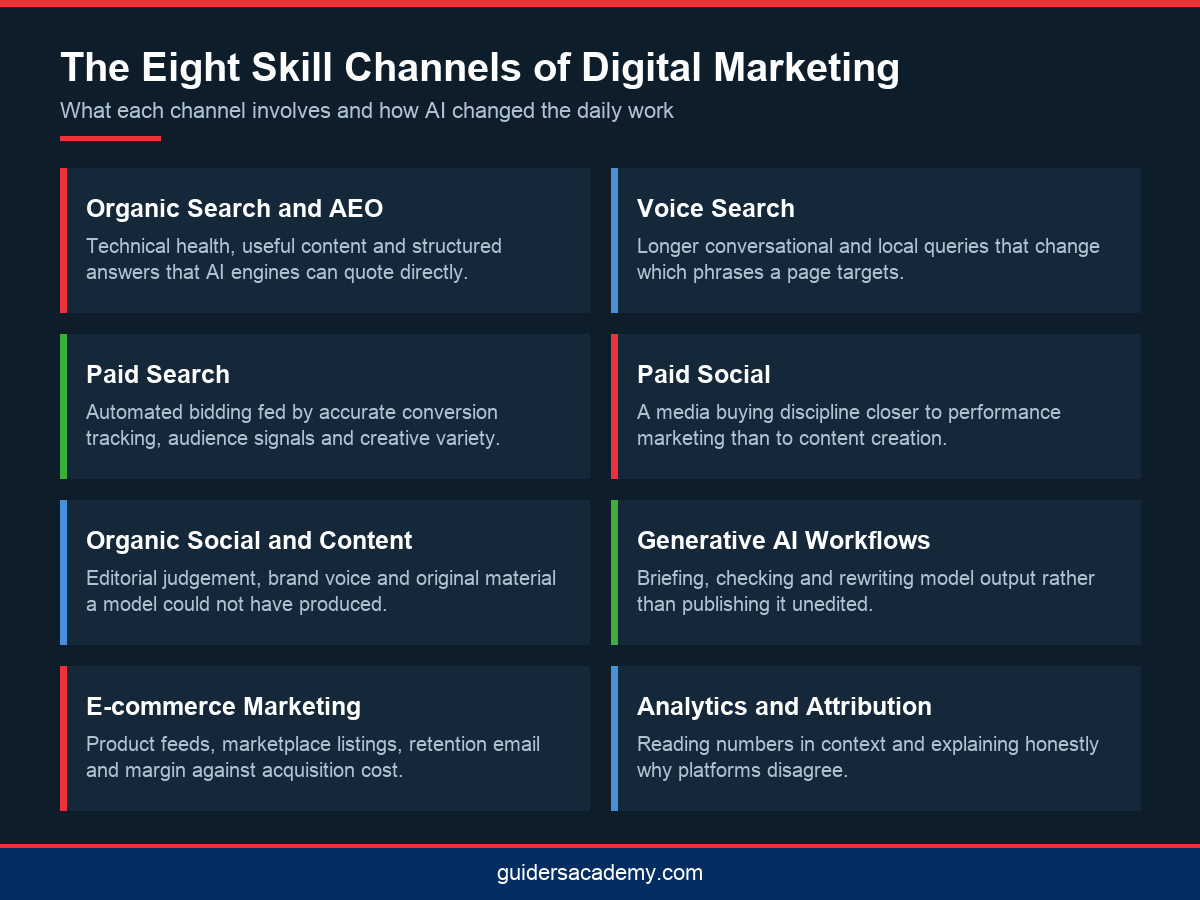
Digital marketing is often sold as one subject, which is why so many graduates end up shallow in everything. In practice it divides into eight channels that hire separately, pay differently, and demand different aptitudes from the people working in them.
A complete curriculum touches all eight so learners can make an informed choice, then lets them go deep in one or two. What follows is what each channel actually involves and how artificial intelligence has changed the daily work inside it.
The four groups below cover organic discovery, paid acquisition, content and social, and measurement. Every campaign a Kerala business runs is assembled from some combination of these, which is why literacy across all four still matters even after you specialise.
Organic Search, AEO and Voice
Search optimisation still starts with the fundamentals set out in the Google search documentation: crawlable pages, useful content, sensible structure, and a technically healthy site. Those have not changed, and most local businesses still fail them.
What has changed is the destination. Answer engine optimisation asks how your content gets quoted inside an AI generated answer, which rewards clear question and answer structure, explicit factual statements, and schema markup far more than dense keyword repetition ever did.
Voice search compounds this. Spoken queries are longer, more conversational, and more likely to be local, which changes the phrases you target and the way a page is written. Marketers who ignore this are optimising for a shrinking share of total search behaviour.
Paid Search and Performance Marketing
Paid search and performance marketing cover everything measured against a cost per acquisition. This is where budgets are largest, where mistakes are most expensive, and where employers ask the sharpest interview questions because the results are unambiguous.
Automation now runs most of the bidding. The skill has moved to feeding the system correctly through conversion tracking, audience signals, and creative variety, and to recognising when an automated strategy is optimising for a goal that does not match the business one.
Certification through Google's own training catalogue is free and expected. A course that charges for it is adding no value, so use that as a quick test of whether an institute is packaging public material as proprietary content.
Social, Content and Generative AI
Social media marketing and paid social have separated into different jobs. Organic community work is about consistency and voice, while paid social is a media buying discipline closer to performance marketing than to content creation in daily practice.
Generative AI sits across both. It accelerates drafting, variation, and repurposing, but it also floods every feed with adequate content, which raises the value of a distinct point of view and original material that a model could not have produced on its own.
The employable version of this skill is editorial. Knowing what to publish, what to reject, and how to keep a brand sounding like itself across hundreds of AI assisted drafts is the part that a small Kerala business genuinely cannot do without help.
Analytics, E-commerce and Attribution
Measurement is the channel most learners skip and most employers test. Free training through Google Analytics Academy covers the platform, but understanding what a number means in context is what separates an analyst from a report generator.
E-commerce marketing adds its own layer: product feeds, catalogue quality, marketplace listings, retention email, and the arithmetic of margin against acquisition cost. It is a distinct specialisation and one of the better paid ones in the state right now.
Attribution ties the group together. Knowing which touchpoint deserves credit, why platform reported conversions rarely reconcile with each other, and how to present that honestly to a client is a skill that immediately marks out a serious candidate.
Reporting closes the loop. Turning platform exports into a short narrative that a business owner can act on, with the caveats stated plainly, is the part of analytics that most junior candidates in Kerala have never practised and the part that hiring managers notice immediately.
Which Channel to Specialise in First
Trying to be equally good at all eight channels is the most common mistake made by new marketers. It produces a resume that lists everything and demonstrates nothing, and it interviews badly because every question can be answered only at surface level.
The better approach is one channel deep and seven channels literate. You should be able to run one discipline unsupervised and hold an intelligent conversation about the rest, which is exactly how agency teams and in house departments are actually structured.
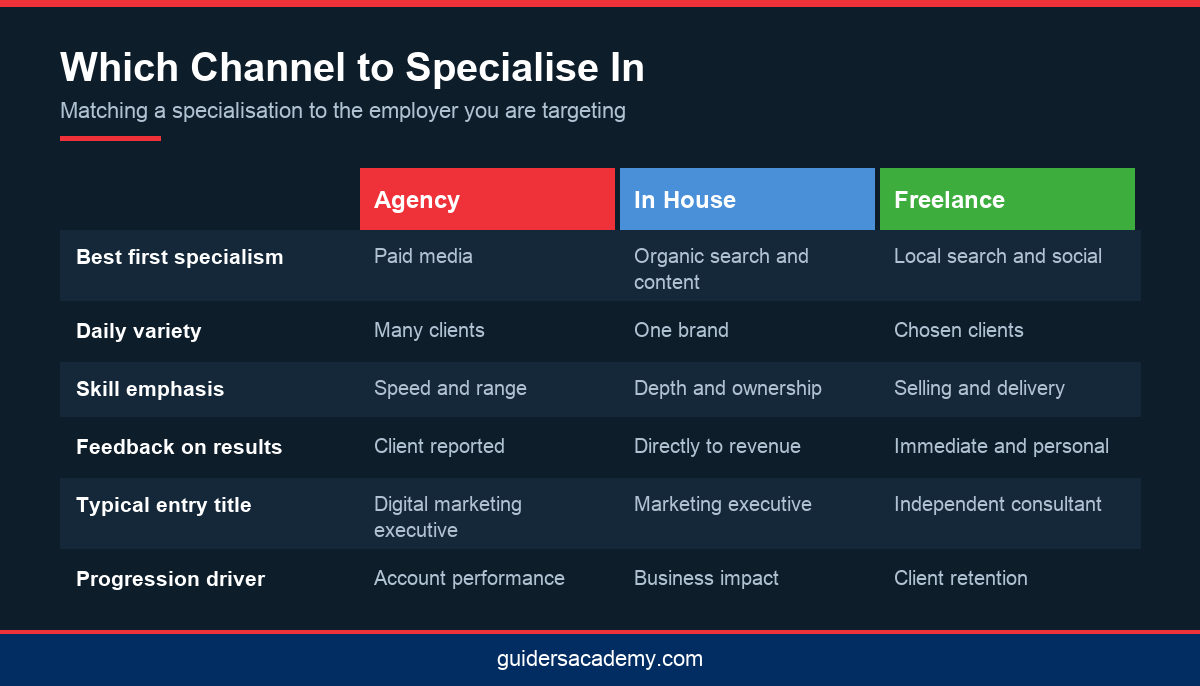
Which channel you pick should follow the kind of employer you want rather than the module you enjoyed most during training. The three routes below cover most Kerala career outcomes.
If You Want Agency Work
Agencies hire for billable specialisms, and paid media is the most consistently billable of them. A candidate who can build, monitor, and explain a paid search or paid social account is useful from the first month rather than after a long training period.
Agency work also rewards speed and range across clients. You will move between industries frequently, so the underlying discipline matters more than sector knowledge, and the ability to pick up an unfamiliar account quickly becomes your real differentiator.
If You Want an In House Role
In house teams in Kerala are usually small, which means they value people who can own organic search and content together. One person often carries the website, the blog, the email list, and the reporting, so breadth within organic disciplines matters more than paid specialism.
These roles suit anyone who prefers depth on one brand to variety across many. They tend to offer more stability and a clearer view of how marketing affects the business, which is useful experience if you later want to move into management.
If You Want to Freelance
Freelancers do best with a service that a small business can understand and buy repeatedly. Local search optimisation, social media management, and e-commerce marketing all fit that description, and the route from training to first client is well documented in this freelancing career path.
The commercial skills matter as much as the technical ones here. Scoping work, pricing it, reporting on it, and knowing when to decline a client whose expectations cannot be met are what separate a sustainable freelance practice from a stressful one.
What Government Approved and Certified Actually Mean in India
Almost every institute uses the words approved, certified, or recognised somewhere in its advertising, and almost none of them explain what the claim actually refers to. The three words are not interchangeable, and the difference matters a great deal when you are comparing two courses priced within a few thousand rupees of each other.
A vocational qualification in India is regulated through national skill bodies, with NCVET as the regulator for awarding and assessment agencies. When an institute says government approved, the fair question is which body approved what, and whether it covers this specific course.
Many claims instead refer to a partner certification, an industry body membership, or a university tie up for a separate programme. None of these are dishonest in themselves, but they are not the same as a nationally recognised qualification for the course you are enrolling in.
Platform certifications are a third category entirely. Credentials from the major advertising and analytics platforms are genuinely valued by employers, are usually free, and can be earned independently, so their presence in a syllabus is normal rather than a distinguishing feature.
The practical approach is to ask for the certificate that a graduate receives, in writing, before enrolling. Reading the actual wording tells you more than any conversation, and a straightforward institute will share it without hesitation or delay.
It is also fair to ask what the certification changes. For most marketing roles in Kerala, employers weigh demonstrated campaign work above any certificate, so treat published accreditations as one input rather than the deciding factor.
The Tools You Should Have Touched Before You Finish
A syllabus that lists thirty tools is usually a warning rather than a selling point, because no cohort can use thirty tools meaningfully in four months. What matters is which ones learners have genuinely operated with live data rather than watched on a projector.
Analytics and search console come first. Every marketer needs to read traffic and query data confidently, diagnose a drop, and understand why two platforms report different numbers for what appears to be the same event on the same day.
One advertising platform should be operated end to end. Building a campaign, setting conversion tracking correctly, running it with real money however small, and reporting on the outcome teaches more than a term of theory about auction mechanics.
A generative AI workflow belongs in the toolkit now, but as an assistant rather than an author. Learners should practise briefing a model well, checking its output against sources, and rewriting what comes back so it carries a brand voice rather than a generic one. Marketers who work closely with build teams often find it useful to understand what a full stack and mobile development track covers.
Email and automation tools are frequently skipped and consistently useful. Retention marketing is where much of the profit sits for e-commerce and service businesses, and very few junior candidates in Kerala arrive able to build a working sequence.
Finally, a reporting habit. Whether the output is a spreadsheet or a dashboard, the ability to present results clearly, with context and an honest read of what worked and what did not, is the skill most often named by employers as missing in new hires across the state.
Career Paths, Salaries and Who Hires in Kerala
The most common entry point is a digital marketing executive role inside an agency, where you support account managers across several clients. It is demanding and repetitive early on, and it remains the fastest way to see a large number of campaigns in a short period.
In house executive roles are the second route, usually inside a growing local business, hospital group, educational institution, or e-commerce operation. The work is narrower but deeper, and the feedback loop between marketing activity and revenue is far more visible.
Specialist roles follow after eighteen months or so. Paid media specialist, SEO specialist, content lead, and marketing analyst are the usual titles, and the jump in pay at this stage is much larger than the jump from the first job to the second.
Freelance and consulting work runs parallel to all of this. Kerala has a large base of small businesses that need help but cannot support a full time marketer, which sustains a healthy independent market for people who can sell and deliver reliably.
Kochi carries the largest share of openings, with Thrissur, Trivandrum, and Calicut contributing steadily, and remote work for clients outside the state widening the field further. Several graduates also move to Gulf markets where Kerala trained marketers are well represented.
Pay follows demonstrated results rather than tenure. Candidates who can show a campaign they ran, the numbers it produced, and an honest account of what they would change next time progress considerably faster than those who can only describe the tools they were shown during training. That gap widens at every promotion point rather than closing.
How to Judge a Digital Marketing Institute in Kerala
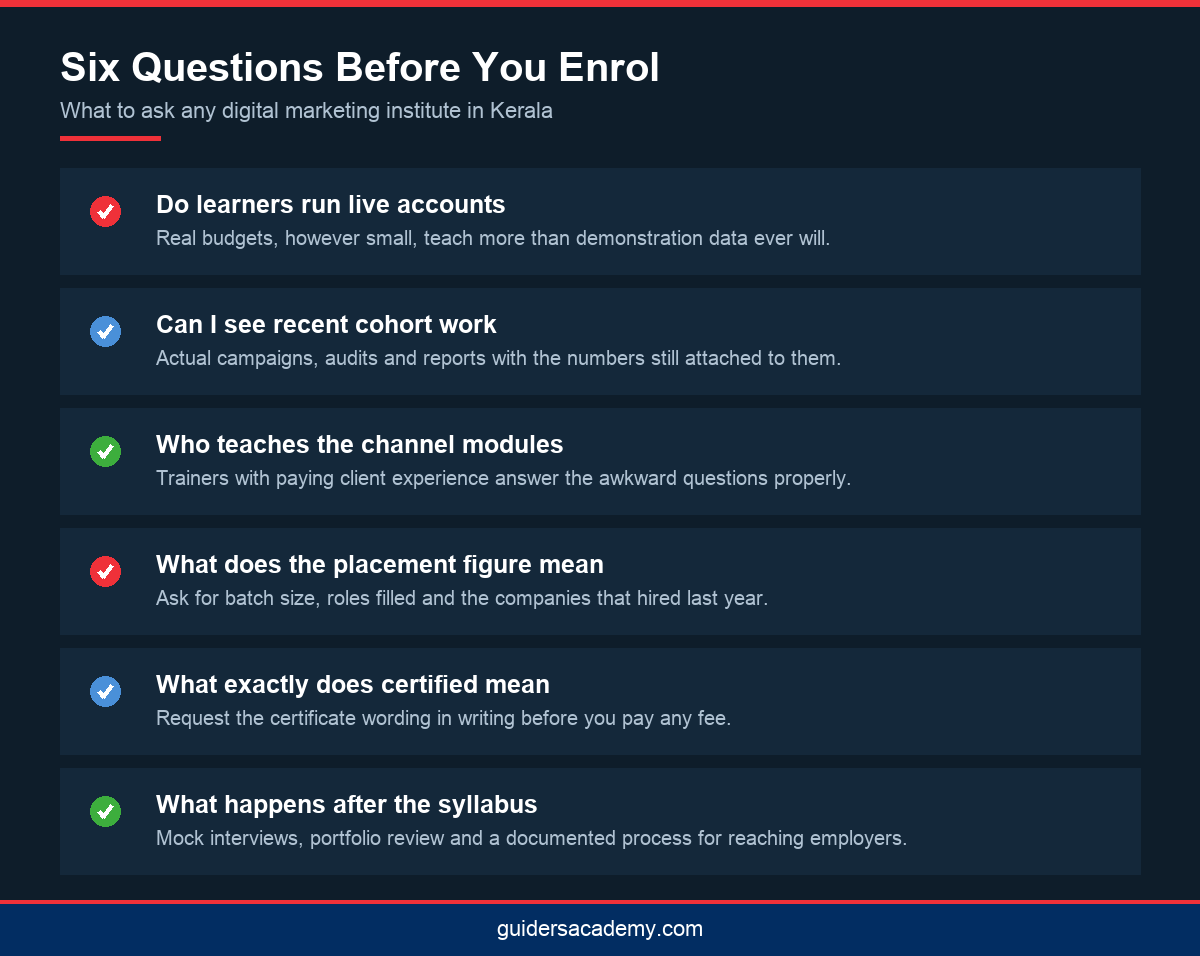
Start with the live account question. Ask whether learners operate real advertising accounts with real budgets, however small, or whether the course runs entirely on demonstration data. This single question separates most institutes into two very different categories.
Ask to see cohort work. Not a portfolio template, but the actual campaigns, audits, and reports that recent learners produced, with the numbers attached. An institute confident in its training will show these readily and will be able to explain the results.
Check who teaches. Trainers who have run campaigns for paying clients teach differently from trainers who have only completed the certifications, because they can answer the awkward questions about budget pressure, client disagreement, and campaigns that did not work.
Interrogate the placement claim. A percentage without a denominator means nothing, so ask how many learners were in the last batch, how many were placed, in what roles, and at which companies. A documented placement record should survive that question.
Compare the format honestly against your own situation. There are real trade offs between classroom and online delivery, discussed in this assessment of whether a remote programme holds up. The same evidence-first approach applies to technical programmes, as this guide to choosing a development course shows.
Finally, meet the people. A conversation with the faculty team tells you more about how a course is actually run than any brochure, and any institute unwilling to arrange one has answered the question for you.
Where the Guiders Digital Marketing Curriculum Fits
The Guiders programme is built around the eight channel structure described above rather than a single linear syllabus. Learners cover each channel well enough to make an informed choice, then commit to a specialisation supported by project work in that discipline.
Artificial intelligence is treated as a working method inside every channel rather than as a separate closing module. That means using generative tools for research, drafting, and analysis within the channel being studied, and then checking the output against real data.
The broader picture of how this vertical has developed locally is set out in the existing overview of AI driven digital marketing as the future of the field, which covers why the shift happened rather than how to work within it.
For learners weighing this against other options, the practical comparison of career scope for AI digital marketing in Kochi covers the local market context in more depth than a syllabus page can.
Programme structure, duration, and entry requirements sit alongside the other diploma programmes, and the internship component is where most learners produce the campaign work that later carries their first interview.
Anyone still deciding between marketing and an adjacent path may find the honest comparison in digital marketing courses in Kerala as a career guide a useful starting point, alongside the wider question of why so many people are switching into digital marketing in the first place.
Conclusion
AI driven digital marketing courses in Kerala are worth taking when they treat the field as eight distinct disciplines rather than one bundled subject, and when learners leave having run something real. Use the channel map in this guide to work out where your own aptitude sits, insist on live account access and visible cohort work, and read certification claims carefully before assuming they mean a national qualification. Specialise in one channel, stay literate across the rest, and let demonstrated results rather than a certificate carry your first interview. To discuss which specialisation suits your background, speak to the Guiders Academy team.