Tally, SAP or IFRS: Which Certification Gets You Hired
 General
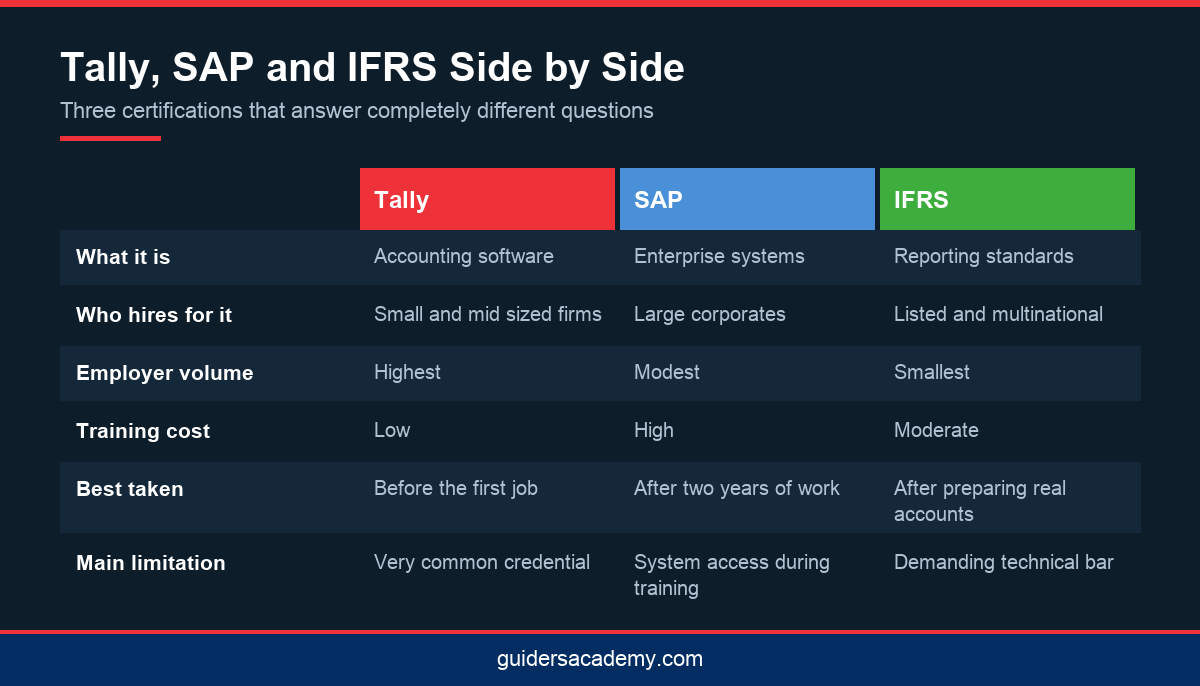
Anyone comparing accounting certification courses in Kerala eventually reaches the same three names: Tally, SAP, and IFRS. They are usually presented as alternatives, which is misleading, because they answer completely different questions. One makes you employable quickly, one moves you toward larger organisations, and one is a technical qualification for a specific kind of reporting work. This comparison sets out what each actually is, who hires for it, how long it takes, and the sequence that makes sense for most people rather than the sequence that gets advertised.
Key Takeaways
- Tally is an accounting software skill, SAP is an enterprise systems skill, and IFRS is a reporting standards qualification.
- They are sequential rather than competing, and taking them in the wrong order wastes both money and study time.
- Tally suits small and mid sized employers, SAP suits large organisations, and IFRS suits listed and multinational reporting work.
- Employers ask what you have done with the certification, so live company data during training matters more than the certificate.
What Each Certification Actually Is
Tally is accounting software. A certification in it demonstrates that you can operate a package used by a very large share of small and medium businesses across India for bookkeeping, inventory, payroll, and statutory compliance work.
The Tally product documentation sets out the functional scope, and the practical value of the certification is that a small employer can hire you and expect productive work within days rather than weeks.
SAP is enterprise resource planning software, and the finance modules within it are what accounting professionals train on. It is used by large organisations where finance, procurement, manufacturing, and sales all run inside one connected system.
That difference in scale changes the job. Working in SAP means understanding how a finance entry originates in another department's process, which is organisational knowledge as much as it is software knowledge in daily practice.
IFRS is not software at all, which is the most common confusion. It is a set of international financial reporting standards, and the certification demonstrates that you understand how transactions should be recognised, measured, and disclosed.
The standards themselves are published by the IFRS Foundation, and the qualification matters for listed companies, multinational subsidiaries, and any organisation reporting to an overseas parent under those standards.
So the three are not competitors. Comparing accounting certification courses in Kerala sensibly means asking which stage of a career each one belongs to rather than which is objectively better than the others.
Who Hires for Each One
Tally skills are demanded by the largest number of employers by volume. Small businesses, retail operations, trading firms, professional practices, and educational institutions across Kerala all run on it, which makes it the fastest route to a first job.
The trade off is that it is common. Because so many candidates hold it, the certification opens the door but does not distinguish you, so it should be paired with demonstrable accuracy and statutory filing experience.
SAP is demanded by a much smaller set of employers who pay considerably more. Large manufacturers, multinational shared service centres, and sizeable corporates recruit for it, and the candidate pool is far thinner than for Tally.
The barrier is genuine though. SAP training is expensive, access to a practice system is limited, and employers frequently prefer candidates who used it in a real job over those who only trained on it in a classroom.
IFRS is demanded by listed companies, subsidiaries of overseas groups, audit practices with international clients, and finance teams preparing consolidated accounts. The volume of roles is modest and the technical bar is high.
Geography changes the calculation. Kerala's own demand skews toward Tally, while Gulf and multinational employers recruiting from this state weight SAP and IFRS considerably more heavily than local small business hiring does.
The existing detail on the IFRS course and standards is worth reading for anyone whose target employers report under those standards rather than only under domestic rules.
Recruitment consultants are a useful sanity check here. Asking two or three local consultants which certifications they are currently asked for costs nothing and produces a far more current picture of demand than any institute brochure will. Employers increasingly test the capabilities listed in this set of skills for aspiring accountants.
Time, Cost and the Sequence That Makes Sense
Tally training is short and inexpensive, typically running a few weeks to a few months depending on depth. It is the reasonable first certification for almost everyone entering accounting from a commerce background in this state.
The mistake people make is stopping there. Tally alone plateaus fairly quickly, because the employers who use it are mostly small and the ceiling on both responsibility and pay arrives sooner than graduates expect.
SAP training is a much larger commitment in both time and fees, and it is best taken after a year or two of real accounting work. Without that grounding, the modules are abstract and the training rarely converts into a role.
IFRS study is intellectually demanding rather than expensive. It rewards people who already understand accounting well, which is why attempting it before you have prepared real financial statements tends to be an inefficient use of study time.
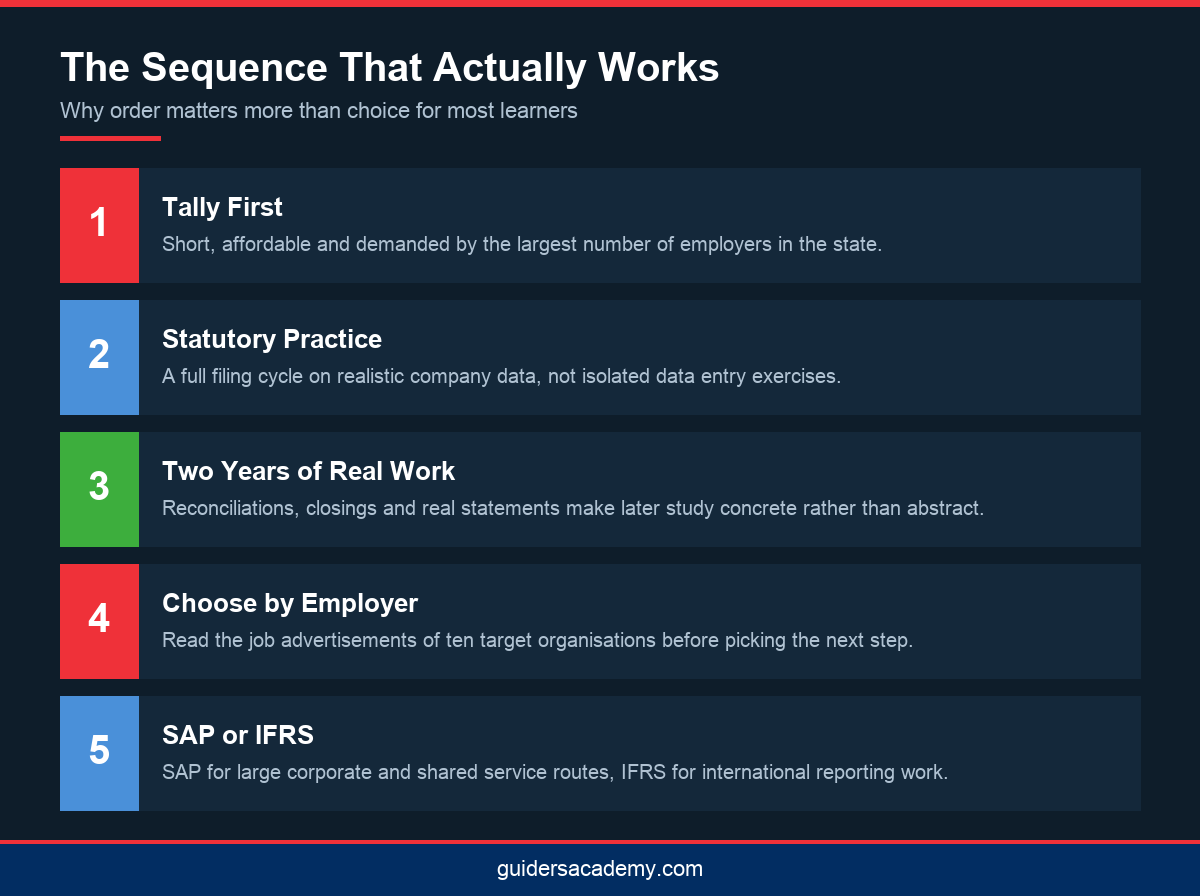
The sensible sequence for most learners is therefore Tally first, then two years of practical work, then either SAP or IFRS depending on the employers they are targeting rather than on which course is being promoted locally.
There is a good local starting point in the Tally course in Ernakulam for anyone at the beginning of this sequence and unsure where to start their training.
Cost should be weighed against employer demand rather than against course length. An expensive certification that no employer in your target list asks for is a worse investment than a cheap one that several of them require. Sequencing matters more than prestige, a point the case for a financial accounting diploma makes clearly.
How to Choose and What to Ask an Institute
Start from the employers rather than the courses. List ten organisations you would genuinely want to work for, look at what their finance job advertisements ask for, and let that decide which certification you pursue first.
Ask what data learners work with during training. Practising on realistic company data, including a full statutory filing cycle, produces graduates who can work from day one, while sample exercises produce graduates who need retraining.
For SAP specifically, ask about system access. How many hours of practice system time does each learner receive, and is it a genuine environment or a limited demonstration, because this is where most SAP training quietly falls short.
For IFRS, ask who teaches it. The standards are technical and the teaching quality varies enormously, so a trainer who has actually prepared or audited statements under those standards is worth considerably more than one working from a textbook.
For Tally, ask about statutory coverage. A course that stops at data entry has taught half the subject, since the compliance side including returns and reconciliations is what employers actually need on day one of a job.
Consider the wider qualification too. The accounting programme at Guiders Education can bundle software skills with the accounting foundation that makes those skills usable rather than mechanical, which is what employers are actually paying for.
Finally, ask about outcomes as always. Where did the last cohort go, in what roles, and can the institute point to a documented placement record rather than an unqualified success rate.
Ask about refresher access as well. Software versions and reporting standards both change, and an institute that lets former learners return for updated sessions is offering something with a longer useful life than a one off certificate. If you are studying alongside a job, the practical case for learning online is worth weighing.
Conclusion
Comparing accounting certification courses in Kerala is straightforward once you stop treating Tally, SAP, and IFRS as alternatives. They belong to different career stages: Tally makes you employable, real work makes you useful, and SAP or IFRS then moves you toward larger or international employers depending on where you want to be. Pick the sequence from your target employers' job advertisements rather than from a brochure. To discuss which certification fits your stage, contact the Guiders Academy team.
Frequently Asked Questions
Which of these accounting certification courses in Kerala should I take first?

Is IFRS a software certification?
Why is SAP training so much more expensive?
Can Tally alone sustain a full career?
Which certification pays the most?
Do Gulf employers value these differently from local ones?
Should I take SAP straight after graduation?
How do I judge an IFRS course?
What should a Tally course include beyond data entry?