Social Media Marketing Course in Kerala: Beyond Posting
 General
A social media marketing course in Kerala has to answer a question most brochures avoid: are you being trained to post, or to produce results a business can measure. Those are different jobs with different pay scales. Organic community work and paid social media buying have separated into distinct disciplines, and generative tools have made producing content cheap while making genuinely distinctive content more valuable. This guide sets out what belongs in a serious syllabus, how the two career tracks differ, and how to judge an institute without relying on its own follower count.
Key Takeaways
- Organic social and paid social have become separate jobs, and a good course teaches both while making the difference explicit.
- Strategy, content production, community management, paid distribution and reporting are the five components a syllabus must cover.
- Generative tools made content cheap, so editorial judgement and a distinct brand voice now carry most of the professional value.
- Judge an institute by the accounts learners actually ran and the numbers attached, not by the size of its own following.
What Social Media Marketing Involves Beyond Posting
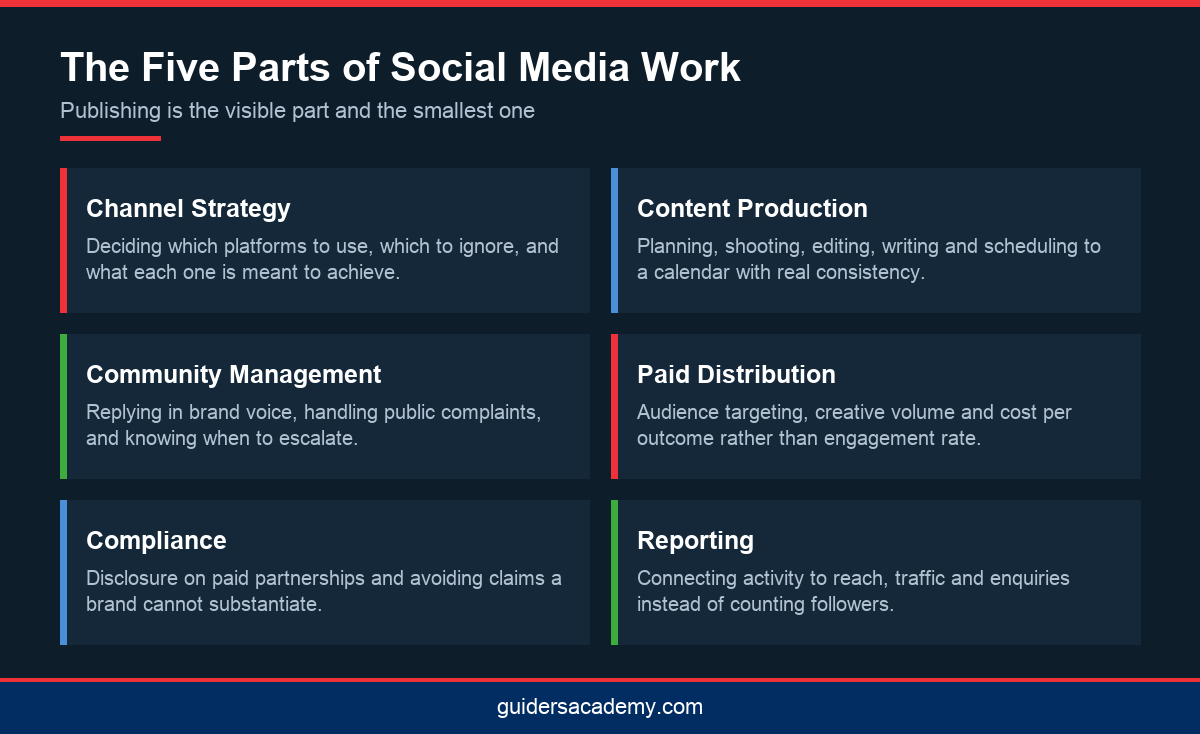
The visible part of the job is publishing, and it is the smallest part. Behind every published post sits an audience decision, a message decision, a format decision, and a measurement plan, and those four are what a business is actually paying for.
Strategy comes first. Knowing which platforms a business should be on, which it should ignore, and what each channel is meant to achieve prevents the most common waste in Kerala marketing budgets, which is spreading effort across every network equally.
Content production is the second component and the most demanding day to day. Planning, shooting, editing, writing, and scheduling to a calendar is operational work that requires consistency more than inspiration, and it is where most beginners underestimate the effort involved.
Community management is the third and it is genuinely skilled. Responding to comments and messages in a brand's voice, handling complaints in public, and knowing when to escalate rather than reply are judgement tasks that no tool performs reliably.
Paid distribution is the fourth and it changes the economics entirely. Organic reach on most platforms is now small enough that a serious campaign assumes budget, which turns social media into a media buying discipline rather than a publishing one.
Reporting is the fifth. Follower counts and likes are the easiest numbers to produce and the least useful, so a professional report connects activity to reach, engagement quality, traffic, and where possible, enquiries or sales generated. The role sits inside the wider map drawn in this marketing career guide.
The digital marketing programme at Guiders Education covers all five rather than concentrating on production because it is the most visible and the easiest part of the work to demonstrate in a classroom.
Organic and Paid Social Are Now Different Jobs
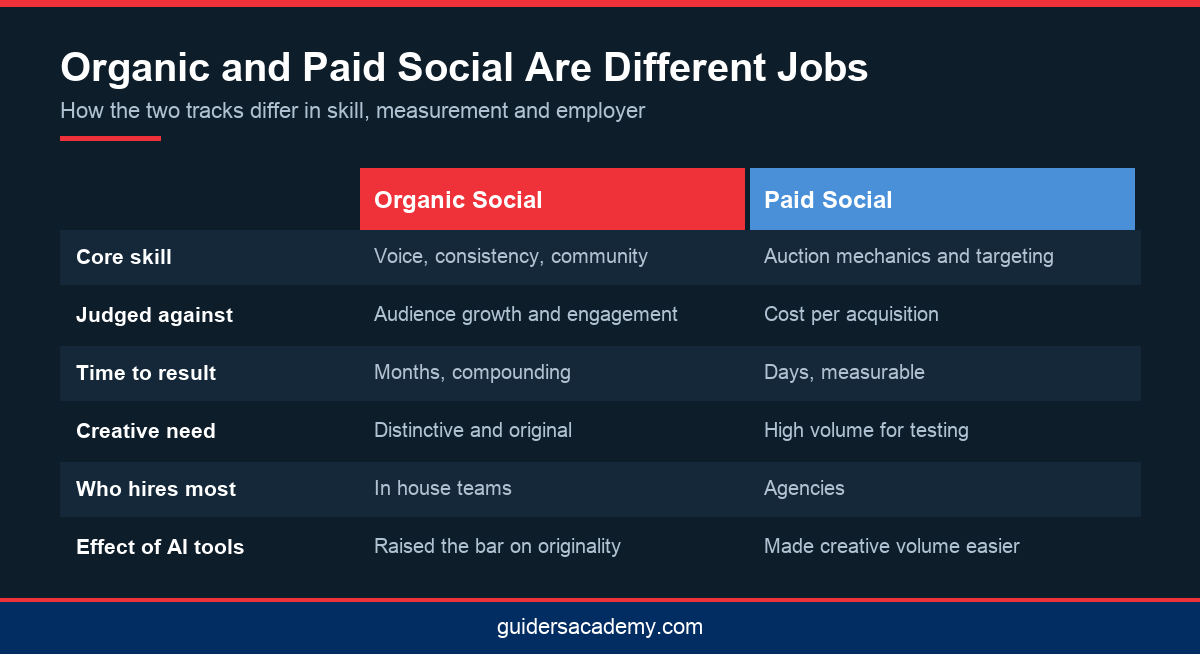
Organic social is about consistency, voice, and community. The person doing it well knows the audience intimately, publishes reliably, responds quickly, and builds something that compounds slowly over months rather than producing an immediate measurable return.
Paid social is about auction mechanics, audience targeting, creative volume, and cost per outcome. It is closer to performance marketing than to content creation, and it is judged against acquisition cost rather than against engagement rate or follower growth.
The skills overlap less than people assume. A brilliant community manager may be poor at reading a campaign report, and a capable media buyer may write posts that feel entirely wrong for the brand they are promoting to an audience.
Employers in Kerala hire for both, but they hire differently. Agencies typically want paid capability because it is billable, while in house teams in smaller businesses often want one person who can carry the organic work end to end.
Generative tools have changed the organic side more than the paid side. Producing captions and variations is now fast, which means the differentiator has moved to original material, local relevance, and a voice that does not sound machine assembled.
The advertising itself is regulated too. Influencer disclosure and misleading claims are covered by the Advertising Standards Council of India guidelines, and a course that never mentions compliance leaves learners exposed on their first client account. Paid work overlaps heavily with the numbers side covered in AI marketing careers in Kochi.
Understanding both sides is what makes a candidate flexible. It also explains why the free platform mechanics available through Google Analytics Academy still matter here, since social traffic has to be measured somewhere beyond the platform's own dashboard.
The Tools and Work You Should Do During the Course
You should build a content calendar for a real business and then execute it. A month of planned, produced, published, and reviewed content teaches operational discipline that no amount of theory about content pillars can substitute for.
You should run at least one paid campaign with real money. Even a small budget teaches audience selection, creative testing, and the discomfort of watching spend produce a result that does not justify itself in the first week.
You should learn one editing workflow properly rather than sampling five. Short form video is the dominant format across platforms, and being able to shoot, cut, caption, and publish quickly is a directly employable operational skill.
You should practise community management on something real. Responding to genuine comments, including negative ones, teaches tone control and escalation judgement in a way that role play exercises in a classroom never quite manage to replicate.
You should build a reporting habit early. A monthly report that connects activity to outcomes, admits what underperformed, and proposes a change is the artefact that most clearly separates a professional from an enthusiastic amateur.
You should leave with a portfolio. Published work for a real business, with the numbers attached and a short note on what you would do differently, is what carries an interview far more effectively than a certificate does.
You should also work to a brief you did not write. Executing someone else's creative direction, including when you disagree with it, is a large part of agency life and almost nobody practises it before their first week on the job.
Careers, Employers and Choosing an Institute
The usual entry role is social media executive in an agency, handling several client accounts at once. It is demanding and repetitive early on, and it exposes you to more brands, formats, and failure modes in a year than any other route.
In house roles suit people who prefer depth over variety. Kerala businesses in education, healthcare, hospitality, retail, and real estate all employ social media staff directly, and the work connects visibly to enquiries and footfall.
Freelance work is common and reachable. Small businesses across the state need consistent social presence but cannot justify a salary, and the path from training to independent client work is described in this freelancing career route.
Content creation itself is a parallel path. Some graduates move into production roles, working on video and design for brands, which uses the same operational skills with a heavier emphasis on craft than on measurement.
When comparing institutes, ignore their own follower count. It measures their marketing rather than their teaching, and several of the strongest trainers in the state have deliberately small personal audiences and long client histories instead. Anyone weighing study formats should read this assessment of online courses.
Ask instead about learner work and outcomes. Which accounts did the last cohort run, what did the numbers do, and can the institute point to a documented placement record with named roles and employers attached.
Conclusion
A social media marketing course in Kerala is worth the fee when it treats the subject as five disciplines rather than one, when learners run a real calendar and a real paid campaign, and when reporting goes beyond follower counts. Decide early whether you are drawn to the organic side or the paid side, because they lead to different jobs, then build a portfolio of published work with numbers attached. To discuss the current batch and how the paid and organic modules are structured, speak to the Guiders Academy team.
Frequently Asked Questions
What does a social media marketing course in Kerala cover?

Is social media marketing a real career or just posting?
Do I need to be good on camera to work in this field?
Has AI made social media marketing easier or harder?
How much budget do I need to learn paid social?
Which platforms should a Kerala business prioritise?
What should my portfolio contain after the course?
Do influencer disclosure rules apply to my client work?
How do I judge an institute in this field?