Performance Marketing Masterclass in Kerala: Spend to Sale
 General
A performance marketing masterclass in Kerala should be the most uncomfortable course on any marketing syllabus, because performance marketing is the one discipline where the results are unambiguous. Money goes in, outcomes come out, and the arithmetic either works or it does not. That clarity is exactly why employers pay well for it and why interviews in this area are the sharpest. This guide sets out what the training must cover, the numbers you will be tested on, and how to tell a serious programme from a tour of advertising dashboards.
Key Takeaways
- Performance marketing is judged against cost per acquisition, so every module should end in a number rather than an opinion.
- Automated bidding has moved the skill from manual adjustment to feeding the system correct conversion data and creative variety.
- Employers test the arithmetic: margin, lifetime value, payback period and the difference between platform reported and actual results.
- Only a course where learners spend real money, however little, teaches what a live campaign actually feels like to manage.
What Performance Marketing Actually Covers
Performance marketing is any paid activity measured against a defined business outcome rather than against reach or impressions. If the campaign is not accountable to a cost per lead, a cost per acquisition, or a return on ad spend, it is brand advertising under a different name.
In practice that spans paid search, paid social, shopping and product feeds, display remarketing, and affiliate arrangements. The platforms differ, but the discipline is identical: define the outcome, measure it accurately, and improve the cost of producing it over time.
The measurement half is where most beginners underestimate the work. Conversion tracking that fires twice, counts the wrong action, or misses mobile traffic entirely will make a poor campaign look excellent, and nobody notices until the sales figures disagree.
The creative half is equally underrated. Automated systems now need variety more than they need manual bid changes, so producing enough distinct headlines, images, and offers to let the platform find what works has become a core operational skill.
None of this is separate from the rest of marketing. The digital marketing programme at Guiders Education should connect to landing page quality, offer design, and retention, because paid traffic sent to a weak page fails regardless of how well the account is built. It is the discipline behind most of the roles listed in this career guide to marketing in Kerala.
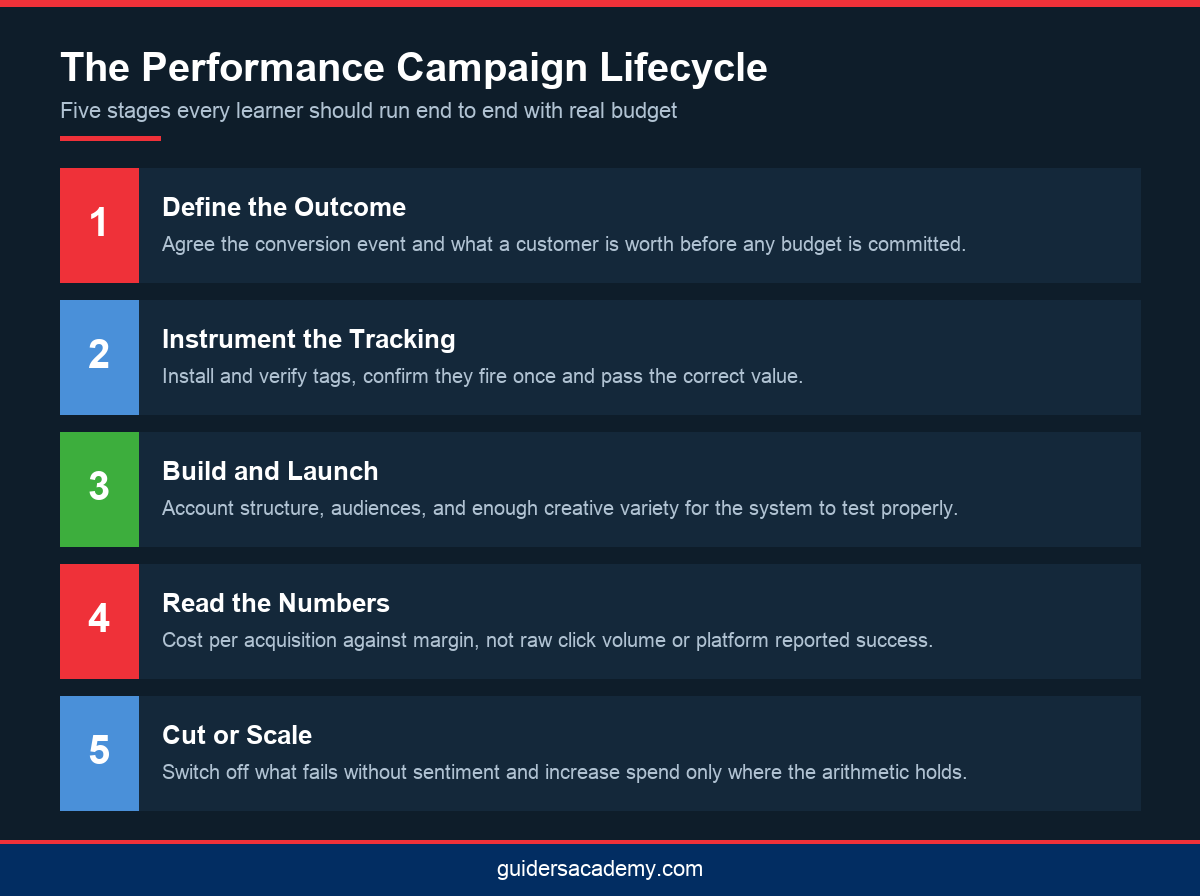
The mindset shift is the real lesson. Performance marketers are comfortable killing their own work when the numbers say so, and a course that never teaches learners to switch off something they built has skipped the most important habit in the field.
The Numbers You Will Be Tested On
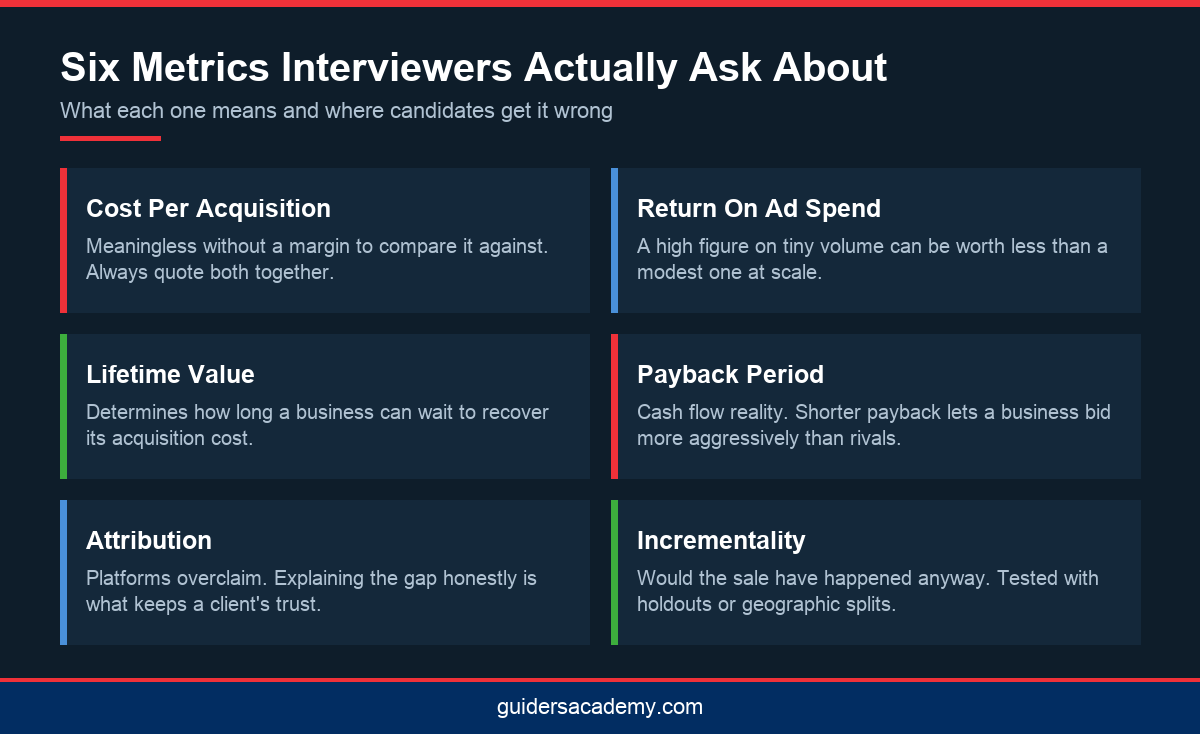
Cost per acquisition is the headline figure, but it means nothing without a margin to compare it against. Learners should be able to say what a customer is worth before deciding whether a given acquisition cost is a success or a slow way to lose money.
Return on ad spend is the second, and it is regularly misused. A high figure on a low volume campaign may be less valuable than a modest figure at scale, and interviewers ask about this precisely because it separates memorisation from understanding.
Lifetime value and payback period matter for anything with repeat purchase or subscription. A business that can wait three months to recover acquisition cost can outbid one that needs to break even on the first order, which changes the whole strategy.
Attribution is the hardest conversation. Every platform claims credit it cannot fully justify, reported conversions rarely reconcile, and a marketer who cannot explain that difference to a client will lose trust the first time the numbers are compared.
Incrementality is the advanced version of the same question. Would this sale have happened anyway. Testing that properly, through holdouts or geographic splits, is what distinguishes a senior practitioner from someone reporting whatever the dashboard displays.
Analytics literacy underpins all of it, and the free material in Google Analytics Academy covers the platform mechanics well enough that no institute should be charging a premium to teach them separately. Candidates who can defend these numbers are the ones described in why so many people are switching into marketing in 2026.
Sample size is the discipline that ties these together. Deciding a creative has failed after forty clicks is guesswork rather than optimisation, and learners who never internalise this will spend a career switching off campaigns before the data could possibly have told them anything.
Tools, Platforms and Real Budget
One search platform should be operated end to end. Building the account structure, writing the assets, configuring conversion tracking correctly, launching, and then reporting on the result teaches more in three weeks than a term of theory about auction mechanics.
One social platform should follow. Paid social behaves differently because the audience is not actively searching, which changes creative requirements, testing approach, and how quickly a campaign fatigues and needs replacement material.
Conversion tracking implementation must be hands on. Learners should install a tag, verify that it fires once, confirm the value passed is correct, and then deliberately break it so they recognise the symptoms when it happens on a client account.
Platform certifications are free and expected. Working through the Google Ads help documentation and the official training catalogue costs nothing, so treat any institute charging separately for them as a warning sign.
Real money is the non negotiable part. A budget of a few thousand rupees is enough to teach the emotional reality of spending someone else's money, watching a campaign underperform, and having to decide whether to persist or stop.
Reporting tools come last and matter least. A clear spreadsheet with honest commentary beats an elaborate dashboard that nobody reads, and employers consistently say that clear written explanation is the skill missing from junior candidates.
Careers, Employers and Choosing the Right Programme
The usual entry point is a paid media executive role in an agency, supporting account managers across several clients. It is the fastest way to see many accounts, many industries, and many failure modes within a single year of work.
In house roles follow, usually in e-commerce, education, healthcare, or real estate businesses that spend consistently. The account is smaller but the accountability is direct, and you see exactly how marketing spend affects the business behind it.
Freelance performance work is viable once you have a track record, though it demands commercial confidence. You are asking a business owner to trust you with real budget, and the route from training to independent client work is covered in this freelancing path.
Kochi carries most local demand, with steady volume from Trivandrum and Calicut, and a significant amount of remote work for clients outside the state. Several graduates also move into Gulf markets where the discipline transfers without much adjustment.
When comparing programmes, ask one question first: how much real money will I manage during this course. The answer sorts institutes quickly, and the wider market context in this career scope assessment for Kochi is worth reading alongside it.
Then check the outcome. Ask for the last batch size, how many were placed, into what roles, and at which companies, and confirm the institute can show a documented placement record rather than a headline percentage. Format matters less than supervision, a point this review of online study makes well.
Progression in this field is unusually fast for anyone who can demonstrate results. Because the outcomes are numerical, a candidate with a documented account history moves into specialist roles considerably sooner than in disciplines where contribution is harder to isolate.
Conclusion
A performance marketing masterclass in Kerala earns its name when learners manage real budget, implement their own conversion tracking, and defend their numbers to somebody who will challenge them. Look past the module list to the arithmetic being taught, insist on live account access, and treat any programme that avoids the uncomfortable questions about attribution and incrementality as incomplete. The discipline rewards people who are honest about results, including their own. To discuss the current batch and what live account access looks like, speak to the Guiders Academy team.