Meta Ads Expert Course in Kerala: What Good Looks Like
 General
A Meta Ads expert course in Kerala should be honest about one thing from the start: paid social is not social media management with a budget attached. It is a media buying discipline where nobody asked to see your advertisement, which changes everything about creative, targeting, and how quickly a campaign wears out. This guide sets out what separates paid social from paid search, the creative volume the platform actually needs, the measurement problems that catch out juniors, and how to judge a training programme in Kochi or Thrissur.
Key Takeaways
- Paid social interrupts rather than answers demand, so the creative has to earn attention before targeting can do anything useful.
- Automated audience delivery moved the skill from manual targeting to creative volume, offer clarity and accurate conversion signals.
- Campaign fatigue is faster on social than on search, so a production pipeline for new creative is part of the job itself.
- Judge a course by the live budget learners manage and the number of distinct creatives they actually shipped and tested.
Why Paid Social Is a Different Discipline From Paid Search
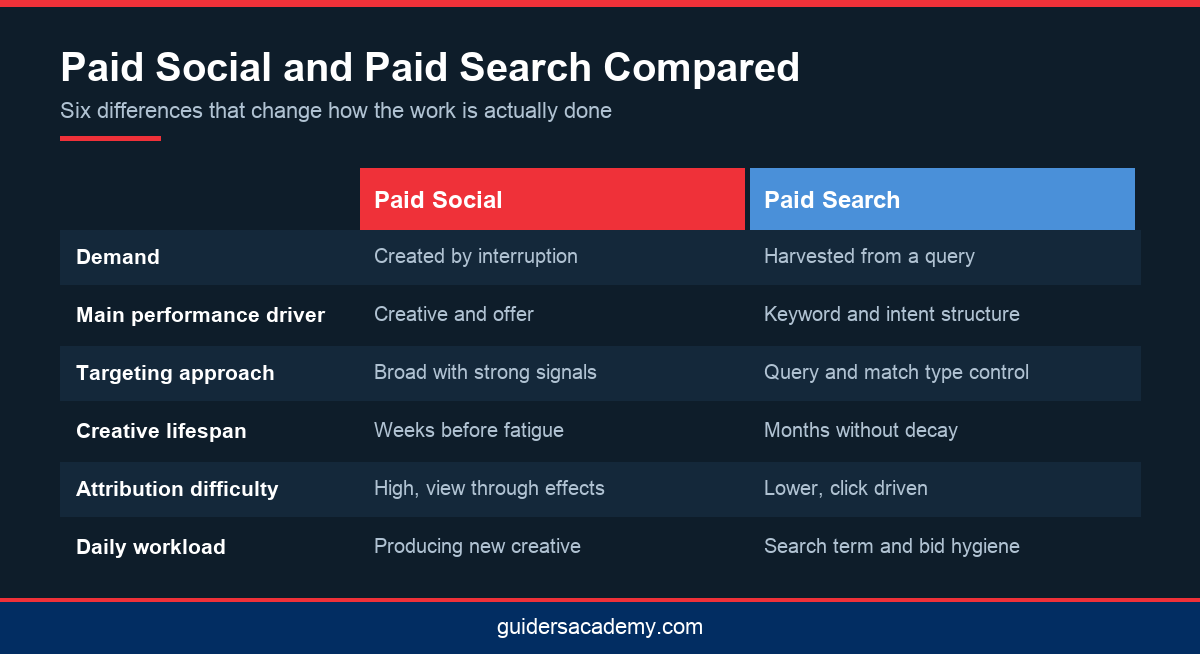
Paid search meets demand that already exists. Someone types a query, and your advertisement answers it. Paid social interrupts something else entirely, which means the first job of the creative is to earn a moment of attention that nobody offered voluntarily.
That single difference reorders the priorities. On search, keyword and intent structure carry most of the performance. On social, the creative carries it, and even excellent targeting cannot rescue an advertisement that people scroll past without registering it.
Audience targeting has also changed direction. Detailed manual audience building has given way to broader targeting with the delivery system finding buyers, provided it receives accurate conversion signals and enough creative variety to test against different people.
Fatigue arrives much faster too. A search advertisement can run for months without decay because new people keep searching. A social advertisement shown repeatedly to the same audience declines within weeks, which makes creative production a continuous requirement.
The measurement is harder to defend. Click through behaviour on social is noisier, view through effects are real but difficult to prove, and platform reported conversions frequently exceed what the business can see in its own records.
None of this makes paid social inferior. It reaches people before they have started searching, which is the only way to create demand rather than harvest it, and that is exactly why Kerala businesses with new products depend on it. Paid search runs on different instincts, which is why a broad career guide is worth reading alongside this.
The digital marketing programme at Guiders Education therefore spends most of its time on creative and measurement rather than on the interface, because the interface takes an afternoon to learn.
The Creative Volume the Platform Actually Needs
Most beginners produce three creatives and expect the system to optimise. It cannot. Automated delivery works by testing variations against different people, and a campaign given too little material simply repeats itself until the audience stops responding.
Volume means genuine variation rather than colour changes. Different hooks, different formats, different offers, and different lengths give the system meaningfully different options, whereas five versions of one idea are treated as one idea by the algorithm.
Short form video dominates and should be taught as a production workflow. Shooting, cutting, captioning, and publishing quickly is an operational skill, and the learner who can produce ten usable variants in a day is immediately valuable to any agency.
This is where generative tools genuinely help. Producing script variants, headline options, and format adaptations at speed is exactly the task they are good at, provided a person still selects, edits, and rejects what does not fit the brand.
The offer matters more than the production quality. A clear, specific, believable proposition in a rough video will beat a polished film with a vague message, and courses that emphasise aesthetics over offer clarity teach the wrong priority.
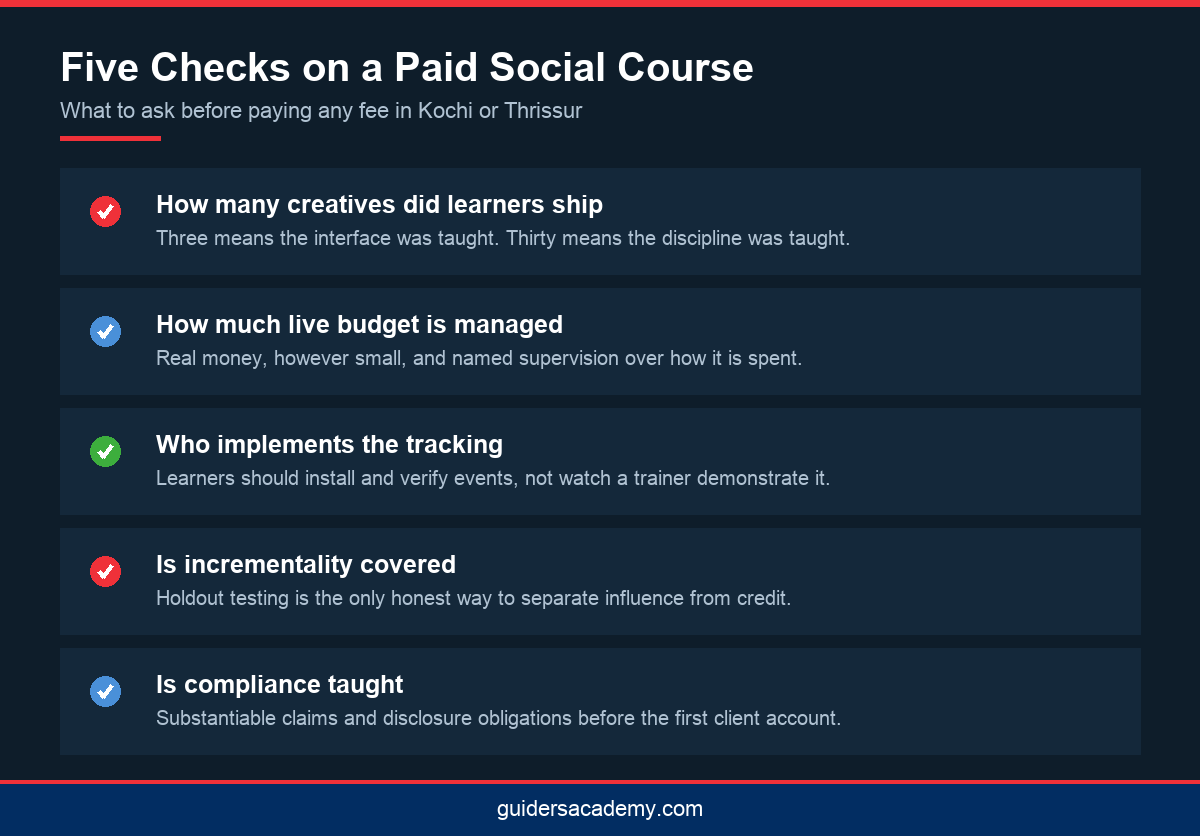
Compliance sits alongside creative work. Claims must be substantiable, and disclosure obligations under the Advertising Standards Council of India framework apply to promotional content, which juniors regularly discover only after a client raises a concern. Creative production at volume is increasingly an AI-assisted job, a shift covered in the future of AI marketing.
Testing discipline matters as much as production. Launching twelve creatives at once and switching them off after two days teaches nothing, so learners need to understand how long a variation must run before the result means anything at all.
Measurement, Attribution and the Honest Conversation
Conversion tracking has to be implemented rather than assumed. Learners should install the tracking, verify events fire once with correct values, and understand what changes when browser restrictions or consent choices interrupt the signal.
Platform reported results will overstate contribution. The system counts conversions it believes it influenced, including some it did not, and a media buyer who repeats those numbers without qualification will eventually be contradicted by the client's own sales data.
That makes independent measurement essential, and the free material in Google Analytics Academy covers enough of the mechanics for learners to compare platform claims against site behaviour rather than accepting one dashboard.
Incrementality is the honest test and it is rarely taught. Holding out a region or an audience segment and comparing outcomes shows whether the advertising created sales or simply took credit for ones that were going to happen anyway.
Frequency and audience saturation deserve attention. Watching cost per result rise as frequency climbs teaches learners to recognise fatigue early rather than concluding that the platform stopped working for reasons nobody can explain.
The reporting skill is what clients remember. Explaining what the platform claims, what the business can verify, and where the difference comes from is a conversation that builds trust precisely because it does not oversell the result.
Seasonality shapes the account calendar too. Festival periods, wedding seasons, and school admission cycles concentrate demand for many Kerala advertisers, and a media buyer who plans creative and budget around those peaks will outperform one who runs the same campaign every month.
Careers and How to Judge a Course in Kerala
The entry role is usually paid social executive or performance executive inside an agency, running campaigns for several clients at once. It is the fastest route to volume experience, and volume is what builds judgement in this discipline.
In house roles appear in e-commerce, education, healthcare, and hospitality businesses that advertise continuously. The account is smaller, the accountability is direct, and you generally get more control over the offer and the landing experience.
Freelance paid social work is common because small businesses advertise constantly and rarely employ a specialist. The route from training to independent client work is described in this account of moving from zero to freelancing.
When comparing institutes, ask how many distinct creatives each learner shipped during the course. A programme where the answer is three has taught the interface. One where the answer is thirty has taught the actual discipline.
Ask about live budget as well, and about who supervises it. The wider hiring context for these roles is covered in this career scope assessment for Kochi, which is worth reading before you commit a fee.
Finally, check the outcomes properly. Ask for last batch size, roles filled, and named employers, and confirm the institute keeps a documented placement record rather than quoting an unqualified percentage. Career direction is mapped in AI against digital marketing jobs.
Ask about the feedback loop on creative too. A trainer who reviews the advertisements a learner produced, explains why one hook worked and another did not, and sends them back to reshoot is teaching the part of this job that cannot be read.
Conclusion
A Meta Ads expert course in Kerala earns the word expert only when learners leave having produced real creative at volume, managed live budget, implemented their own tracking, and defended a result they could not fully attribute. Treat paid social as a creative and measurement discipline rather than an interface skill, and choose a programme by how much genuine production and account time it provides. The portfolio of campaigns you build is what carries the interview. To discuss the current batch, speak to the Guiders Academy team.
Frequently Asked Questions
What should a Meta Ads expert course in Kerala cover?

How is paid social different from Google Ads?
How many creatives do I need for one campaign?
Do I need video production skills?
Why do platform reported conversions exceed actual sales?
How much budget do I need while learning?
Do Indian advertising rules apply to social campaigns?
What jobs can I get after this course?
How do I judge whether a course is serious?