Accounting Career Growth in Kerala: 3 Real Paths
 General
Articles about accounting career growth in Kerala usually describe the qualifications and leave the career itself abstract. This piece follows three composite paths instead: one into practice and audit, one into corporate taxation, and one into a finance function inside a growing company. Each is assembled from the typical route graduates take rather than from a single named individual. The point is to show where the branches actually appear, what triggers each promotion, and which decisions in year two mattered most five years later.
Key Takeaways
- Almost every accounting career in Kerala starts on the same bookkeeping and compliance desk regardless of where it eventually goes.
- The branch point arrives around year two, when someone chooses practice, corporate finance or a specialism such as taxation.
- Software fluency and filing accuracy get people promoted faster than theoretical knowledge in every one of these three paths.
- The graduates who advanced fastest all added a specific certification while working rather than waiting for an employer to fund it.
The Shared Starting Point Everyone Passes Through
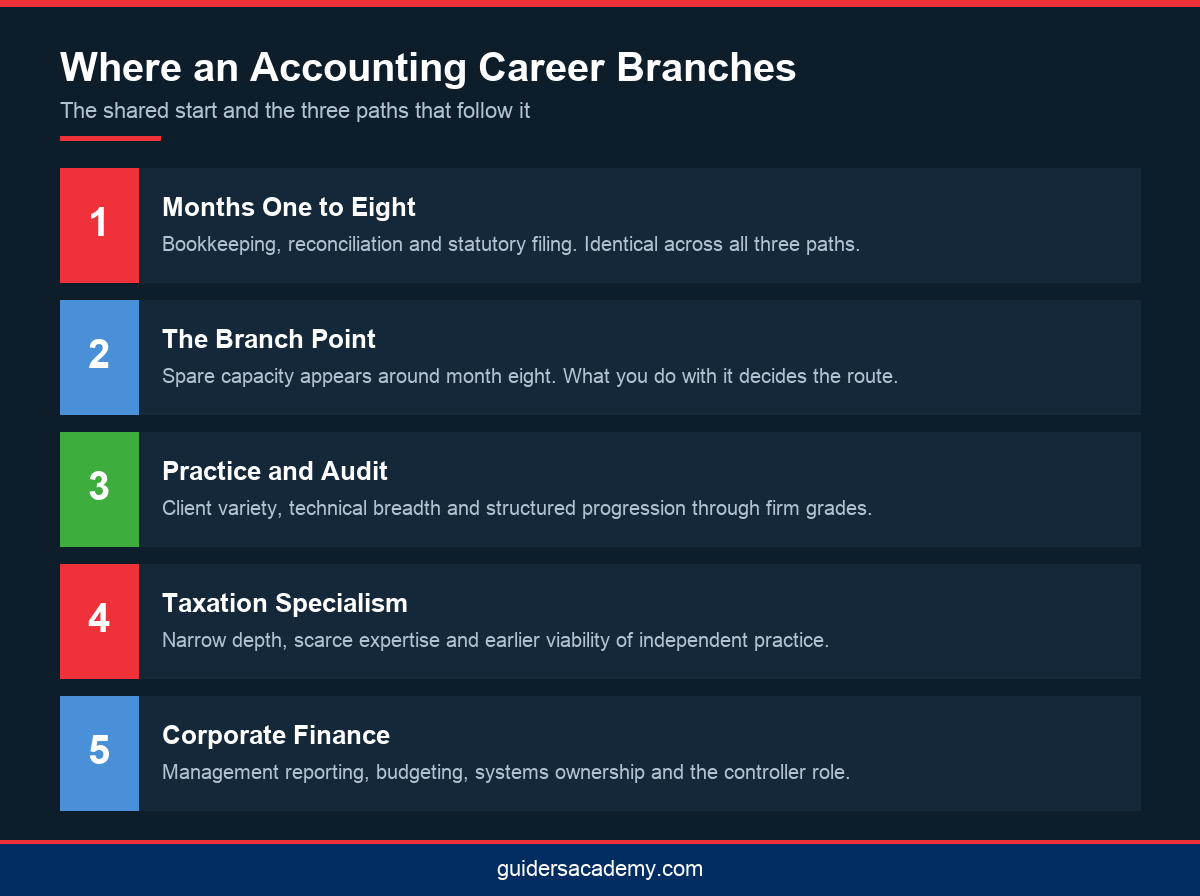
The first job is almost always the same regardless of ambition. Entering transactions, reconciling bank statements, chasing missing invoices, and preparing the routine filings occupy the first six months in practice and in industry alike.
That work is repetitive by design and it is teaching something. Handling hundreds of real transactions builds a feel for what a normal set of numbers looks like, which is what later allows someone to notice when something is wrong.
Software fluency arrives quickly or the job becomes painful. Accounting packages, spreadsheet work, and the statutory portals are used daily, and the graduate who learns keyboard level speed early frees up hours every week for actual thinking.
Statutory filing introduces real deadlines. Returns submitted through the GST portal and the income tax filing system have fixed dates and consequences, which imposes a discipline that classroom study rarely does.
Accuracy becomes an identity in this period. Colleagues form a view within months about whose work needs rechecking, and that reputation follows a person through every subsequent internal promotion decision far more than any examination result does.
The theory taught during the accounting programme at Guiders Education starts to make sense here rather than in the classroom, because the entries finally attach to something a person can see, follow through, and argue about with a colleague.
Most graduates report the same realisation at around month eight. The routine work has become fast, there is spare capacity, and what they do with that capacity is what separates the three paths that follow. The shared foundation is exactly what this explanation of accounting inside a business describes.
Path One: Practice, Audit and Compliance
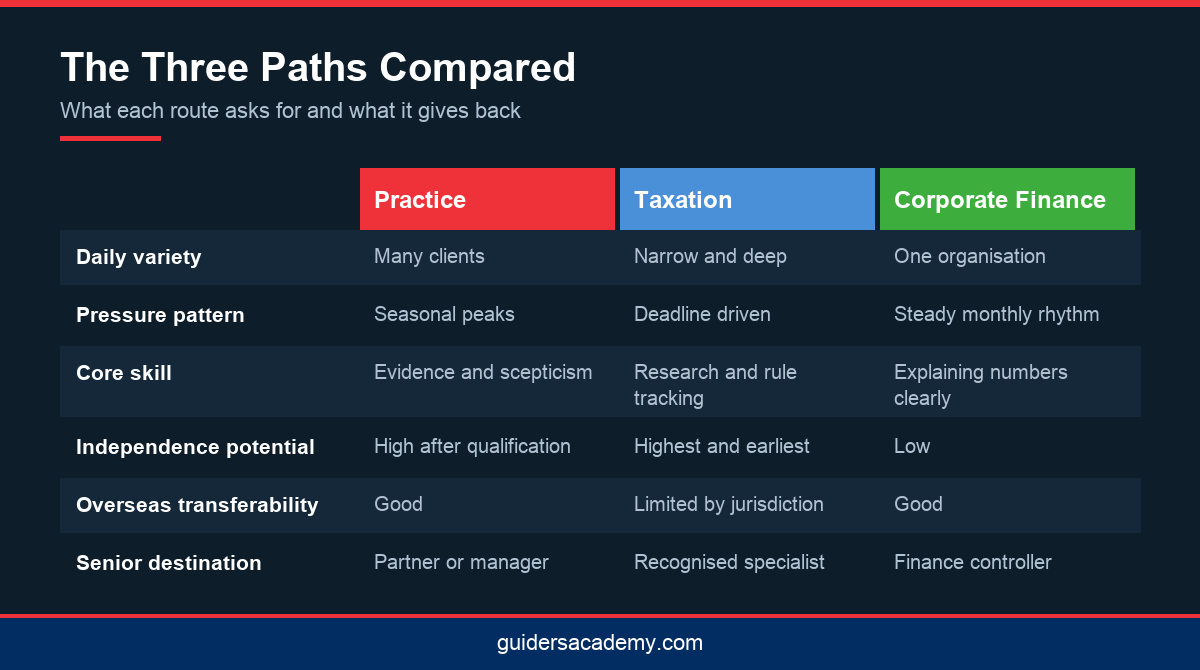
The first path runs through a chartered accountancy firm or an audit practice. Work is organised around clients rather than a single employer, and the variety is considerable because each client has different systems, problems, and personalities.
Audit teaches a particular kind of scepticism. Testing whether reported numbers are supported by evidence, tracing a balance back to source documents, and asking uncomfortable questions politely are skills that transfer into every finance role afterwards.
Progression here is fairly structured. Assistant to senior to supervisor follows a recognisable pattern, and the professional standards published by ICAI define much of the technical framework the work operates within.
The hours are demanding during statutory seasons and lighter afterwards. Graduates who cope well tend to be those who accept the rhythm rather than fighting it, and who use the quieter months to study for further qualifications.
Client exposure builds a network quickly. Many practice trained accountants eventually move into an industry role at a client they audited, which is one of the most common transitions in this profession anywhere in the state.
The technical depth acquired here is the path's real asset. Someone who has audited thirty different businesses understands more variations of a control problem than a colleague who has only ever seen one company's books.
This route suits people who like variety, cope with pressure in bursts, and are comfortable being the person asking questions rather than the person answering them at a management meeting.
Study alongside the job is effectively expected on this route. Firms build their schedules around examination seasons, colleagues sit the same papers, and the peer pressure that creates is one of the reasons practice trained accountants qualify faster than their industry counterparts. Practice work leans heavily on software, which is where practical Tally training in Ernakulam earns its place.
Path Two: Taxation and Regulatory Specialism
The second path narrows deliberately into taxation. Indirect tax, direct tax, and increasingly transfer pricing and international structuring are distinct bodies of knowledge that reward depth rather than breadth over a career.
The trigger is usually accidental. Someone handles a complicated assessment or a notice in year two, finds the research satisfying rather than tedious, and begins volunteering for the tax work that colleagues avoid whenever possible.
Regulatory change is the constant. Rules shift regularly, and the professionals who stay current by reading primary sources rather than summaries become the person their firm sends into a difficult conversation with an authority.
The scarcity is real and it shows in pay. Businesses across Kerala need reliable tax advice, competent specialists are limited in number, and independent practice becomes viable earlier in this path than in most other accounting routes.
The work also travels less well than general accounting. Tax knowledge is jurisdiction specific, so someone planning to work overseas should think carefully before specialising too narrowly too early in their career.
Building the specialism usually means studying while working. The skills every aspiring accountant should master include the study discipline that makes this possible alongside a full time job.
This route suits people who enjoy research, tolerate ambiguity in rules, and prefer being the recognised expert on a narrow subject to managing a broad function with many moving parts.
Path Three: Corporate Finance and the Controller Route
The third path moves into a company finance function rather than a practice. The work shifts from checking numbers to producing them, and then to explaining what they mean to people who do not read accounts easily.
Management reporting is the first real step up. Preparing monthly figures, variance analysis, and commentary for a leadership team requires understanding the business rather than only the ledger, which is a genuine change in the nature of the job.
Budgeting and forecasting follow. This is where finance becomes forward looking, and where an accountant starts influencing decisions rather than recording their consequences after the fact in a set of monthly statements.
Systems ownership often lands here too. Someone has to run the accounting platform, manage integrations, and design the reporting structure, and that person tends to become indispensable to the operation quite quickly.
The controller role consolidates all of it. Responsibility for the accuracy of the accounts, the compliance calendar, the team, and the relationship with auditors makes this the natural senior destination of the corporate route.
The range of destinations is wider than most graduates expect, as the overview of career opportunities with an accounting qualification sets out across sectors that do not describe themselves as finance businesses.
This route suits people who want to belong to one organisation, enjoy explaining numbers to non specialists, and are willing to take responsibility for a function rather than for a set of individual tasks.
Non finance sectors employ more of these people than most students expect. Hospitals, educational trusts, hotels, construction firms and cooperative societies across Kerala all run finance functions, and several of them offer faster responsibility than a small accounting practice would. Graduates weighing further study should look at professional options after a BCom.
Conclusion
Accounting career growth in Kerala follows a predictable shape: a shared bookkeeping and compliance start, a branch point around year two, and then divergence into practice, taxation, or a corporate finance function. What actually accelerated each of these composite paths was the same in all three cases, which was software fluency, filing accuracy, and adding a specific qualification while working rather than waiting for someone to fund it. Decide the branch deliberately. To discuss which accounting programme fits the path you want, contact the Guiders Academy team.
Frequently Asked Questions
What does accounting career growth in Kerala usually look like?

Is the first accounting job always repetitive?
Which path pays best over a career?
How important is accounting software skill?
Should I study further while working?
Can I move between these three paths later?
Does tax specialisation limit overseas options?
What triggers the first real promotion?
Which route suits someone who dislikes deadlines?