Is Your Digital Marketing Course Really Approved?
 Digital Marketing
Searching for a government approved digital marketing course in Kerala turns up dozens of institutes using the phrase and almost none explaining it. The words approved, recognised, certified, and accredited get used interchangeably in advertising even though they mean very different things in Indian education. This guide explains which bodies actually approve what, how to verify a claim in a few minutes, when the approval genuinely matters for your career, and when a platform certification or a portfolio of live campaign work will serve you far better.
Key Takeaways
- Approved, recognised, certified and accredited are not interchangeable, and only some of them refer to a national qualification.
- Skill sector approval, university affiliation, platform certification and private accreditation are four separate things with different weight.
- Verification takes minutes: ask for the awarding body, the qualification name, and the exact wording of the certificate issued.
- For most Kerala marketing employers a portfolio of live campaign work outweighs the approval status of the course entirely.
What the Four Words Actually Mean
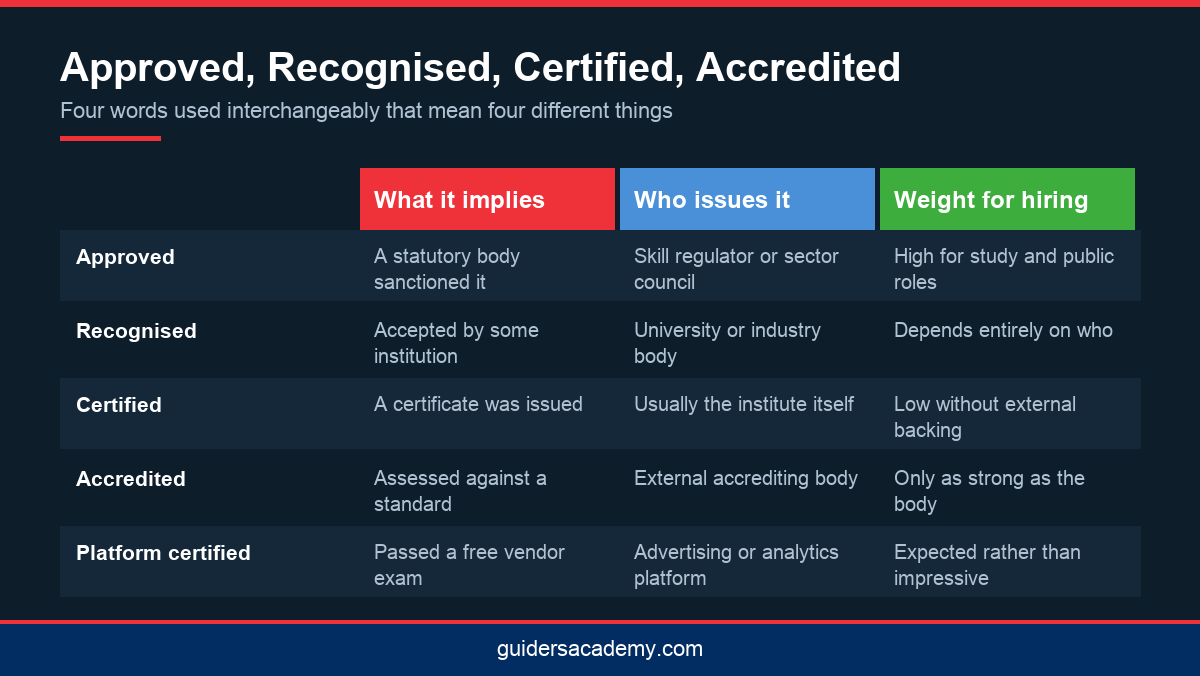
Approved usually implies that a statutory or regulatory body has sanctioned a programme or an institution. In vocational training that generally points to the national skill framework rather than to a state education department, and the specific body should be named.
Recognised is looser and often refers to a qualification being accepted by a university, an industry association, or an employer group. It can be meaningful, but on its own it tells you nothing without knowing who is doing the recognising.
Certified normally refers to the certificate a learner receives at the end, which any institute can issue in its own name. That is not dishonest, but it says nothing about external validation, and it is the most commonly used of the four terms.
Accredited should mean that an external body has assessed the institution against a published standard. In practice it is sometimes used to describe a commercial partnership, which is why the name of the accrediting body matters more than the word itself.
The regulator for vocational awarding and assessment bodies in India is NCVET, while skill development programmes sit within the framework overseen by the Ministry of Skill Development and Entrepreneurship. Those are the names worth looking for.
Degree and diploma programmes affiliated to universities operate under a different system entirely, and a marketing certificate course is rarely part of it, so a claim referencing university approval deserves a question about which programme it covers.
None of this means an unapproved course is a poor course. It means the phrase needs a follow up question before it can be treated as a differentiator, whichever digital marketing programme you are comparing.
How to Verify a Claim in Ten Minutes
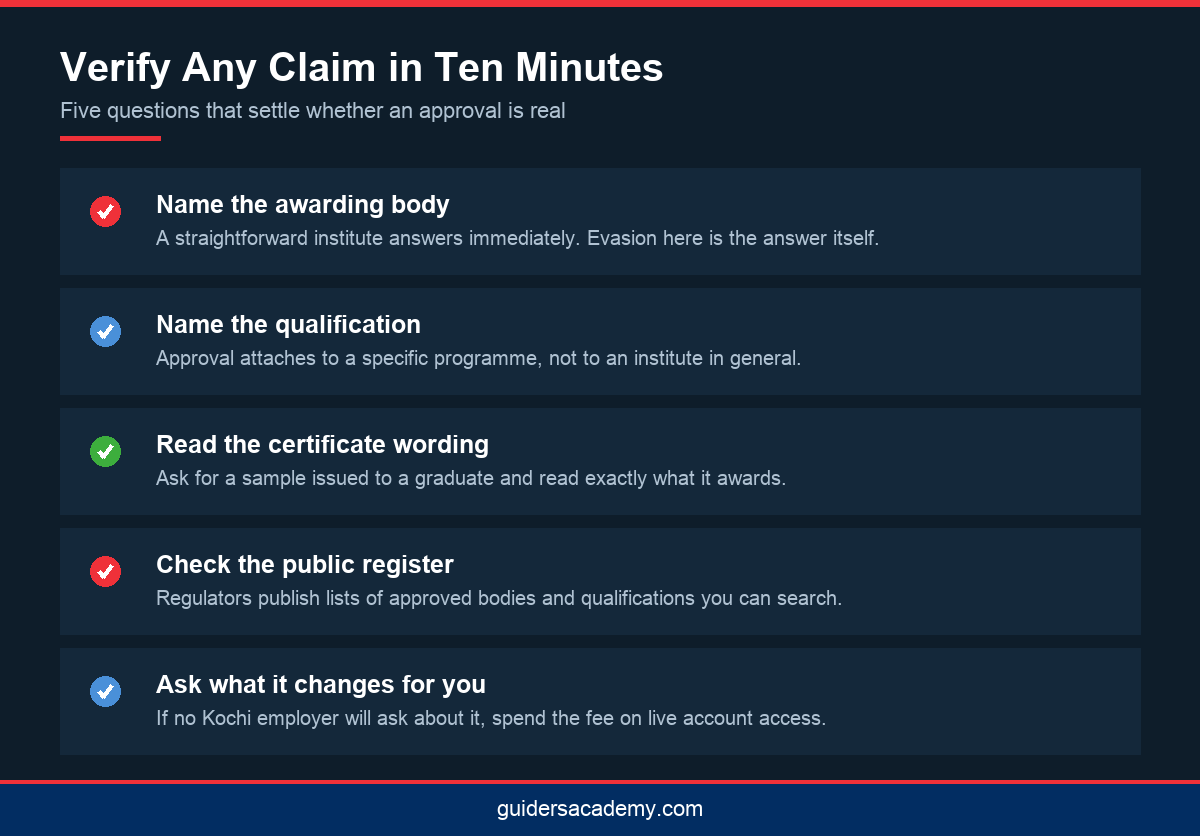
Start by asking for the awarding body by name. A straightforward institute will answer immediately, and an evasive answer at this point is more informative than anything printed in the brochure you were handed at the front desk.
Then ask for the qualification title. Approval attaches to a specific named qualification rather than to an institute in general, and a body may have approved one programme while the marketing course you are considering sits outside it entirely.
Ask to see the actual certificate a graduate receives. Reading the wording tells you exactly what is being awarded and by whom, and it takes one minute. Any hesitation about sharing a sample is itself an answer to the question.
Check the claim against the body's own published register where one exists. Regulators and skill councils maintain lists of approved bodies and qualifications, and a claim that cannot be found there needs an explanation rather than a benefit of the doubt.
Separate the platform certifications out. Advertising and analytics credentials are genuinely valuable, entirely free, and issued by the platforms themselves, so their presence in a syllabus is standard rather than evidence of government approval.
Finally, ask what the approval changes for you. If the answer is a line on a certificate that no marketing employer in Kochi will ask about, the fee difference between two courses is better spent on one with live account access. The same verification habit applies to any institute claim, and this guide to choosing a development course applies the identical test.
Keep a written record of the answers as well. If an institute later issues a certificate that does not match what you were told at enrolment, a dated note of the conversation and the sample certificate you were shown is the only useful evidence you will have.
When Approval Genuinely Matters and When It Does Not
It matters for further study. If you intend to use the qualification toward a degree, a diploma, or an application requiring recognised credentials, the awarding body has to be one the receiving institution accepts, and that must be checked in advance.
It matters for some overseas processes. Visa and employment routes in certain countries ask for qualifications from recognised awarding bodies, and Kerala has a large number of learners who eventually work abroad, which makes this worth confirming early.
It matters for government and public sector roles where eligibility criteria are written around specific qualification frameworks. Private marketing employers almost never apply those criteria, but public sector recruitment frequently does and states it explicitly.
It matters much less for ordinary hiring. Agencies and in house teams in Kochi ask what you have run, what it cost, and what it returned, and the approval status of your course does not appear in that conversation.
It matters least of all for freelance work. A client hiring you to run their campaigns wants evidence that you can produce results, and a portfolio with numbers attached settles that question far faster than any certificate can. For most employers the label matters far less than the evidence described in why people move into marketing careers.
The practical conclusion is to know why you want the approval. Anyone whose goal is a marketing job should weigh live account access and cohort outcomes far more heavily, as set out in this digital marketing career guide for Kerala.
What to Look For Instead of the Label
Look at live account access first. Whether learners manage real budget, implement their own conversion tracking, and work on a real website is the single largest difference in outcome between two otherwise identical syllabuses in this state.
Look at who teaches. Trainers with client experience explain why a technically correct decision was still commercially wrong, which is the reasoning a junior marketer needs and which no approval framework assesses in any way.
Look at cohort evidence. Ask for the campaigns, audits, and reports produced by the last batch with the numbers attached, because a confident institute will show them and a weak one will change the subject to accreditation.
Look at the placement denominator. A percentage means nothing without batch size, so ask how many learners there were, how many were placed, into which roles, and whether the institute maintains a documented placement record.
Look at the institution's published position. Where an institute does hold external recognition it should list it openly, and Guiders publishes its accreditations rather than relying on an unexplained phrase in advertising copy.
Look at fit as well. The trade offs between classroom and online study are real, and the assessment of whether a remote programme is worth the fee is worth reading before you decide. What a serious curriculum contains is set out in this 2026 view of AI marketing training in Kochi.
Look at the fee against what is actually included too. A course costing less because it omits live account access is not cheaper in any meaningful sense, since the missing component is the one that determines whether you can be hired afterwards.
Conclusion
A government approved digital marketing course in Kerala can be exactly what you need or an empty phrase, and the difference is settled by three questions: which body, which qualification, and what does the certificate actually say. Ask them before you pay. If your goal is further study, an overseas process, or public sector eligibility, insist on a verifiable answer. If your goal is a marketing job in Kochi, weigh live campaign access far more heavily than the label. To ask those questions directly, contact the Guiders Academy team.
Frequently Asked Questions
What does a government approved digital marketing course in Kerala mean?

Which body approves vocational courses in India?
How do I verify an institute's approval claim?
Are free platform certifications the same as government approval?
Does approval matter for getting a marketing job in Kochi?
Is an unapproved course a bad course?
Will approval help me work abroad?
What if an institute refuses to name the awarding body?
What should I prioritise instead?