Google Ads and PPC Certification in Kerala: Worth the Fee
 General
Google Ads and PPC certification training in Kerala carries an awkward truth at its centre: the certification itself is free, available to anyone, and takes a weekend. So what exactly are you paying an institute for. The honest answer is account judgement, which no online exam tests. This guide separates the certificate from the skill, sets out what a paid training programme must add on top of the free material, and lists the account questions that Kochi employers actually ask when they interview a junior media buyer.
Key Takeaways
- The official certification is free and expected, so any institute charging separately for it is adding cost rather than value.
- What you pay for is supervised account work: structure, tracking, creative testing, and the judgement to stop something that fails.
- Automated bidding moved the skill to feeding correct conversion data and supplying enough creative for the system to test.
- Interviews test arithmetic and account decisions, not definitions, so insist on training that ends in a real campaign you ran.
What the Free Certification Does and Does Not Prove
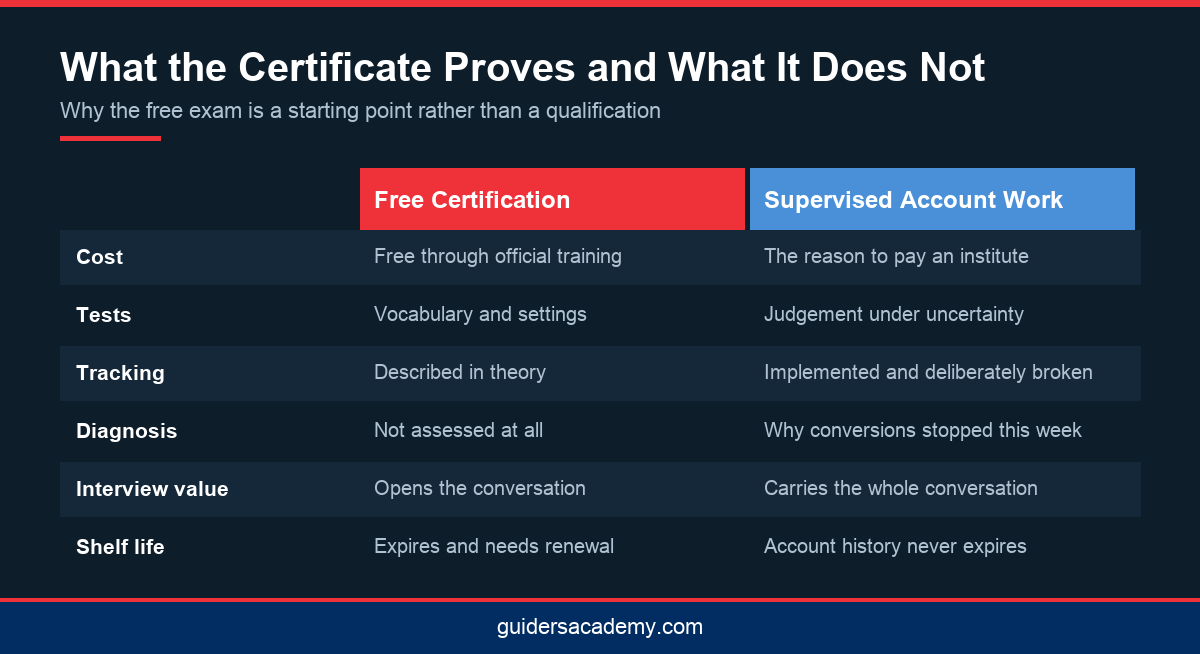
The official exams cover platform vocabulary, campaign types, policy basics, and the intended purpose of each setting. They are useful, they are genuinely worth holding, and the material sits publicly in the Google Ads help documentation for anyone to read.
They also cost nothing. The exams and the supporting courses are free through the official Skillshop training catalogue, which means an institute charging a premium specifically for certification is repackaging public material rather than teaching anything new.
What the exam cannot test is judgement under uncertainty. Nothing in a multiple choice question replicates deciding whether a campaign at twice its target acquisition cost should be restructured, given more time, or switched off before the month ends.
Nor can it test diagnosis. Working out why conversions stopped, whether a tag broke, whether a competitor entered the auction, or whether a landing page change caused the drop is the daily work and it requires access to a real account.
Employers know this. In interviews they skip the definitions and ask what you ran, what it cost, what it returned, and what you changed when it underperformed, and candidates with only a certificate have nothing to say at that point.
That is the value proposition a paid programme has to justify. The digital marketing programme at Guiders Education uses the free material as the baseline and spends its own time on supervised account work. The gap between a certificate and hireable skill is a recurring theme in why people are switching into marketing careers.
It should also be honest about the certificate's shelf life. These credentials expire and the platform changes several times a year, so the durable asset is the account history you build rather than the badge itself.
What Supervised Account Work Should Cover
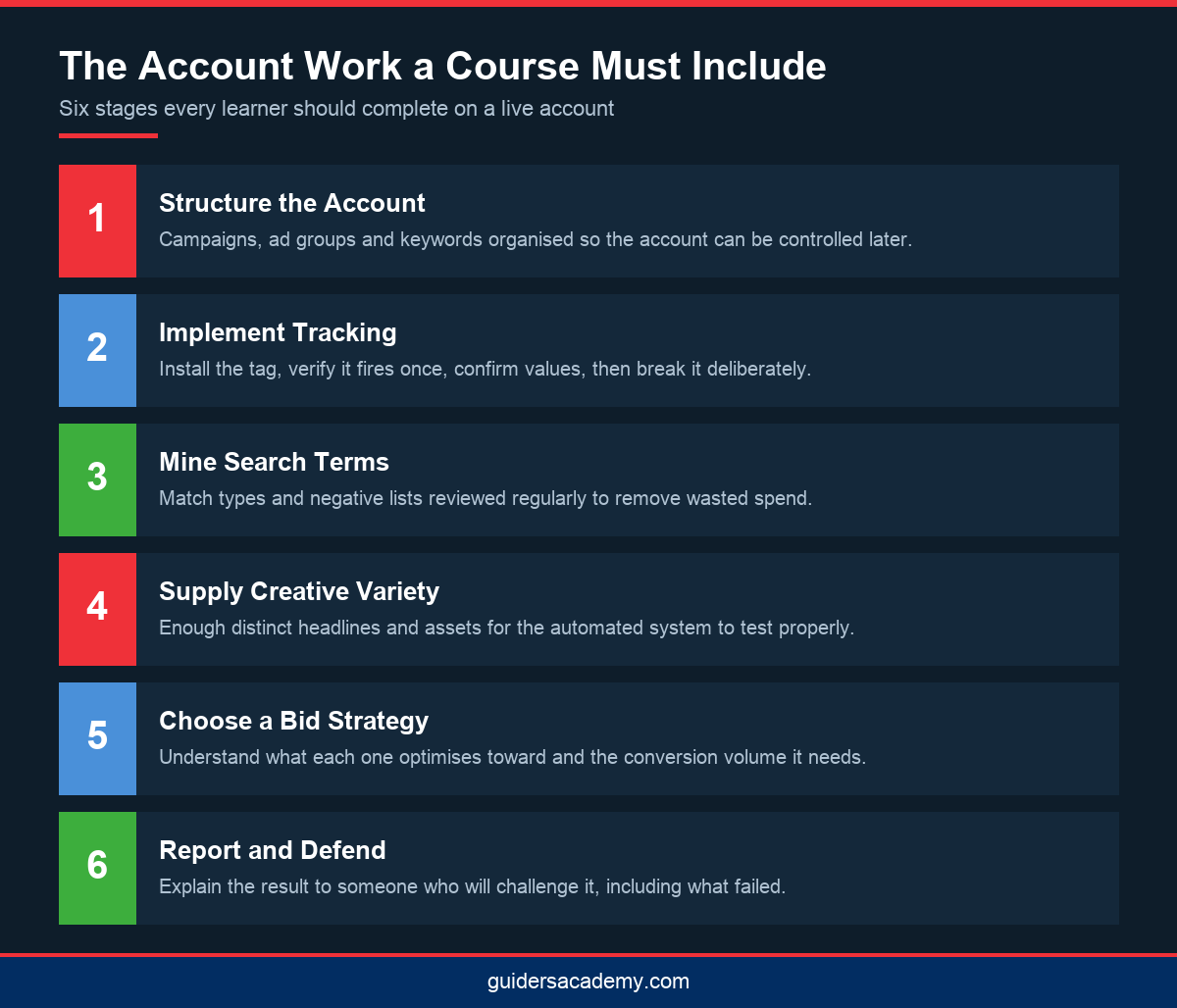
Account structure comes first. How campaigns, ad groups, and keywords are organised determines what you can control later, and a badly structured account is difficult to diagnose no matter how much budget is subsequently poured into it.
Conversion tracking must be implemented by the learner rather than demonstrated. Installing a tag, verifying it fires once, confirming the value passed is correct, and deliberately breaking it teaches recognition of the most common and most expensive account fault.
Keyword and search term work follows. Match types, negative keyword lists, and regular search term review are where wasted spend is found, and a learner who has never mined a search term report has not done the core hygiene task of the role.
Creative volume matters more than it used to. Automated systems need many distinct headlines, descriptions, and assets to test against, so producing and rotating that variety has become an operational requirement rather than a creative flourish.
Bidding strategy needs explanation rather than instruction. Learners should understand what each automated strategy optimises toward, when it needs sufficient conversion volume to work, and how it fails when the goal it is given does not match the business one.
Landing page quality belongs in the syllabus too. Paid traffic sent to a slow or unconvincing page fails regardless of account quality, and media buyers who cannot argue for a page change are limited in what they can achieve.
Finally, the reporting conversation. Explaining results to someone who will challenge them, including the parts that did not work, is the skill that turns a competent operator into someone a client or manager will trust with a bigger budget.
The Arithmetic Employers Test
Cost per acquisition is the first question and it is never asked alone. A good answer states what the customer was worth, which is the only context in which an acquisition cost can be judged as acceptable or wasteful.
Return on ad spend comes second, usually with a trap attached. Interviewers like to offer a very high figure on trivial volume and see whether the candidate notices that scale, not ratio, is what the business actually needed.
Impression share and lost share explain missed opportunity. Knowing whether you lost auctions to budget or to rank tells you which lever to pull, and candidates who confuse the two give away that they have not managed a constrained account.
Quality signals affect cost directly. Understanding how relevance between keyword, advertisement, and landing page influences what you pay per click is the mechanism behind most efficiency gains a junior buyer can actually deliver.
Attribution comes up in every serious interview. Platforms overclaim, reported conversions rarely reconcile with the business system, and the ability to explain that difference calmly is what stops a client from concluding they are being misled. Freelance work is where the arithmetic bites hardest, as this account of building income from marketing shows.
The wider commercial framing sits in this discussion of career scope for AI digital marketing in Kochi, which covers where paid media specialists sit within the local hiring market.
Choosing a Programme and What Comes After
Ask the budget question first. How much real money will learners manage during this course, on whose account, and with what supervision. The answer sorts institutes faster than any comparison of module lists ever will.
Ask who teaches the module. A trainer who has managed client accounts under commercial pressure can explain why a technically correct decision was still the wrong one, which is exactly the reasoning a junior buyer needs to absorb.
Check whether learners implement tracking themselves. This is the single most common point of failure in real accounts, and a course that only demonstrates it produces graduates who cannot diagnose the problem when it inevitably occurs.
Ask what happens with the account afterwards. A learner who leaves with a documented campaign, its numbers, and a written account of the decisions taken has a portfolio, while one who leaves with a certificate has a credential anyone can get free.
Consider the wider programme too. Paid search rarely stands alone in a Kerala marketing role, and the broader digital marketing career guide for Kerala explains how the specialism fits alongside the other channels.
Then verify the outcome. Ask for the last batch size, how many were placed, in which roles, and at which companies, and confirm there is a documented placement record behind the headline figure. Whether to study online or in a room is treated honestly in this review of online programmes.
Finally, ask what account access looks like after the course ends. Learners who can keep managing a small live account while job hunting arrive at interviews with recent results, which is a meaningful advantage over a portfolio that stopped on the last day of class.
Conclusion
Google Ads and PPC certification training in Kerala is worth paying for only when it delivers what the free certification cannot: supervised work on a real account with real money, tracking you implemented yourself, and the habit of defending your numbers to someone who will challenge them. Take the free exams regardless, then choose a programme by how much account time it gives you. The portfolio you leave with matters more than the badge. To discuss live account access on the current batch, speak to the Guiders Academy team.
Frequently Asked Questions
Is Google Ads and PPC certification training in Kerala worth paying for?

How long does the official certification take?
Do certifications expire?
How much budget do I need to learn properly?
Has automated bidding made this skill obsolete?
What do interviewers actually ask in a PPC interview?
Can I work in PPC without a marketing degree?
Which industries in Kerala run the largest PPC budgets?
How do I compare two institutes offering PPC training?