Generative AI for Marketing in Kerala: Tool or Threat?
 General
Generative AI for marketing in Kerala is taught in two very different ways. One version hands learners a list of prompts and calls it a module. The other treats the tools as part of a working process, with checking, editing, and judgement built around them. Only the second produces people that employers want, because generating marketing assets is now close to free while deciding what is worth publishing is not. This guide sets out what belongs in a serious course, where these tools genuinely fail, and what remains a human skill.
Key Takeaways
- Generative tools compress drafting, variation and summarising, which changes how marketing work is scheduled rather than removing the role.
- The employable skill is briefing well, verifying output against sources, and editing until the result carries a distinct brand voice.
- Factual errors, invented citations and generic tone are the three failure modes that must be trained out deliberately.
- Judge a course by whether learners produce publishable work with an audit trail, not by how many tools appear on the syllabus.
What Generative AI Genuinely Changed in Marketing Work
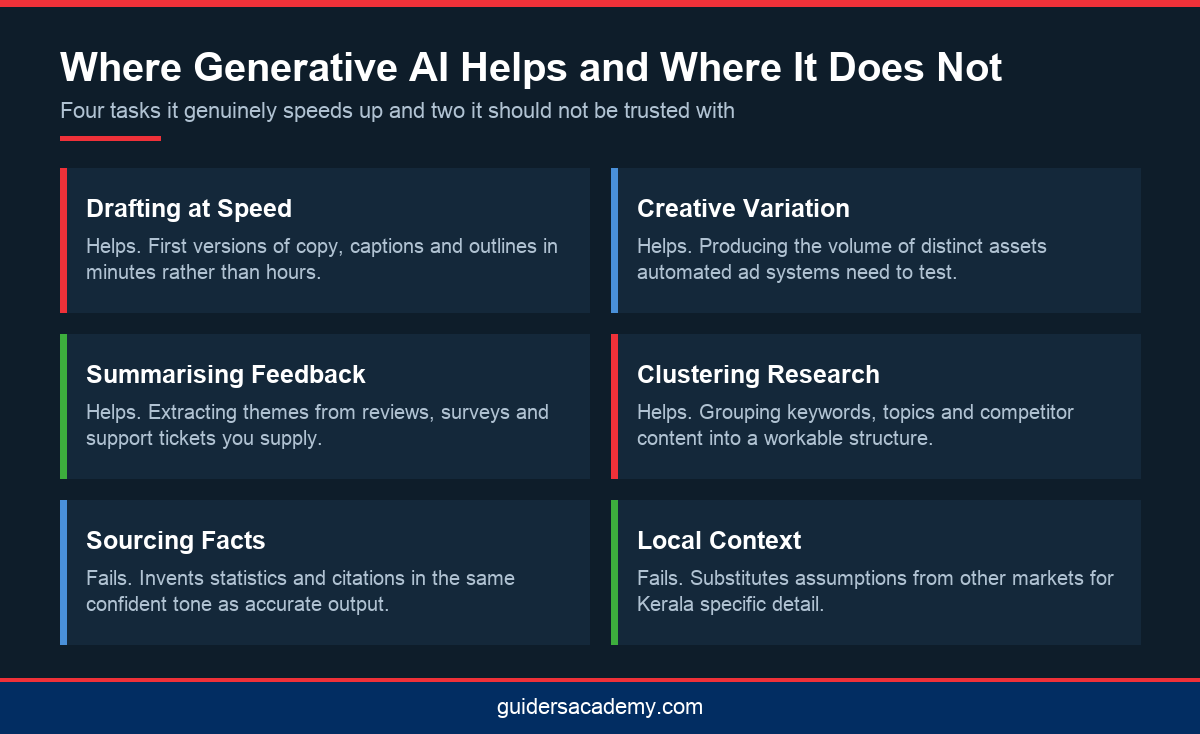
The clearest change is drafting speed. A first version of ad copy, a set of social captions, an email sequence, or an outline that once took a morning now takes minutes, which frees time that used to be spent producing rather than deciding.
Variation is the second change, and it matters more than most people expect in paid media. Automated advertising systems need many distinct headlines and images to test against, and producing that volume by hand was previously the bottleneck in every campaign.
Summarising and analysis form the third. Reading through survey responses, review text, support tickets, or competitor content and extracting themes is work that these tools do quickly and reasonably well when the material is provided rather than assumed.
Research is where the tools are least reliable and most used. A model that produces a confident paragraph containing an invented statistic has cost a marketer more time than it saved, because the error is only found after someone has repeated it publicly.
None of this removes the marketing role. It removes a category of production work, which is why the digital marketing programme at Guiders Education has to spend its time on judgement, verification and editing rather than on tool demonstrations that will be obsolete within a year. The commercial context is set out in this 2026 view of AI marketing careers in Kochi.
The broader shift in the profession is set out in the existing overview of AI driven digital marketing as the future of the field, which is worth reading before deciding how much weight to give this module.
What a Serious Generative AI Module Should Teach
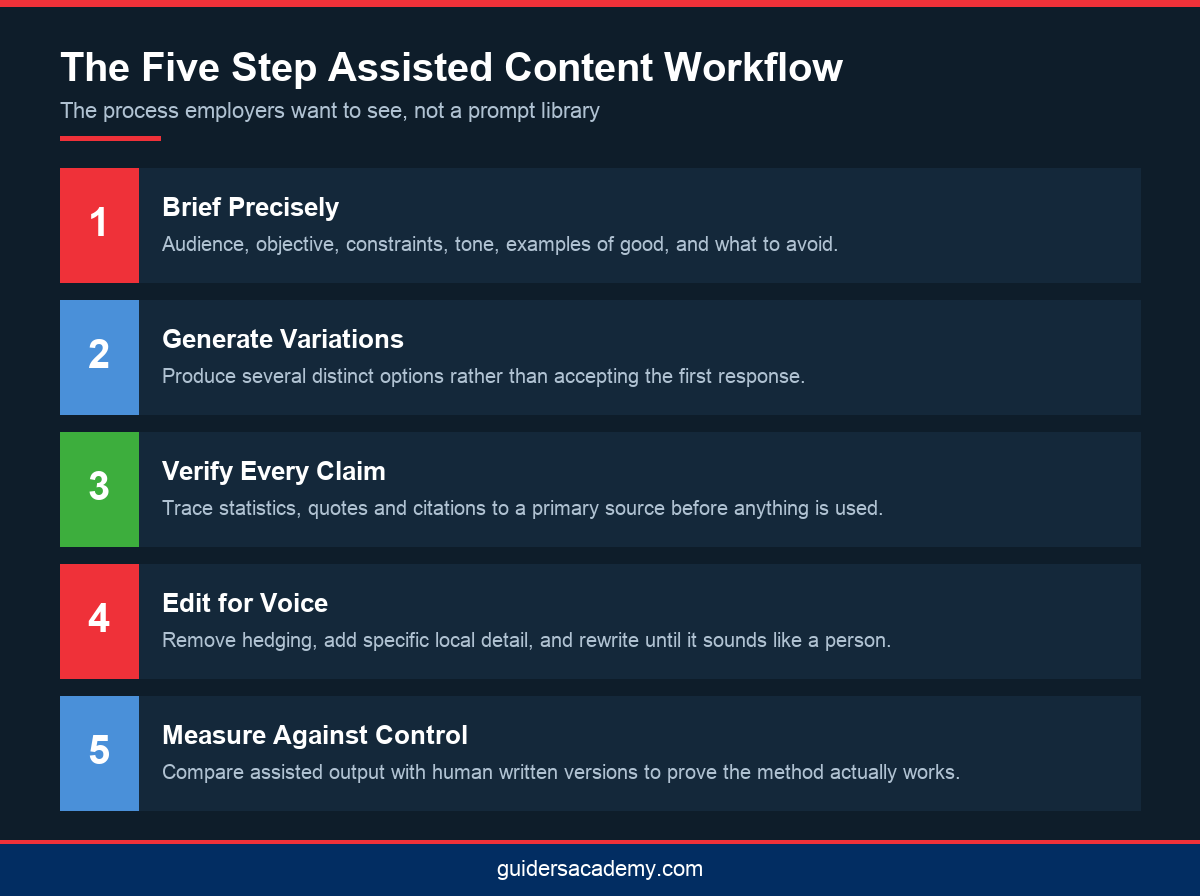
Briefing comes first. A useful brief carries audience, objective, constraints, tone, examples of what good looks like, and what to avoid. Learners who type a one line request and complain about generic output have not yet been taught the actual skill.
Verification comes second and should be assessed. Every factual claim, statistic, or citation in a generated draft must be traced to a source before publication, and a course that does not build this habit is training people to publish errors confidently.
Editing for voice is the third component. Model output has a recognisable cadence, and removing it requires deliberate rewriting: shorter sentences, specific detail, local reference, and the removal of the hedging phrases that appear in almost every generated paragraph.
Structured application is the fourth. Using these tools well inside a specific channel, whether that is producing thirty ad variants, drafting a content brief, or clustering keyword research, is more useful than general prompt technique taught in isolation.
Policy and disclosure deserve a session. Learners should understand what client data can be entered into a third party tool, what should never leave a company system, and how to record which assets were AI assisted for later review.
Finally, measurement. Comparing the performance of AI assisted work against human written control versions is the only way to know whether the tools help in a given context, and very few courses ask learners to run that test.
Measurement literacy sits underneath all of it, and the free material in Google Analytics Academy is enough to teach learners how to set up an honest comparison between assisted and unassisted work rather than guessing at the difference.
Where These Tools Fail and Why It Matters
Confident invention is the most dangerous failure. Models produce plausible statistics, misattributed quotes, and citations to documents that do not exist, and they do so in the same assured tone as accurate output, which defeats casual review completely.
Genericness is the most common failure. Because the output reflects a very large average of published text, unedited drafts read like every competitor's content, which fails the usefulness standard set out in the Google search documentation and defeats the entire point of publishing.
Local context is a persistent weakness. Content written for a Kerala audience needs the right cities, regulations, seasons, festivals, and price expectations, and generated drafts routinely substitute assumptions drawn from a different market entirely.
Recency is limited too. Anything that depends on the current version of a platform, a fee structure, or a rule that changed recently should be verified against a primary source rather than trusted from the model's own account of it.
There is a career risk as well as a content risk. Marketers who use these tools only to produce output are competing with software rather than using it, and that position weakens each time the tools improve slightly. None of that removes the fundamentals covered in a full marketing career guide.
The honest comparison of what this means for jobs is set out in the existing discussion of AI against digital marketing careers, which is a more useful starting point than either the optimistic or alarmed version of the debate.
How to Judge a Course Teaching Generative AI
Ask what learners produce. A module that ends with a folder of published work, each item traceable to a brief, a source check, and an edit pass, has taught a process. One that ends with a prompt library has taught a shortcut.
Ask how errors are handled. The strongest sign of a serious course is an exercise where learners are given a generated draft containing deliberate factual errors and are marked on how many they catch before it goes anywhere near a client.
Check that the module sits inside the channels rather than beside them. Learning to use these tools for search content, for ad variation, and for analysis separately is more useful than a standalone unit that never touches real campaign work.
Be wary of tool count as a selling point. Naming twenty platforms is easy and dates within a year, whereas teaching a repeatable working method survives every model release and transfers to whichever tool an employer happens to use.
Ask about the disclosure and data policy taught. Any institute that has not thought about what client information learners may paste into a third party service has not thought carefully about professional practice at all.
Then look at outcomes as usual. Where did the last cohort go, what were they hired to do, and can the institute show a documented placement record rather than a general statement about industry demand for AI skills. Freelancers in particular should read how the work translates into income.
Ask how the module is updated as well. Model behaviour changes several times a year, so an institute that cannot describe how it revises this material is teaching from a syllabus that was accurate at some point in the past.
Conclusion
Generative AI for marketing in Kerala is worth studying as a working method rather than as a novelty, and the difference shows up immediately in what a graduate can produce. Learn to brief precisely, verify every claim, edit until the writing sounds like a person from this market, and measure whether the assisted version actually performs better. The tools will keep changing; the discipline around them will not. To discuss how this module runs inside the wider marketing programme, speak to the Guiders Academy team.