E-commerce Marketing Course in Kerala: Sell, Not Just Post
 Digital Marketing
An e-commerce marketing course in Kerala should feel closer to a business course than a marketing one, because everything in this discipline eventually reduces to unit economics. You can drive traffic beautifully and still lose money on every order. Kerala has a growing base of direct to consumer brands, marketplace sellers, and traditional retailers moving online, and all of them need people who understand margin as well as advertising. This guide sets out what the syllabus must cover, from product feeds to retention, and how to judge a programme honestly.
Key Takeaways
- E-commerce marketing is judged on contribution margin after acquisition cost, not on traffic, impressions, or engagement figures.
- Product feed quality, catalogue hygiene, and marketplace listing discipline quietly determine most paid shopping performance.
- Retention through email, messaging, and repeat purchase is where profit sits, and it is the module courses most often skip.
- Judge a programme by whether learners work with a real catalogue, a real feed, and a real order dataset rather than samples.
What Makes E-commerce Marketing Its Own Discipline
In most marketing roles the outcome is a lead, and someone else converts it. In e-commerce the transaction happens inside the channel you control, which means the marketer owns the entire path from first impression through to a completed order.
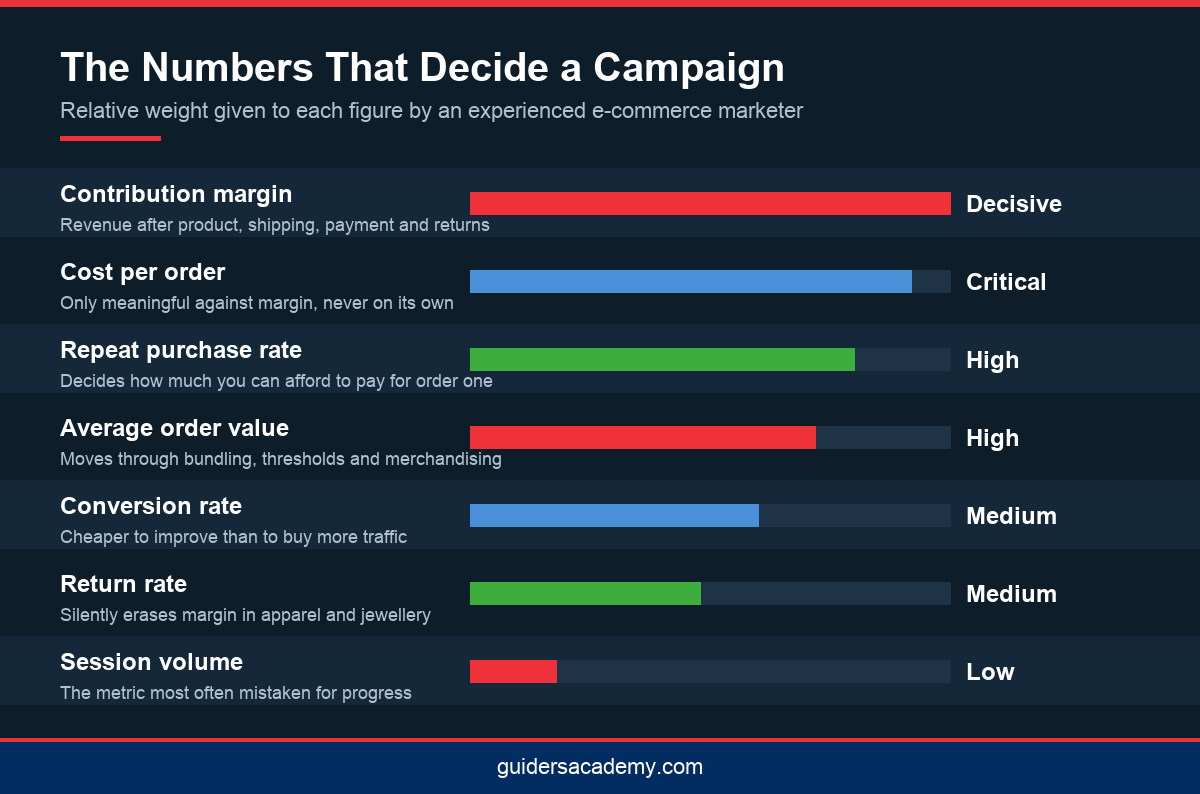
That ownership brings arithmetic with it. Product margin, shipping cost, payment charges, returns, and discounting all sit between revenue and profit, and a campaign that looks successful on revenue can be quietly destroying value once those are subtracted.
Traffic quality therefore matters more than volume. Sending large numbers of poorly matched visitors to a product page inflates every vanity metric while lowering conversion rate and raising cost per order, which is the most common failure in new accounts.
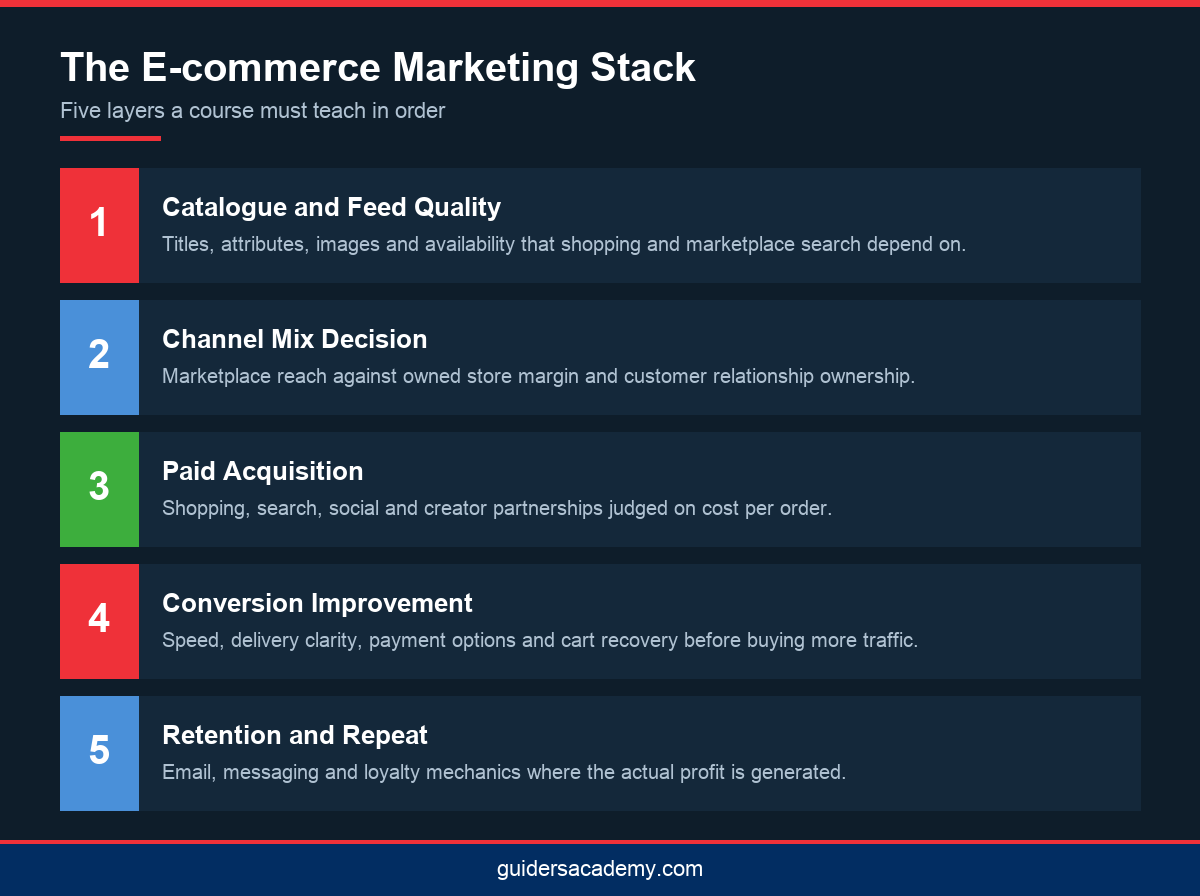
The catalogue itself is a marketing asset. Titles, attributes, images, availability, and pricing feed directly into shopping advertisements and marketplace search, so poor catalogue hygiene limits performance before any campaign has been created.
Retention changes the economics entirely. A business with genuine repeat purchase can afford a much higher acquisition cost than one selling a single item once, which is why lifetime value belongs in every campaign discussion from the beginning.
Kerala has a specific version of this market. Spice, textile, ayurveda, food, jewellery, and handicraft brands all sell nationally and internationally from here, and each faces different margin and logistics realities that shape the marketing approach. Where it sits among the other channels is mapped in this career guide.
The digital marketing programme at Guiders Education therefore has to teach commerce alongside channels, because a marketer who cannot read a margin sheet will optimise toward the wrong outcome confidently.
Feeds, Catalogues and Marketplaces
Product feed work is unglamorous and decisive. A feed with missing attributes, poor titles, or stale availability will underperform regardless of bidding strategy, and the Google Merchant Center product data specification defines what the platform actually expects.
Titles deserve deliberate attention. A product title written for a shopping feed is not the same as one written for a website page, because it has to carry brand, product type, and the attributes buyers search by within a limited character allowance.
Images and availability accuracy affect trust and delivery equally. Out of stock products that continue to be advertised waste budget and damage account quality, which is why feed monitoring is an operational routine rather than an occasional task.
Marketplaces are a parallel channel with their own rules. Listing quality, review volume, fulfilment performance, and internal advertising work differently from a brand's own website, and Flipkart's seller resources illustrate how much of the outcome sits outside classic marketing.
Deciding the channel mix is a strategic skill. Marketplaces provide reach but take margin and own the customer relationship, while a brand's own store keeps both and has to buy its own traffic, and most Kerala brands need a considered balance.
Learners should work with a genuine catalogue during the course. Fixing a real feed, watching disapprovals appear, and correcting them teaches far more than a slide describing what a well formed product record should contain. The delivery side of online retail is worth understanding too, and this look at e-commerce and supply chains covers it.
Pricing and promotion strategy belongs in this module as well. Discount depth, bundle construction, and free shipping thresholds all move margin and conversion in opposite directions, and marketers who change them without modelling the effect regularly destroy the profit they were hired to grow.
Acquisition, Retention and the Numbers That Decide
Acquisition spans shopping campaigns, paid social, search, and increasingly creator partnerships. The channels differ, but the discipline is constant: cost per order compared against contribution margin, tracked continuously rather than reviewed at month end.
Conversion rate optimisation belongs here too. Page speed, image quality, delivery promises, payment options, and return policy clarity all change conversion rate, and improving them is usually cheaper than buying more traffic to compensate.
Cart and checkout recovery is the fastest win in most accounts. Buyers who reached checkout and stopped are the warmest audience a store has, and a working recovery sequence frequently pays for the entire marketing effort by itself.
Retention is where the profit sits and where most courses go quiet. Email, messaging, replenishment reminders, and loyalty mechanics turn a single purchase into a customer, and the second order is dramatically cheaper to obtain than the first.
Measurement must reconcile against the store. Platform reported revenue rarely matches what the business banks, and learners should compare advertising claims against actual order data using the free material in Google Analytics Academy.
The commercial arithmetic ties it together. Average order value, repeat rate, return rate, and contribution margin decide what an order can cost to win, and marketers who cannot calculate that will always be arguing about the wrong number.
Subscription and replenishment models deserve a mention where the product suits them. Consumables such as spices, teas, supplements, and personal care items support predictable repeat cycles, and building a marketing plan around that rhythm is far more profitable than chasing new customers every month.
Careers and Choosing a Programme in Kerala
The usual entry role is e-commerce marketing executive, either inside a brand or at an agency serving several stores. The work mixes campaign management, feed maintenance, listing optimisation, and reporting, which suits people who like operational variety.
Specialist paths open quickly. Marketplace specialist, performance marketer, retention marketer, and e-commerce analyst are all distinct roles, and the analyst route in particular rewards anyone comfortable working with order level data.
Freelance and consulting work is realistic because many Kerala brands sell online without any in house marketing capability. The path from training to independent client work is set out in this freelancing career route.
There is also a founder path. A significant number of graduates end up running their own store, and the same skills apply, though the tolerance for optimising toward vanity metrics disappears entirely when the money is your own.
When comparing institutes, ask what data learners work with. A course using a real catalogue, a real feed, and a real order export teaches the job, while one using sample data teaches the vocabulary of the job instead.
Then check outcomes as always. Ask for the last batch size, roles filled, and named employers, and confirm there is a documented placement record rather than a percentage with no denominator attached. Tooling is moving quickly, as this 2026 view of AI marketing work sets out.
Consider the seasonality of the sector you want to enter too. Festival periods, wedding seasons, and export cycles concentrate a large share of annual revenue for many Kerala brands, and marketers who plan around those peaks are far more useful than those who do not.
Conclusion
An e-commerce marketing course in Kerala is worth taking when it teaches commerce rather than channels alone, because every decision in this field is settled by margin. Insist on working with a real catalogue and real order data, expect the retention module to be substantial, and learn to calculate what an order can afford to cost before you plan any campaign. That arithmetic is what employers and founders are actually hiring for. To discuss the current batch and the datasets learners work with, speak to the Guiders Academy team.
Frequently Asked Questions
What does an e-commerce marketing course in Kerala cover?

How is this different from general digital marketing?
Do I need to understand accounting or finance?
Should a brand sell on marketplaces or its own website?
Why does product feed quality matter so much?
What is the fastest improvement in most stores?
Which Kerala sectors hire e-commerce marketers?
Can I start my own store after this course?
What should I ask an institute before enrolling?