Best SEO Course in Kochi: 7 Questions Before You Pay
 General
Choosing the best SEO course in Kochi is harder than it looks, because every institute in the city advertises the same module list and the same promise of ranking results. The syllabuses are nearly interchangeable, so the differences that matter are practical: whether learners work on a live website, whether anyone teaches technical diagnosis properly, and whether the trainers have done the work for paying clients. This guide sets out what a serious SEO programme must contain and the specific questions that separate one institute from another.
Key Takeaways
- Every SEO syllabus in Kochi looks similar on paper, so judge the course by the live site access and the assessments instead.
- Technical diagnosis, content structure, link acquisition and honest measurement are the four pillars a serious programme must cover.
- AI answers and zero click results have changed reporting, so a course that measures only sessions is already out of date.
- Ask what the last cohort ranked, for which client, and how long it took before you accept any placement claim.
What an SEO Course Must Actually Cover
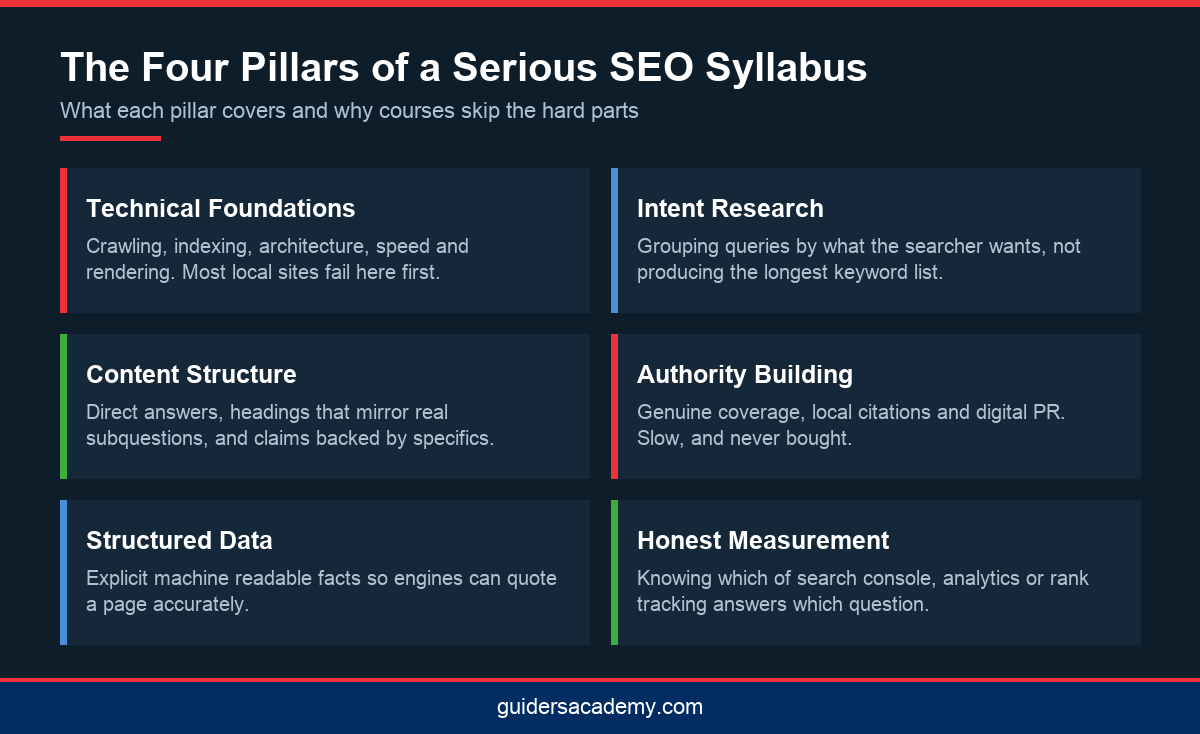
The foundations come first and they are not glamorous. Crawling, indexing, site architecture, internal linking, page speed, and mobile behaviour determine whether anything else you do has an effect, and most local business websites fail several of them.
The Google search starter guide is the reference point for all of this, and any course that never asks learners to read primary documentation is teaching second hand interpretation of rules that change regularly.
Keyword and intent research follows. The useful version of this skill is not producing a large list, it is grouping queries by what the searcher actually wants and deciding which of those intentions the business can genuinely satisfy with a page.
Content structure is where most learners improve fastest. Writing a page that answers the question directly, uses headings that reflect real subquestions, and supports claims with specifics is a discipline that improves rankings and conversions at the same time.
Technical diagnosis deserves dedicated time. Reading a crawl report, spotting duplicate content, fixing canonical problems, and understanding why a page is indexed but invisible are the tasks that agencies actually assign to junior staff in their first month.
Authority building is the fourth pillar and the most misrepresented. Genuine coverage, useful resources, local citations, and digital public relations work slowly. Any course teaching link purchasing as a technique is preparing learners for a penalty rather than a career.
Measurement closes the loop. Search console data, analytics, and rank tracking each answer different questions, and knowing which tool to trust for which question is a skill that takes deliberate teaching rather than a single demonstration.
Why AI Answers Changed the Reporting Conversation
Search results now frequently include a generated answer above the links. When that answer resolves the question, the searcher has no reason to click, which means visibility and traffic have separated in a way that older reporting formats never anticipated.
This creates a difficult conversation with clients. Impressions can rise, the brand can be quoted, and sessions can still fall, and a marketer who cannot explain that clearly will lose the account before the strategy has had time to work.
The practical response is to write for extraction. Direct answers early in a page, clear factual statements, and structured data help a page be quoted, and the Google guidance on snippets explains how that selection is influenced.
It also raises the value of brand. If a generated answer names your client rather than linking to them, the return comes through branded search and direct visits later, which is why those metrics belong in every report now rather than as an afterthought.
None of this makes traditional ranking work obsolete. Pages still have to be eligible, useful, and technically sound before any engine will quote them, so the fundamentals remain the majority of the job in daily practice.
What it does mean is that the digital marketing programme at Guiders Education now teaches both layers rather than the classic ranking model alone, and treats measurement as a professional obligation. That reporting shift is part of the wider change described in the future of AI-driven marketing.
Anyone weighing this specialisation against the wider field will find the local context in this digital marketing career guide for Kerala a useful companion to the technical picture.
How to Separate One Kochi Institute From Another
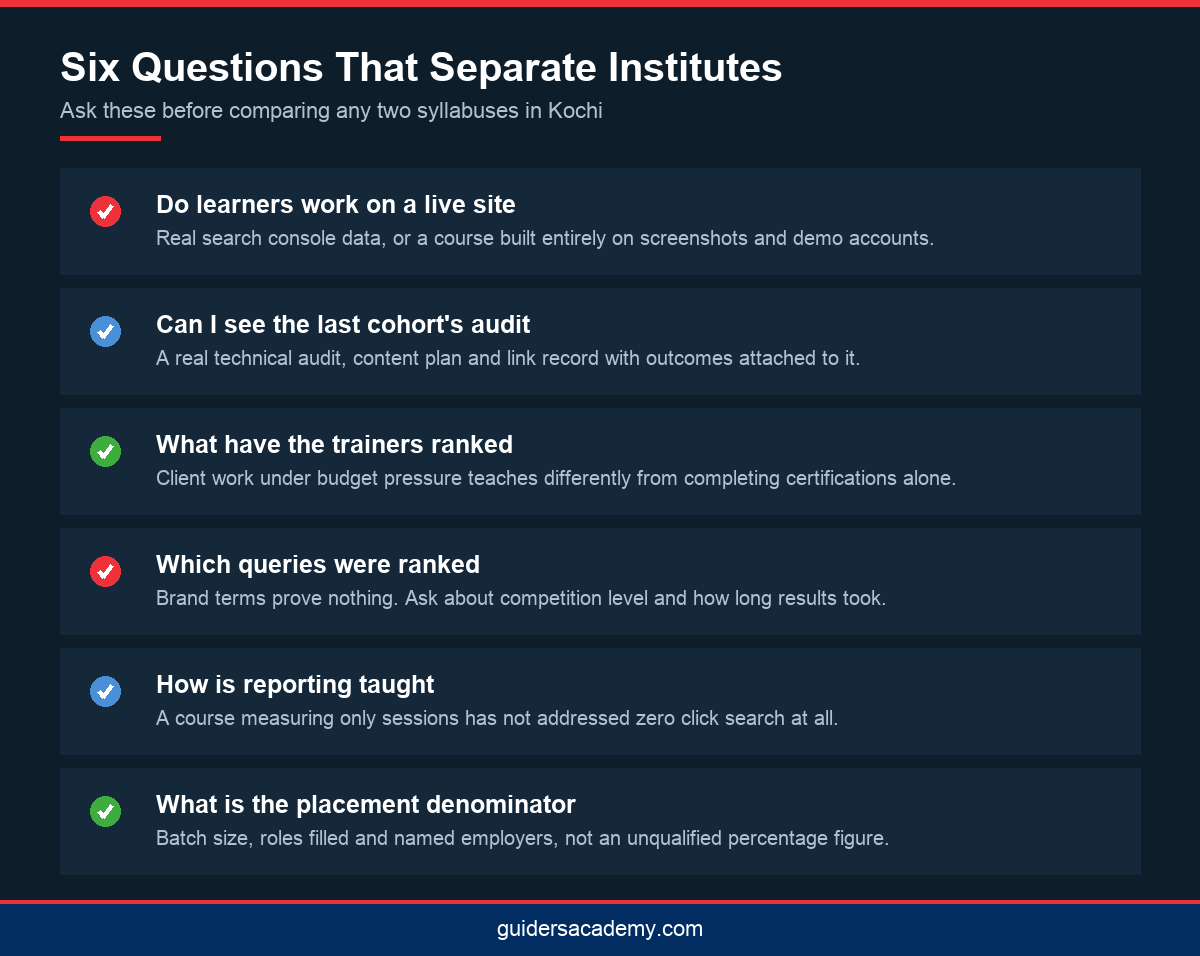
Start with live site access. Ask whether learners work on a real website with real search console data, or whether the entire course runs on screenshots and demonstration accounts that nobody can actually break or fix.
Ask what the last cohort produced. A technical audit, a content plan, and a link acquisition record for an actual business are concrete artefacts, and an institute confident in its training will show them along with the outcomes attached.
Check who teaches. Trainers who have delivered for paying clients answer differently from those who have only completed certifications, because they have experienced budget pressure, client disagreement, and campaigns that quietly failed to work.
Interrogate the ranking claims. Ranking a low competition brand term proves nothing, so ask which queries were targeted, what the competition looked like, and how long the results took to appear in practice.
Compare the format against your own circumstances honestly. There are real trade offs between classroom and online delivery, and this assessment of studying remotely is worth reading first.
Then check the outcome data. A percentage without a denominator is not a placement record, so ask for batch size, roles filled, and employers, and confirm the institute maintains a documented placement record. The same due diligence works for technical programmes, as this guide to picking a development course shows.
Ask about class size as well. Technical SEO is taught by looking over a learner's shoulder while they read a crawl report, and a batch large enough to make that impossible will produce graduates who can recite the theory without ever having diagnosed anything.
Careers, Timelines and Realistic Expectations
The first role is usually SEO executive inside an agency, where you handle audits, content briefs, and reporting across several clients. The volume is high and the learning curve is steep, which is exactly why it remains the best starting point.
In house roles follow, often in education, healthcare, tourism, or e-commerce businesses in Kochi that depend on organic visibility. The work is narrower and deeper, and you see the effect of your decisions on the business much more directly.
Freelance and consulting work becomes viable after eighteen months or so. Kerala has a large base of small businesses that need search help but cannot employ a full time specialist, which sustains a steady independent market for competent practitioners.
Be realistic about timelines. Organic search is slow, meaningful movement usually takes three to six months, and any course or agency promising rapid ranking gains is either targeting trivial queries or describing something that will not survive an algorithm update.
Expect the technical share of the job to grow. Structured data, site performance, and diagnosing rendering problems are increasingly what separates a capable SEO from a content marketer who understands keywords, and employers test for it. Where the discipline leads as a career is mapped in AI against digital marketing jobs.
Progression rewards writing and explanation as much as technique. The people who advance are those who can present a complex result simply, admit what did not work, and recommend the next step with reasons attached.
Conclusion
The best SEO course in Kochi is not the one with the longest syllabus, it is the one where you touch a real website, read real search console data, and are marked on a diagnosis rather than a definition. Insist on live access, ask exactly what the last cohort ranked and how long it took, and check that reporting covers the zero click reality rather than sessions alone. Approach the field with patience, because search rewards it. To discuss the current batch and what live site work looks like, speak to the Guiders Academy team.
Frequently Asked Questions
What should the best SEO course in Kochi include?

How long does an SEO course usually take?
Do I need coding knowledge to work in SEO?
How quickly can SEO produce results for a business?
Is SEO still relevant now that AI answers questions directly?
What jobs can I get after an SEO course in Kochi?
Are SEO certifications worth anything to employers?
Should I choose an online or classroom SEO course?
How do I verify an institute's ranking claims?