Best Aviation Colleges in Kerala: A Complete Guide
 General
Picking the right aviation colleges in Kerala can shape how quickly your career takes off. The state trains thousands of students each year across airport management, airline management, cabin crew, and ticketing programs, yet training quality varies widely between institutes. This guide breaks down what actually separates a strong aviation training institute from an average one, the career tracks worth considering, and how Kochi and Thrissur campuses compare for hands on learning. Whether you have just finished school or are planning a career change, use this overview to compare your options with more confidence.
Key Takeaways
Accreditation, IATA alignment, and a verifiable placement record matter more than brand recognition when comparing aviation colleges in Kerala.
Airport management courses in Kerala typically combine ground handling, ticketing, Galileo GDS training, and customer service for real airport readiness.
Campus location matters. An aviation training institute kochi students shortlist often benefits from proximity to Cochin International Airport for internships and live industry exposure.
Why Kerala Is a Strong Base for Aviation Careers
Kerala is one of the few Indian states with four international airports, giving aviation students direct access to live airport environments instead of classroom simulations alone. A steady Gulf travel corridor keeps passenger traffic high year round, which sustains demand for ground staff, cabin crew, and airline support roles across the state.
Add a thriving tourism sector and growing air cargo activity, and it becomes clear why Kerala produces strong aviation talent. Cochin International Airport alone handles millions of passengers each year, giving students in Kochi genuine proximity to a working aviation ecosystem. Shipping terminals, expanding cargo volumes, and a dense network of travel agencies create adjacent opportunities for graduates too. Employers across the state regularly look for candidates who already understand airport documentation, security protocols, and passenger handling before an interview even begins. This local demand means graduates are not forced to relocate immediately after their course, since airport, airline, and travel companies across Kerala actively recruit aviation and airport management diploma holders every hiring cycle. State backed skilling programs and private academies have both expanded their intake in recent years, a sign that employer demand has kept pace with the growing number of graduates entering the field each season.
What to Look for in Aviation Colleges in Kerala
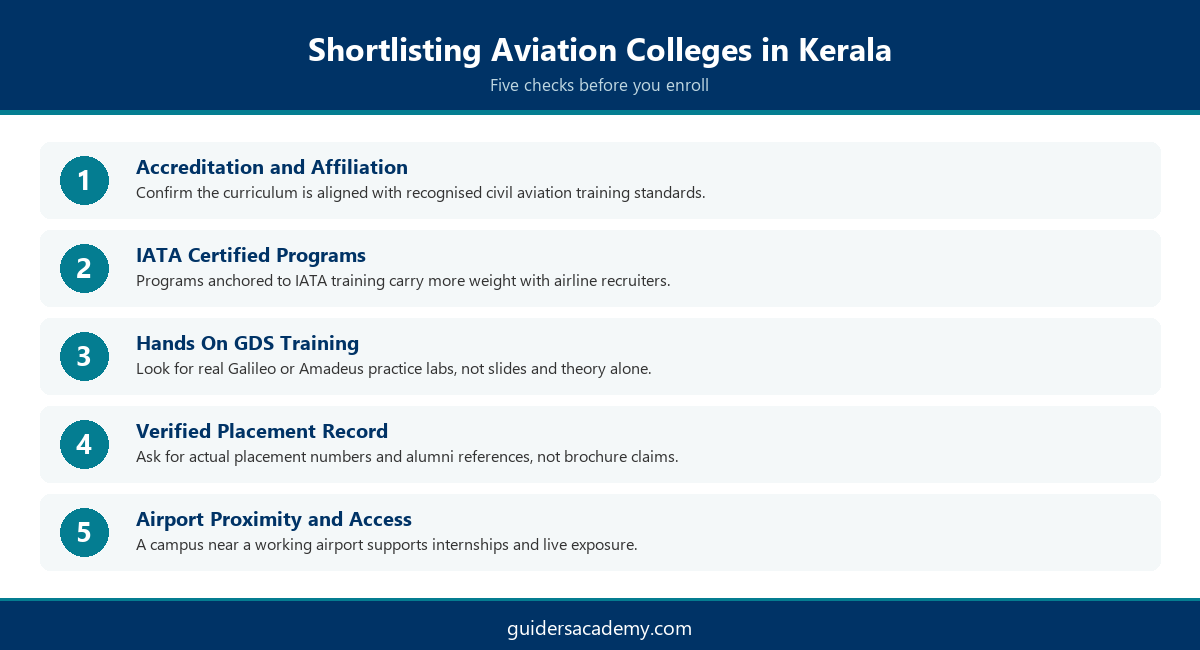
Not every institute delivers the same outcomes, so evaluate a few essentials before enrolling anywhere. Check whether the curriculum aligns with recognised civil aviation standards, look at faculty experience, and confirm the institute runs hands on ticketing and Galileo GDS labs rather than theory alone.
Programs anchored to IATA certified programs tend to carry more weight with airline recruiters, since IATA sets globally recognised benchmarks for travel and aviation training. Also ask for verifiable placement data, not just marketing claims, and request alumni references wherever possible before making a final decision. Infrastructure matters just as much as course content. Walk through the campus before enrolling and check for a functioning mock airport counter, a computer lab dedicated to GDS practice, and a grooming or personality development component built into the timetable. Faculty who have actually worked at an airport or with an airline bring practical insight that textbook trainers cannot replicate, and current students can usually tell you more about day to day teaching quality than any prospectus. Search interest in airport management courses kerala wide keeps climbing each admission season, which is exactly why comparing the fundamentals above matters more than comparing brochures.
Popular Career Programs: Airport Management, Cabin Crew, and Ticketing
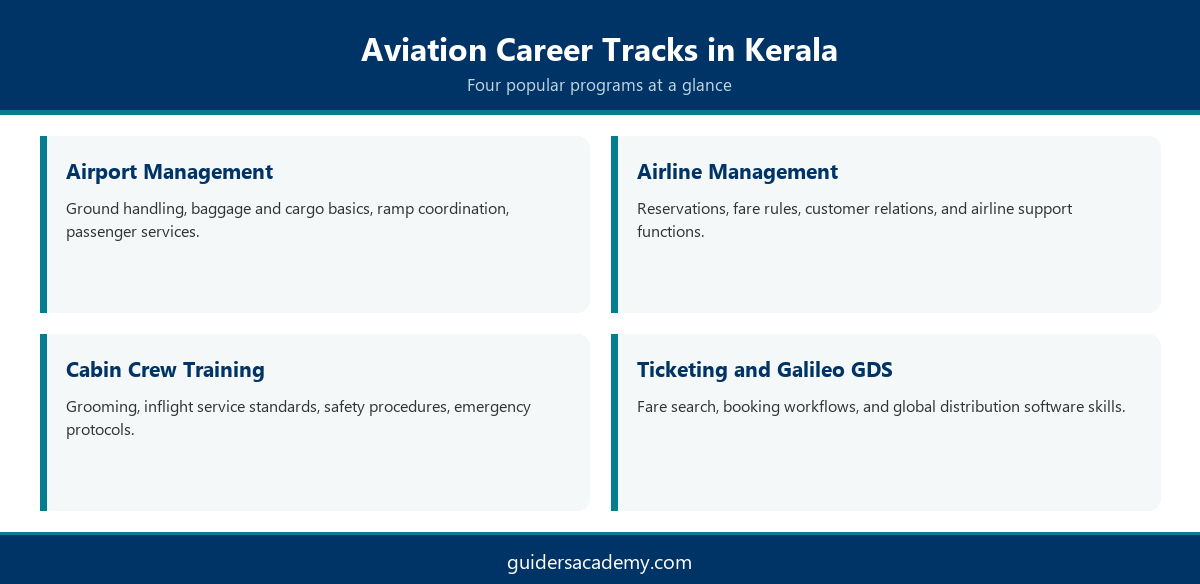
Most aviation colleges in Kerala offer a similar core lineup: airport management, airline management, cabin crew training, and ticketing with GDS software. Airport management focuses on ground operations and passenger services, while airline management leans toward reservations, fare rules, and customer relations.
Cabin crew programs cover grooming, safety procedures, and inflight service standards, preparing students for public facing roles that demand composure under pressure. Program length and delivery format vary across institutes. Diploma courses generally run close to a year, while certificate modules can be shorter and more focused on a single skill set. Airport management suits students who enjoy structured operational work, while cabin crew training appeals to those comfortable with frequent travel and passenger interaction. Ticketing and GDS programs work well for students who prefer desk based, detail oriented tasks. Comparing your own strengths against each track before enrolling saves time later and helps you choose a specialisation you are more likely to enjoy long term, rather than switching tracks midway through a course. Many institutes also let students sample more than one track through short orientation modules in the first few weeks, which gives beginners a low risk way to confirm their choice before committing to a full program.
Airport Management Courses in Kerala: What They Actually Cover
Airport management courses in Kerala typically span ground handling procedures, baggage and cargo basics, security awareness, and customer service under pressure. Reputable programs also teach Galileo and Amadeus GDS systems for ticketing and reservations, since airlines expect operational familiarity from day one.
Security and safety modules vary in depth from institute to institute, so ask specifically which topics map to real airport protocols rather than general aviation theory. A well built curriculum blends classroom instruction with internships, mock drills, and soft skills coaching so graduates handle passenger situations calmly from their very first shift. Internship access is one of the biggest differentiators between programs. Institutes with established airport relationships can place students in short term observation programs during peak travel seasons, which builds confidence well before graduation. Assessment methods matter too. Practical evaluations and scenario based tests prepare students far better for real airport pressure than written exams alone, since day to day airport work rarely resembles a classroom setting. Fee structures for these programs vary as well, so ask upfront whether GDS certification, uniforms, and industry visits are included in the quoted course fee or billed as separate add ons later. A short conversation with the admissions office about batch size and instructor to student ratio often reveals more about actual teaching quality than the syllabus document itself.
Kochi or Thrissur: Choosing Your Aviation Training Campus
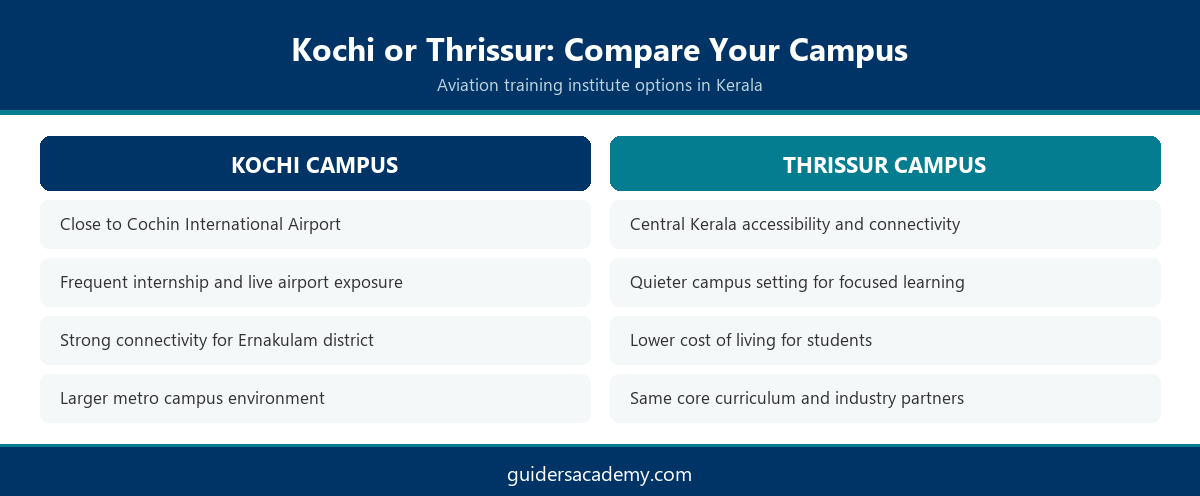
Kerala's two main education hubs, Kochi and Thrissur, both host solid aviation training options, so the right choice often comes down to convenience and access. Kochi offers proximity to Cochin International Airport, useful for internships and networking, while Thrissur suits students who prefer a quieter campus setting.
Institutes with both a Kochi and Thrissur presence let students choose based on commute and budget without compromising curriculum quality or placement support, since core training standards typically remain consistent across campuses within the same academy network. Budget is a practical factor many students overlook early on. Kochi, being a larger metro, generally carries higher accommodation and daily living costs compared to Thrissur, which adds up over a full course duration. Commute time also affects how much energy students have left for extra practice sessions after class. Whichever campus you choose, prioritise the institute's actual teaching quality and industry connections over the city name alone, since strong training standards should hold steady across an academy's campuses regardless of location. If you can, visit both campuses before deciding, sit in on a live GDS session if the institute allows it, and talk to current students about commute time, hostel or PG options nearby, and how much individual attention each batch actually receives.
Conclusion
Picking from the many aviation colleges in Kerala comes down to three things: accreditation, hands on training quality, and a genuine placement track record. Programs built around IATA standards, Galileo GDS practice, and real airport exposure consistently produce more job ready graduates than those relying on theory alone. Narrowing down the best aviation college kerala has to offer takes some homework, but the payoff shows up later in stronger placement outcomes. Guiders Academy combines an industry aligned curriculum with campuses in Kochi and Thrissur, giving students flexibility without sacrificing training quality. If you are evaluating your options, compare curriculum depth, faculty background, and verified outcomes before enrolling, then reach out to shortlisted institutes with specific questions about placement history.
Frequently Asked Questions
Which is the best aviation college in Kerala?

What are the top skills taught in airport management courses in Kerala?
Is IATA certification necessary for aviation jobs in Kerala?
What is Galileo GDS and why do aviation courses teach it?
Do aviation colleges in Kerala guarantee placements?
What is the eligibility for airport management courses after 12th?
Which city is better for aviation training in Kerala, Kochi or Thrissur?
Can commerce or arts students join aviation courses in Kerala?
What career options are available after an aviation course in Kerala?
How do I get more information about aviation courses in Kerala?