BBA, BCom or Diploma in Logistics: Which One Pays Off
 General
Anyone researching BBA and BCom logistics courses in Kerala eventually hits the same wall: separate articles explain each qualification well, and none of them put the three options next to each other. A BBA, a BCom with logistics, and a diploma lead to different starting points, different timelines, and different ceilings. This comparison sets them side by side on duration, cost, entry role, progression, and the kind of learner each one actually suits, so the decision can be made on structure rather than on impression.
Key Takeaways
- A diploma gets you working fastest, a BCom builds the strongest finance foundation, and a BBA opens management progression earliest.
- All three lead into the same entry level operational roles, so the real difference appears at the three to five year mark.
- Cost and time commitment vary by more than most families expect, and the opportunity cost of three years is part of the calculation.
- The right choice depends on whether you want to start earning quickly, keep postgraduate options open, or aim at management.
What Each Qualification Actually Is
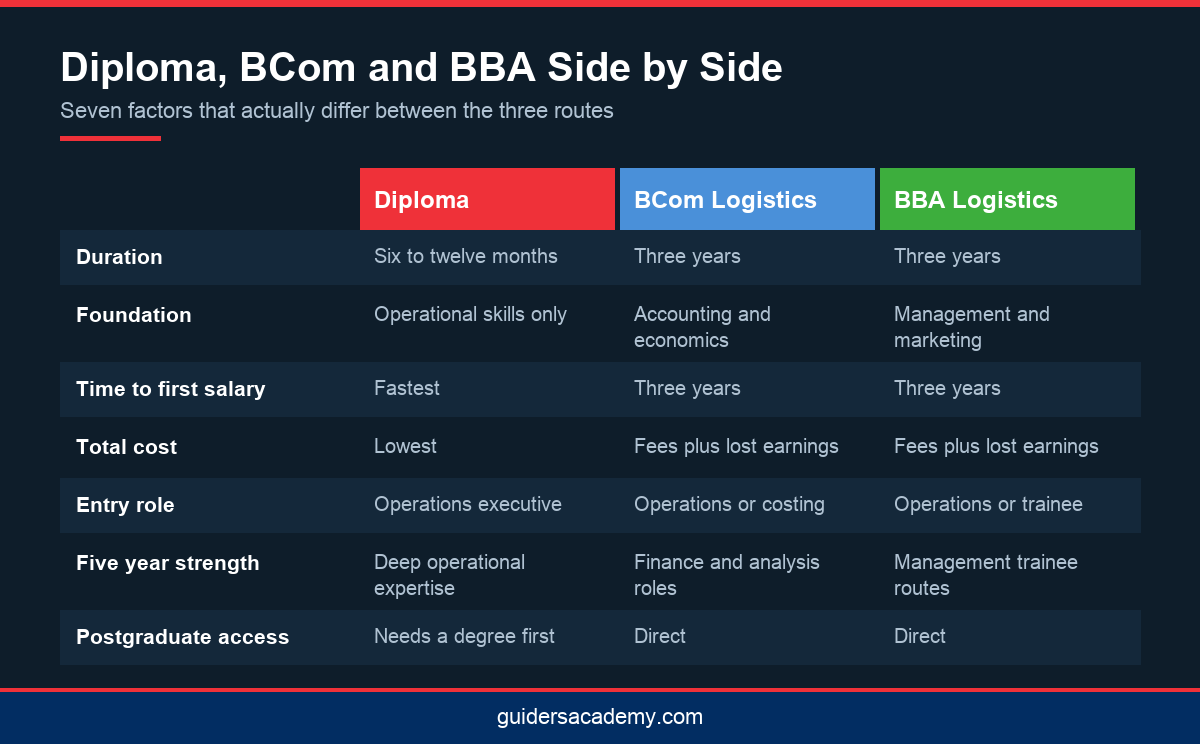
A diploma in logistics is a focused vocational qualification, usually running six months to a year. It concentrates on operational skills: documentation, freight processes, warehousing, and customs basics, with limited general education content around them.
A BCom with a logistics specialisation is a three year degree built on a commerce foundation. Accounting, taxation, business law, and economics form the core, with logistics modules layered on top rather than replacing that base.
A BBA with logistics or shipping is also three years but built on a management foundation. Organisational behaviour, marketing, human resources, and operations management provide the frame, with supply chain content as the specialisation.
The distinction matters because employers read them differently. A BCom signals numerical and commercial grounding, a BBA signals management orientation, and a diploma signals that someone is ready to do the operational job immediately.
All three are recognised in the sector. Degree programmes operate within the framework overseen by the University Grants Commission, and management degrees additionally sit within the standards published by the All India Council for Technical Education, while diplomas typically sit within vocational or institute awarded qualification structures instead.
Kerala offers all three widely, which is why the choice feels difficult. Programmes such as a BBA with shipping and logistics sit alongside shorter diploma routes at many of the same institutions.
The important point is that none of them is a lesser option. They answer different questions about how quickly you want to start earning and how far you eventually want to go inside a large organisation. The diploma route is set out in full in this guide to diploma careers in the field.
Duration, Cost and Time to First Salary
The diploma route puts you in a job soonest. Six to twelve months of study followed by an entry level operational role means earning begins while degree students are still in their first year of lectures and assignments.
That head start is real but it is not permanent. Degree holders typically catch up within three to four years of graduating, because certain progression steps and employer categories are effectively closed without a bachelor's qualification behind them.
Cost differences are significant in both directions. A diploma costs less and involves fewer years without income, while a degree carries three years of fees plus three years of foregone earnings, which families frequently underestimate.
There is also a middle path that many graduates take without planning it. Completing a diploma, working for two years, and then studying part time or through distance education produces a degree without the full opportunity cost.
Entry salaries do not differ much at the start. All three qualifications lead into similar operational roles at similar pay, which surprises families expecting the degree to command an immediate premium in the local market.
The comparison changes at the three year point. That is when management trainee schemes, larger employers, and structured progression paths begin to filter on qualification level rather than on demonstrated operational competence alone.
A rundown of degree providers in the state covers the degree landscape in more detail for anyone leaning toward the three year route. Short programmes compress the timeline further, as this look at short-term study options explains.
Where Each Route Leads at Three and Five Years
Diploma holders typically reach senior executive or team lead positions by year three, having accumulated more operational experience than their degree educated peers who entered the workforce later.
By year five the picture starts to separate. Diploma holders who specialised in customs, documentation, or warehousing continue to progress on expertise, while those who stayed general sometimes find the next step harder to reach.
BCom graduates tend to move toward roles where the commercial and financial content pays off. Costing, billing, credit control, and analytical positions favour candidates who genuinely understand accounts rather than merely tolerate them.
BBA graduates more often enter management trainee programmes with larger employers, which compress early progression. The trade off is that these schemes are competitive and concentrated in bigger organisations rather than in smaller local firms.
Postgraduate study is more accessible from either degree. An MBA in supply chain or operations is a common step at the five to seven year mark, and it generally requires a bachelor's qualification as the entry condition.
The career opportunities associated with BCom logistics illustrate how the commerce foundation shapes the roles graduates end up in over the medium term.
None of these paths is closed to the others permanently. People move between them, add qualifications later, and change lanes, but knowing the default trajectory of each helps in making the initial decision deliberately.
Employer size shapes this more than most students expect. Smaller freight forwarders promote on demonstrated competence and rarely ask about qualifications after the first hire, while larger organisations and multinationals apply qualification filters at several points in a career.

Which One Actually Fits You
Choose the diploma if you need to start earning soon, if the cost of three years is genuinely difficult for your family, or if you already know that operational work suits you better than classroom study does.
Choose the BCom if you are comfortable with numbers, if you might eventually move toward finance, costing, or analysis, or if you want a qualification that transfers outside logistics should your interests change later.
Choose the BBA if management is the goal, if you want access to trainee schemes at larger employers, or if you value the broader business grounding that comes with organisational and marketing content alongside supply chain modules.
Consider your school performance honestly as part of this. Learners who found academic study difficult often do considerably better in a practical diploma environment, and there is no advantage in choosing a route that does not suit how you learn.
Consider the family situation too. The realistic question is not which qualification is best in the abstract, but which one your circumstances support without creating pressure that undermines the study itself over three years.
Whichever route you take, the logistics programme at Guiders Education and the shorter diploma options all lead into the same sector, and employers here hire from every one of them for entry level operational positions each year.
Finally, plan the second decision as well as the first. A diploma now with a part time degree at year three is a legitimate strategy, and treating the choice as permanent is the most common mistake families make. Whichever route you take, the capabilities in this list of diploma-level skills are what employers test.
Conclusion
Comparing BBA and BCom logistics courses in Kerala against a diploma comes down to three questions: how soon you need to earn, how comfortable you are with academic study, and how far you want to go inside a large organisation. The diploma is fastest, the BCom builds the strongest numerical foundation, and the BBA opens management routes earliest. All three lead into the same first job, so choose on trajectory rather than on starting salary. To talk through which route fits your circumstances, contact the Guiders Academy team.
Frequently Asked Questions
How do BBA and BCom logistics courses in Kerala differ?

Is a diploma enough to get a logistics job?
Which qualification pays more at the start?
Can I do a diploma first and a degree later?
Which route suits someone who dislikes academic study?
Do employers in Kerala prefer one over the others?
Which route leads toward supply chain analysis?
Is an MBA necessary later in a logistics career?
How should a family weigh the cost difference?